

Celiac disease affects about 1% of the population, yet up to 5% of people in Western societies voluntarily follow a gluten-free diet, and nearly one-third of U.S. adults prefer to reduce or avoid gluten. Most standard cookies aren't safe for a gluten-free diet, but properly labeled options do exist.
That tension explains why the question “are cookies gluten free?” needs a more careful answer than yes or no. A cookie's safety depends on its recipe, ingredient sourcing, preparation environment, and labeling. For many people, gluten avoidance is a lifestyle choice. For someone with celiac disease or gluten sensitivity, however, a casual assumption can have serious consequences.
The Hidden Risks in Your Cookie Jar
A shopper reaches for a familiar chocolate chip cookie, sees no obvious wheat topping, and assumes it's harmless. The flour may be hidden inside the dough, the flavoring, or an ingredient used by a supplier. Even a cookie that looks simple can require a closer inspection.
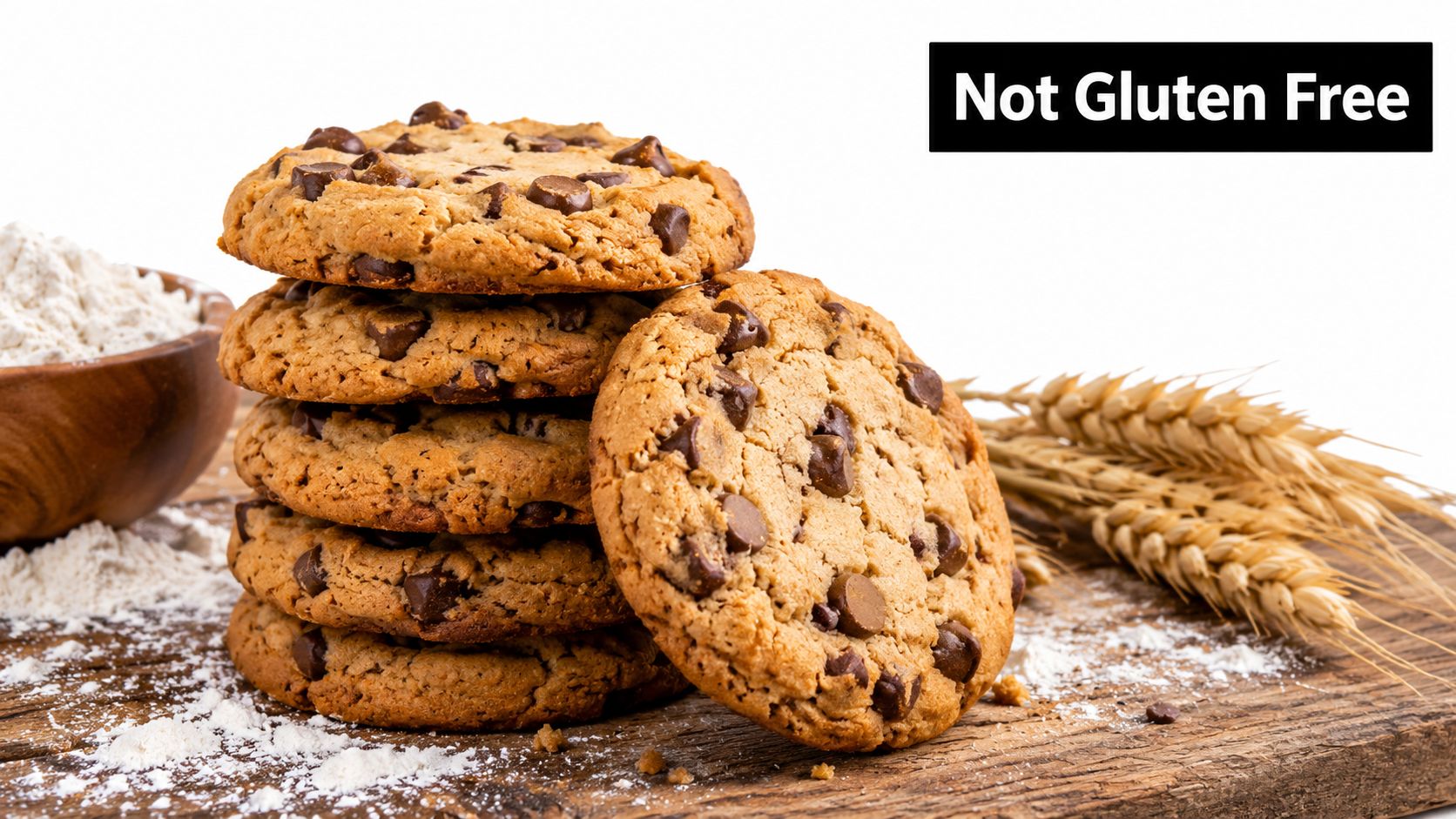
The gap between medical need and consumer interest is wide. A peer-reviewed review of gluten-free diets describes voluntary gluten avoidance among up to 5% of people in Western societies, while an NPR-reported survey found that nearly one-third of U.S. adults preferred to reduce or avoid gluten, despite celiac disease affecting about 1% of the population. That means many shoppers are looking for gluten-free products, but their reasons and risk levels differ.
The basic rule
Not all cookies are created equal. A conventional cookie usually relies on wheat flour, which makes it unsuitable for someone who must avoid gluten. Other recipes may use almond, rice, corn, or oat ingredients, but that change alone doesn't guarantee safety.
Consider two cookies with similar ingredient lists. One is mixed in a bakery that handles wheat dough throughout the day. The other is produced with controlled procedures and carries a regulated gluten-free claim. The recipes may look similar, but the manufacturing risk can be very different.
Practical rule: Treat “made without wheat flour” and “gluten-free” as different statements. The first describes an ingredient choice. The second should reflect the finished product and the controls used to protect it.
People also confuse gluten-free with generally healthier. A gluten-free cookie may still be high in sugar, low in fiber, or unsuitable for a low-carbohydrate eating plan. Safety comes first, but it isn't the only question worth asking.
How FDA Rules Define Gluten-Free Status
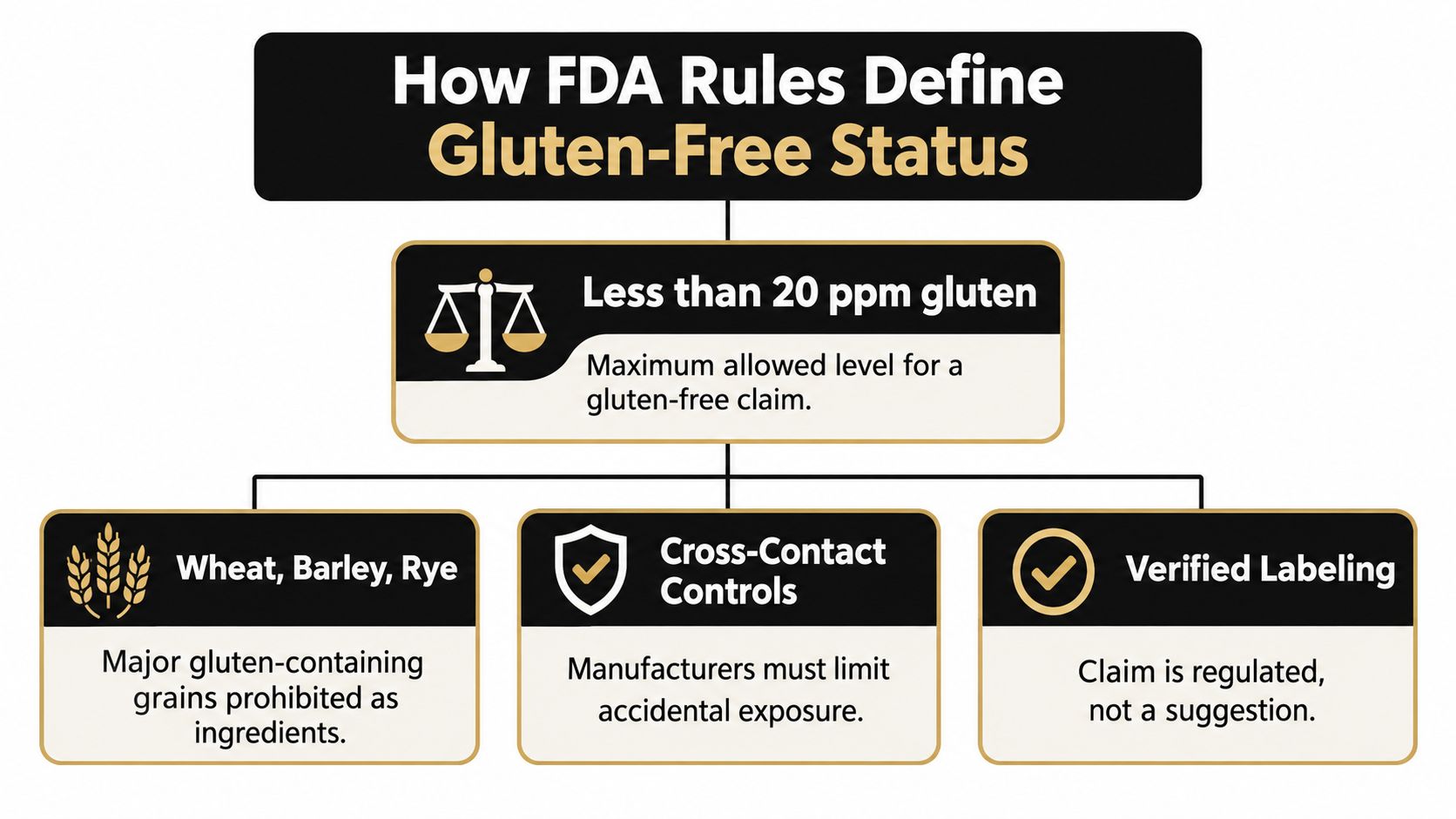
In the United States, gluten-free is a regulated labeling claim, not a casual description. Under the FDA standard, a packaged cookie may use the claim when it is naturally gluten free or contains no prohibited gluten-containing grain ingredients, and any unavoidable gluten in the finished food must remain below 20 parts per million.
The relevant grains include wheat, rye, barley, malt, and triticale. A cookie made with wheat flour generally won't qualify. A cookie made with rice or almond flour may qualify, but its status still depends on the finished product and the way it was produced. The FDA finalized this labeling standard in August 2013 and required compliant gluten-free claims on food labels beginning in 2014, as explained in the agency's questions and answers about the gluten-free labeling final rule.
Why the ingredient list isn't enough
Replacing wheat flour with almond flour doesn't automatically solve the problem. The almond flour could be processed in a facility that also handles wheat, or another ingredient could introduce gluten during production. The standard applies to the final cookie's gluten burden, not merely to whether the first ingredient is wheat flour.
The FDA says manufacturers aren't required to test every ingredient or every finished batch. They are still responsible for ensuring that their products comply with the gluten-free standard. That places importance on supplier documentation, allergen segregation, sanitation procedures, and other controls that consumers may not see on the package.
A label can therefore answer an important question, but it doesn't answer every dietary question. If you're also evaluating protein, sugar, fiber, or carbohydrate content, you'll need to read the Nutrition Facts panel separately. For another example of how snack labels can involve several different ingredient concerns, see this guide to whether Quest Bars are gluten free.
Identifying Safe Ingredients and Processing Risks
Start with the ingredient list, but don't stop there. Look for wheat, rye, barley, malt, and triticale, including ingredients derived from those grains. A cookie that contains one of these may not qualify for a gluten-free claim unless the ingredient has been specially processed and the finished product still meets the applicable threshold.
A practical label scan
Use this order when shopping:
- Find the gluten-free claim. Look for a clear product-level statement rather than assuming the recipe is safe because it uses a non-wheat flour.
- Scan the grain ingredients. Wheat flour is obvious, but malt and barley can be less apparent. Check flavorings, coatings, fillings, and crisp inclusions as well as the cookie dough.
- Review allergen information. A “contains wheat” statement is a direct warning for anyone avoiding wheat. A precautionary statement about shared equipment also deserves attention, especially when you have a medically necessary diet.
- Check the full nutrition panel. Gluten-free status doesn't tell you whether the cookie is low sugar, high fiber, keto-friendly, or appropriate for another nutrition goal.
The FDA explains in its guidance on what “gluten-free” means that a finished cookie must contain less than 20 ppm gluten to carry the claim in the U.S. The agency also emphasizes that formulations using almond, oat, or rice flour still require ingredient-supply verification and cross-contact controls.
Recipe choice versus production control
A home baker may use gluten-free ingredients and produce a suitable cookie in a carefully controlled kitchen. A commercial manufacturer has a more complex responsibility. It must manage incoming ingredients, storage, mixers, ovens, packaging equipment, cleaning, and product changeovers.
That distinction matters because a gluten-free recipe is not automatically a gluten-free product. If you want to understand how broader food-handling practices affect packaged snacks, this overview of snack ingredients offers useful context. When the health consequence of exposure is significant, contact the manufacturer if the label leaves a critical question unanswered.
Why Cross-Contamination Is the Silent Threat
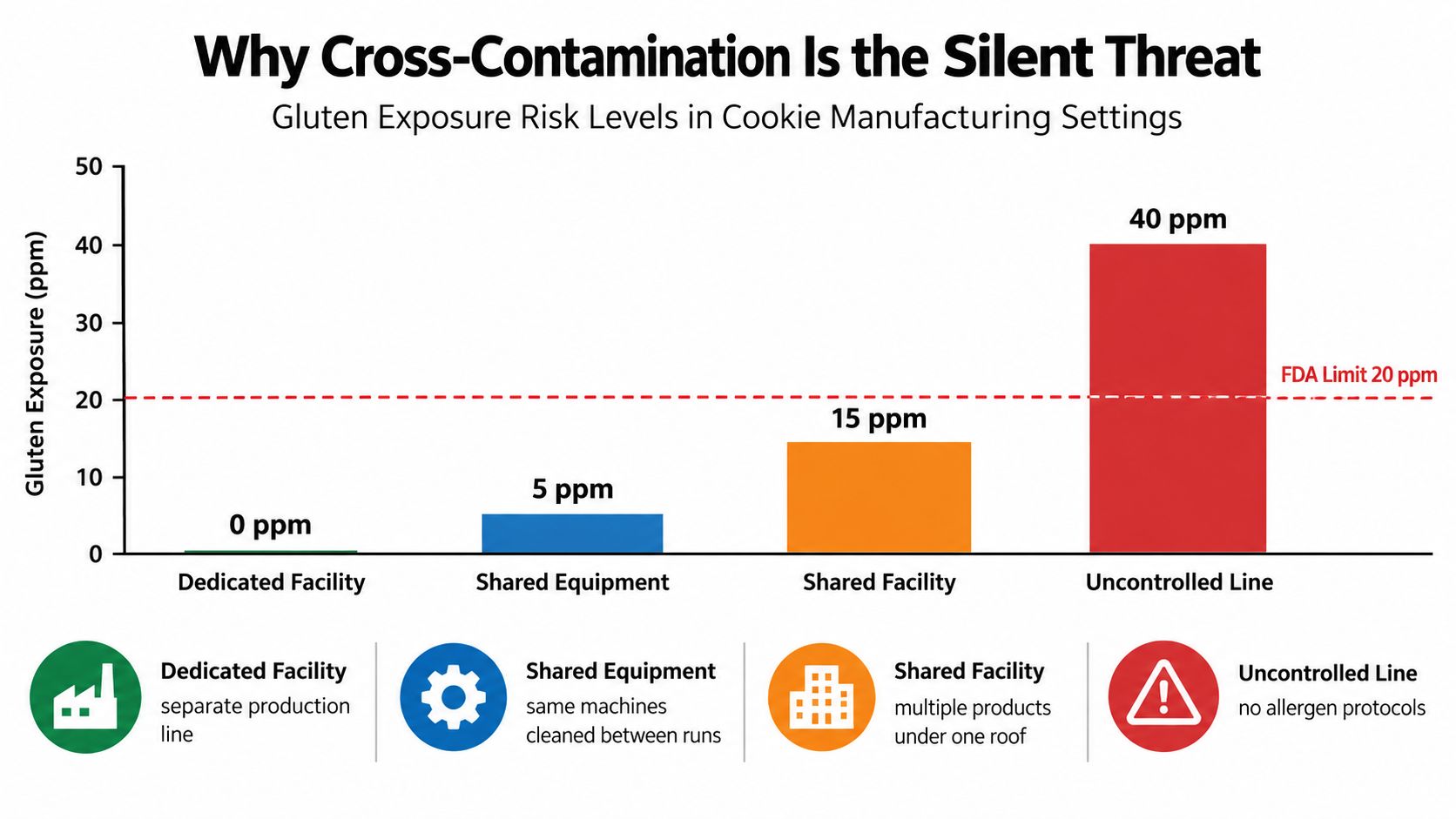
A cookie can begin with a suitable recipe and still become unsafe before it reaches the package. Wheat flour can remain on mixers, conveyors, utensils, storage surfaces, or clothing. Shared equipment isn't automatically unacceptable, but it requires effective cleaning and allergen controls.
A 2026 review of commercially available gluten-free products reported a 42.9% non-compliance rate among the cookie product group examined, highlighting the risk in baked snacks marketed as gluten free. The finding comes from the review of gluten exposure and compliance in commercially available gluten-free products, and it reinforces why ingredient lists alone can't establish the full safety profile.
Compare the production environment
A dedicated gluten-free facility generally presents a different risk profile from a bakery that produces wheat cookies on the same equipment. In a shared setting, the manufacturer needs documented procedures for scheduling, cleaning, verification, and employee handling.
Useful questions include:
- Does the facility use a dedicated line?
- If equipment is shared, how is it cleaned between products?
- Does the company verify high-risk ingredients with supplier documentation?
- Does it use environmental monitoring or finished-product testing?
- Does the package explain the company's allergen controls clearly?
These questions don't mean that every shared facility is unsafe. They help you distinguish between a company that has a defined control system and one that offers only a reassuring-sounding ingredient list. For general food-service guidance, this resource on how to prevent cross contamination can help clarify why separation, cleaning, and handling procedures matter.
A product can also meet gluten-free requirements while failing to meet your other dietary preferences. Compare a cookie with a carefully controlled gluten-free recipe but substantial added sugar against one that also fits your carbohydrate or fiber targets. The safer choice for gluten exposure still may not be the better fit for your overall plan.
Reframing the Search for Better Snacks
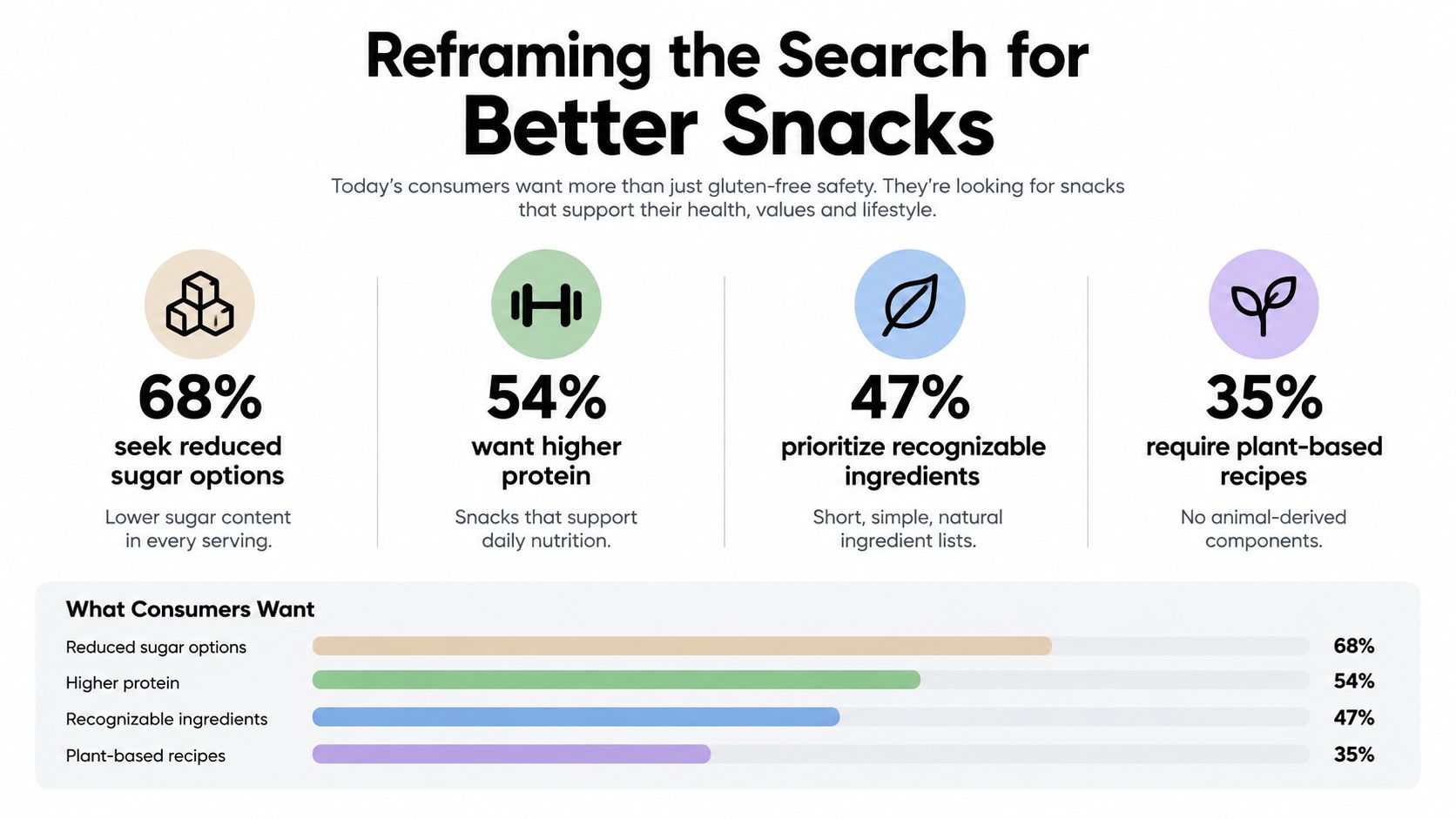
Many shoppers aren't asking only, “Does this cookie contain gluten?” They're also asking whether it fits a lower-sugar routine, a keto approach, or a higher-fiber eating pattern. Gluten-free is a safety filter, not a complete nutrition profile.
Alternative flours can change a cookie's texture, flavor, fiber content, and carbohydrate profile. Almond, coconut, oat, rice, and chickpea ingredients don't produce identical foods, and none of them automatically makes a cookie healthy. A product may satisfy one goal while missing another.
Use a layered decision
Think of the package as answering several separate questions:
| Question | Where to look |
|---|---|
| Is it suitable for a gluten-free diet? | Gluten-free claim, ingredient list, allergen information |
| Does it support lower sugar eating? | Total sugars and added sugars on the Nutrition Facts panel |
| Could it fit a keto or low-carb plan? | Total carbohydrate, fiber, and serving size |
| Is it useful for a higher-fiber pattern? | Dietary fiber per serving |
| Does it match personal preferences? | Ingredients, certifications, and dietary statements |
Market forecasts illustrate why this broader evaluation matters. One projection places the gluten-free cookies market at US$8.49 billion in 2025 and US$14.97 billion by 2034, while another projects the broader gluten-free bakery market to grow from US$7.83 billion in 2025 to US$12.99 billion by 2031. These are forecasts, not guarantees, and they appear in market coverage of gluten-free cookies.
A useful shopping habit is to choose the product that meets your essential requirements first. If gluten exposure is a medical concern, verify gluten controls before comparing sweetness or fiber. If you're avoiding gluten by preference, you may have more flexibility, but the same label review can help you avoid treating “gluten-free” as a synonym for “low sugar.”
Families can also make mix-ups less likely by separating snacks and clearly marking containers. Practical tools such as name labels for daycare meals can help caregivers identify food consistently when several dietary needs are involved.
Finding Trusted Brands and Making Confident Choices
Confident shopping doesn't require memorizing every ingredient. It requires a repeatable process that separates gluten safety from broader nutrition goals.
A store-ready checklist
- Read the front and back of the package. Start with the gluten-free claim, then confirm the ingredient list and allergen statement.
- Look for transparent product information. Clear details about ingredients, dietary attributes, and manufacturing practices are more useful than vague wellness language.
- Check the serving profile. Compare sugar, added sugar, fiber, total carbohydrate, and serving size when you're selecting snacks for a low-sugar, high-fiber, or keto-oriented plan.
- Ask about uncertainty. If the package doesn't answer a medically important question, contact the manufacturer rather than guessing.
- Keep medical advice separate from marketing. Anyone with celiac disease or a diagnosed sensitivity should follow advice from their clinician or registered dietitian. A product's appealing recipe doesn't replace allergen controls.
You can also use a focused guide to gluten-free cookie brands as a starting point, then verify each product's current packaging because formulations and facilities can change. For people coordinating nutrition goals beyond gluten avoidance, individualized data-driven supplement plans may provide a separate planning resource, but supplements don't make an unsafe cookie safe.
The simplest answer to “are cookies gluten free?” is still no, not by default. A suitable choice requires the right recipe, a compliant finished product, reliable manufacturing controls, and nutrition facts that match your personal goals.
Rip Van offers better-for-you snacks with gluten-free options alongside filters for goals such as low sugar, keto, and vegetarian eating. Visit Rip Van to review current product details and choose a snack that fits both your gluten-safety needs and your broader nutrition priorities.
0 comments