

“Whole grain” isn't a health guarantee. It's a starting point.
A box of crackers can carry a 100% whole-grain claim and still deliver too much sodium, added sugar, or too little fiber to deserve a place in your everyday snack routine. The smarter question isn't just whether the cracker contains whole grain. It's whether the product gives you a worthwhile amount of fiber without turning a modest snack into a concentrated source of salt and sweetness.
That distinction matters because serving sizes vary, ingredient lists can obscure refined flour, and the nutrition panel often tells a different story from the front of the package. Use whole grain as one filter, not the entire decision.
The Hidden Trap in Healthy Snack Aisles
Many shoppers treat “whole grain” as shorthand for healthy. That shortcut fails because grain quality and overall formulation are separate issues. A cracker may retain the bran and germ, yet still pair that grain with enough sodium or added sugar to make it a poor choice for frequent snacking.
A useful example comes from a commonly sold whole-grain wheat cracker. Its 28 g serving provides 23 g of whole grain, 120 calories, 20 g of carbohydrates, 3 g of dietary fiber, 3 g of protein, and 125 mg of sodium, according to its retail nutrition panel. The product is labeled as having 100% whole grain, and the same panel lists 0 g saturated fat and added sugars under 1% of the Daily Value.
That's a reasonable profile, but it doesn't make every whole-grain cracker equally useful. Other mainstream products can provide only 1–3 g of fiber while containing roughly 125–220 mg of sodium per serving, as summarized in consumer label guidance on whole-grain crackers. Some commonly cited products also contain 200 mg of sodium and about one teaspoon of added sugar per 1-ounce serving, which shows why the grain claim can create a misleading health halo.
Judge the tradeoff, not the slogan
Fiber is the key counterweight to a cracker's carbohydrate content, but sodium and sugar still matter. The right question is:
How much fiber am I getting for the sodium and added sugar this serving carries?
A cracker with whole wheat flour near the beginning of the ingredient list and meaningful fiber deserves more attention than one that uses vague grain language and delivers little fiber. “Multigrain” doesn't tell you how much of each grain is present. “Made with whole grain” doesn't mean the product is mostly whole grain.
The practical conclusion is blunt. Whole grain improves the base ingredient, but it doesn't erase an unfavorable nutrition panel. Look for a product that makes whole grain, fiber, low added sugar, and moderate sodium work together.
The health halo can hide an ordinary snack
Crackers are convenient, portable, and easy to portion, which makes them useful. They're also easy to eat mindlessly. A savory flavor profile can encourage repeated handfuls, while a sweetened recipe can make the snack feel more like a dessert than a grain-based accompaniment.
Choose crackers whole grain when the label supports the claim with a strong ingredient list and a sensible fiber-to-sodium balance. Don't buy the box because the front uses a healthy-looking color or a prominent grain illustration.
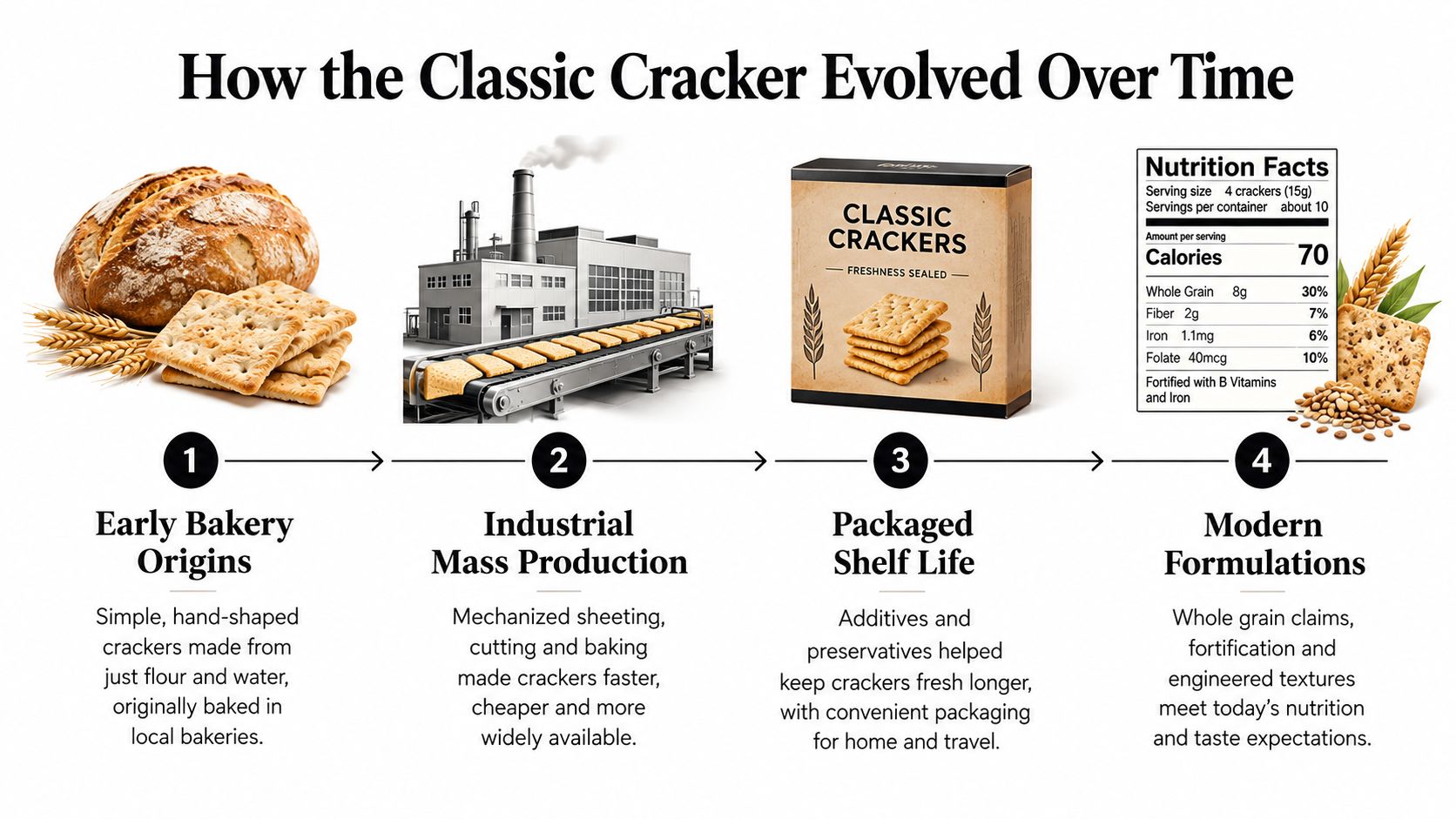
How the Classic Cracker Evolved Over Time
Crackers began as practical bakery foods, not carefully optimized wellness products. Carr's Whole Wheat Crackers date to 1832, placing recognizable whole-wheat crackers in the early industrial era of packaged food, as documented in this history and nutrition reference. Their long shelf life made them useful far beyond the local bakery, and that same durability remains central to modern cracker design.
The modern product has to satisfy several demands at once. It must taste good, remain crisp, survive distribution, and carry a clear label. Those requirements can pull formulation in different directions. More whole-wheat flour can affect texture, while salt, fat, and processing choices help manufacturers create the familiar snap and flavor shoppers expect.
The standard sets a floor, not a nutrition gold standard
The USDA Agricultural Marketing Service standard for whole-wheat crackers requires at least 8 g of whole-wheat flour per serving or 51% whole wheat. It also specifies a shelf life of at least nine months and a firm, crisp texture, according to the USDA cracker standard.
Those rules clarify an important point. A product can meet a meaningful whole-wheat threshold and still be formulated primarily around crispness, stability, and commercial consistency. The standard establishes what qualifies. It doesn't promise that the cracker will be low in sodium, low in sugar, or especially high in fiber.
The category now includes products with very different grain densities. One retail listing reports 5 g of whole grain in a 16 g serving, with 34% of grains being whole grains, while another lists 23 g of whole grain in a 28 g serving. Both can occupy the whole-grain section, but they don't deliver the same amount of whole grain or fiber per bite.
Why shelf stability shapes the eating experience
A cracker designed to stay crisp for months needs controlled moisture and a durable structure. That doesn't automatically make it unhealthy, but it explains why shoppers should evaluate the finished product rather than assume the historical reputation of whole wheat carries through every modern formulation.
Whole grain is valuable because it preserves the grain kernel's bran, germ, and endosperm. Yet the final product still depends on the flour, recipe, serving size, and toppings. Treat the manufacturing standard as a baseline. Your nutrition decision starts with the actual label.
Decoding Labels and Portion Size Confusion
Marketing claims sit on the front of the box. The ingredient list and Nutrition Facts panel show what you are buying.
Start with the grain wording. “100% whole grain” carries more weight than “made with whole grain,” but it still requires verification. Look for specific ingredients such as whole wheat flour, whole rye flour, whole-grain brown rice, whole oats, or whole-grain cornmeal. “Wheat flour” alone does not confirm that the flour is whole grain.
Serving sizes can distort the comparison. Real-world labels list anywhere from 6 crackers to 16 crackers per serving, with sodium ranging from about 55 mg to 220 mg and fiber from 1 g to 3 g, according to consumer guidance on comparing cracker labels. Compare matching portions, not calories per box or sodium per package.
Use a five-part label check
- Check serving size first. Estimate how many crackers you will realistically eat, then compare that portion with the label.
- Confirm the grain in the ingredients. A specific whole-grain ingredient near the beginning of the list provides stronger evidence than a vague front-of-pack claim.
- Use fiber as a benchmark. Products with at least 2.5 g of fiber per serving are a good source, while 5 g or more can qualify as high in fiber, according to this USDA cracker guidance.
- Judge sodium beside fiber. A cracker that delivers little fiber but a substantial sodium load is a poor everyday choice, even if the package highlights whole grains.
- Review added sugars separately. Whole grain does not erase added sugar. Choose a product that keeps sweetness modest, particularly for routine snacking.
For help interpreting panel terminology and serving-size math, use this guide to reading nutrition labels.
Practical rule: Compare products using the same imagined portion, rather than the serving sizes selected by different manufacturers.
A strong label does not need to be perfect. It should make the sodium, sugar, fiber, and portion tradeoffs clear enough for a practical decision.
Comparing Mainstream Brands to Better Alternatives
Mainstream whole-grain crackers often succeed at taste, availability, and crunch. Their weakness is inconsistency. One product may provide a useful amount of whole grain and fiber, while another leans heavily on sodium or added sugar and offers only a modest fiber return.
The comparison below is a decision tool, not a claim that every product in either category follows one formula.
| Feature | Mainstream Whole Grain | Better-for-You Alternative |
|---|---|---|
| Grain claim | May say “made with whole grain” or use a whole-grain blend | States the grain clearly and supports it in the ingredient list |
| Fiber | Can range from low to meaningful | Prioritizes a stronger fiber contribution per serving |
| Sodium | May be moderate or high for the amount of fiber provided | Gives shoppers a more favorable sodium-to-fiber balance |
| Added sugar | May appear in flavored or sweet-leaning recipes | Keeps added sugar low or avoids it where practical |
| Portion strategy | Often encourages comparison by cracker count | Makes the serving and nutrition tradeoff easy to understand |
| Best use | Convenient base for dips, cheese, or lunchboxes | A more deliberate choice for frequent snacking |
Don't confuse “alternative” with “cracker”
A better-for-you snack doesn't have to copy a traditional cracker. It may be a wafer, crisp, cookie, or bar that addresses a different need, such as lower sugar or portability. Rip Van offers low-sugar wafers, wafer bars, and cookies, with options organized around dietary preferences including keto, gluten-free, and vegetarian choices. That makes it relevant when the goal is to replace a sweet or highly processed snack, not necessarily to recreate a savory whole-grain cracker.
The right comparison depends on the job. For hummus, choose the cracker with the clearest grain ingredients and useful fiber. For a sweet craving, compare added sugar and fiber rather than assuming a savory whole-grain product is automatically the better fit.
Use this guide to 100% whole-grain crackers to sharpen your ingredient-list check, then compare the actual products in your basket.
Strategic Pairings for Sustained Energy
A cracker rarely functions as a complete snack. On its own, it may leave you reaching for more soon afterward, especially if the portion is small and the topping adds little protein or fat. Use the cracker as a delivery vehicle for foods that make the snack more satisfying.
Start with a whole-grain base that provides useful fiber and keeps added sugar low. Then add one substantial protein source and, when it fits, a source of unsaturated fat. This approach improves the snack's structure without requiring complicated recipes.
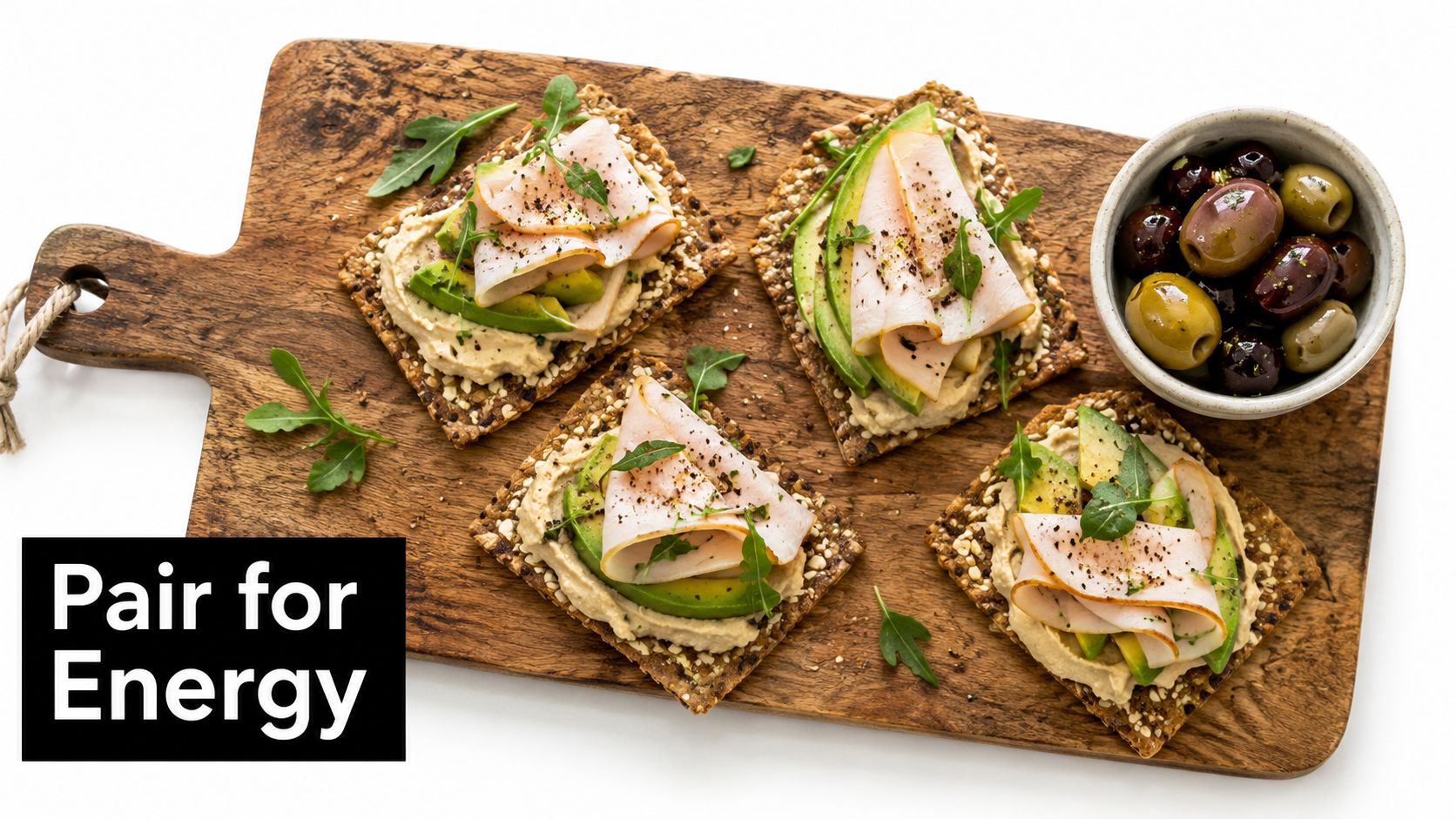
Pairings that work in real life
- Hummus and vegetables: Add cucumber, bell pepper, or tomato for freshness and volume. The creamy dip makes a plain cracker feel complete without relying on sugar.
- Cottage cheese and fruit: Use cottage cheese for protein, then add berries or sliced pear for contrast. Choose fruit rather than sweetened spreads when you want flavor without turning the snack into candy.
- Turkey and avocado: A small amount of sliced turkey adds savory protein, while avocado supplies richness. Keep an eye on the turkey's sodium if the cracker is already salty.
- Cheese and apple: Sharp cheese brings flavor, so you don't need a heavily seasoned cracker. An apple adds crunch and a naturally sweet finish.
For more ideas that combine a crisp base with a satisfying topping, see these whole-grain crackers with cheese.
A desk snack should be portable and clean. A lunchbox snack should be familiar enough to eat. A pre-workout option may need to stay lighter. The pairing should match the occasion, but the principle remains consistent: improve the snack by adding substance, not by eating more crackers.
Building Your Ultimate Snack Pantry
A useful snack pantry is built around situations, not health claims. Stock foods that make a balanced choice quick when you are working, packing lunch, or leaving the house.
Buy one savory whole-grain cracker for hummus, cheese, or vegetables. Add one low-sugar portable option for times when you want something sweet. Compare the complete label before buying, and use the earlier USDA guidance for crackers as a practical reference for fiber.
Build the pantry around use
- Desk snack: Keep a sealed portion of crackers beside a protein-rich topping, such as hummus, cheese, or cottage cheese. Pre-portion the crackers so convenience does not turn into repeated handfuls.
- Lunchbox: Choose a familiar format that travels well. Pair it with fruit and a protein food rather than relying on a larger serving of crackers to provide fullness.
- Travel option: Store a low-sugar packaged snack that can handle a bag or car compartment. Pick a product you will actually eat, not one bought only because the package suggests wellness.
- At-home plate: Keep vegetables and a flavorful dip ready. Fresh toppings add volume and make a plain cracker more satisfying without adding hidden sweetness.
Use packaging to support the routine. Keep savory crackers where you prepare lunch, and place portable options near the door or in a work bag. The goal is to reduce last-minute choices, not to fill every shelf with products carrying whole-grain claims.
Rip Van sells portable Dutch-style wafels, crispy wafers, wafer bars, and cookies, with filters for dietary preferences. Its 100% satisfaction Royal Guarantee and direct online ordering offer one way to try a lower-sugar format, while retail shoppers can look for comparable options in stores.
A strong pantry makes the better snack easy to reach. Choose the right format, prepare the pairing, and let convenience work in favor of your nutrition goals.
For a portable lower-sugar option beside savory staples, explore the treats available from Rip Van.
0 comments