

In Catholic practice, a fully gluten-free host is invalid matter for the Eucharist, so most Catholic churches need a low-gluten wheat host or Communion from the chalice. Gluten-free wafers that are entirely free of gluten serve other denominations and dietary needs, and a low-gluten host tested at 70 ppm contains about 0.14 milligrams of gluten in a wafer weighing roughly 0.2 grams.
A parish administrator usually encounters this question at an ordinary, tender moment. A longtime congregant mentions celiac disease before worship, and the altar guild discovers that one supplier says “gluten free” while another says “low gluten.” Both packages look suitable, yet they may not serve the same religious or medical purpose.
The confusion comes from two systems using similar words differently. Food labeling describes the ingredients and measured gluten level in a finished product. Liturgical rules describe what can function as Eucharistic bread within a particular tradition. Individual wrapping helps with handling and separation, but it doesn't settle either question by itself.
Why the Label on the Box Matters More Than You Think
Suppose a congregant asks for a gluten-free wafer. One volunteer finds a wafer made without wheat. Another finds a wheat-based host marketed as low gluten. A third suggests using the individually wrapped option because each portion appears protected. The group may still be unsure which wafer is safe for the person, valid for the service, or appropriate for the denomination.
That uncertainty isn't a failure of care. The terms overlap in everyday conversation. A food manufacturer may use “gluten free” to describe a measurable regulatory status, while a Catholic supplier may use “low gluten” to describe a wheat host that preserves sacramental validity. Those labels answer different questions.
Practical rule: Treat “gluten free,” “low gluten,” “wheat,” and “individually wrapped” as separate pieces of information, not as interchangeable promises.
The first decision is theological. What kind of bread does this church and rite require? The second is medical and regulatory. What level of gluten can the communicant safely receive, and what evidence supports that level? The third is operational. Can the parish store, prepare, and distribute the wafer without exposing it to ordinary wheat hosts?
Clear ingredient information helps, but it isn't enough on its own. A parish can use ingredient transparency as a purchasing principle, asking suppliers to state the product's wheat source, gluten specification, intended religious use, and handling controls in plain language.
This guide resolves the practical questions in that order. You'll learn how fully gluten-free and low-gluten wafers differ, how to interpret a parts-per-million result, what an individual wrapper protects against, and which documents an altar guild should request before placing an order. You'll also have a repeatable Sunday procedure rather than a last-minute decision at the communion rail.
Gluten Free vs Low Gluten Communion Wafers Explained
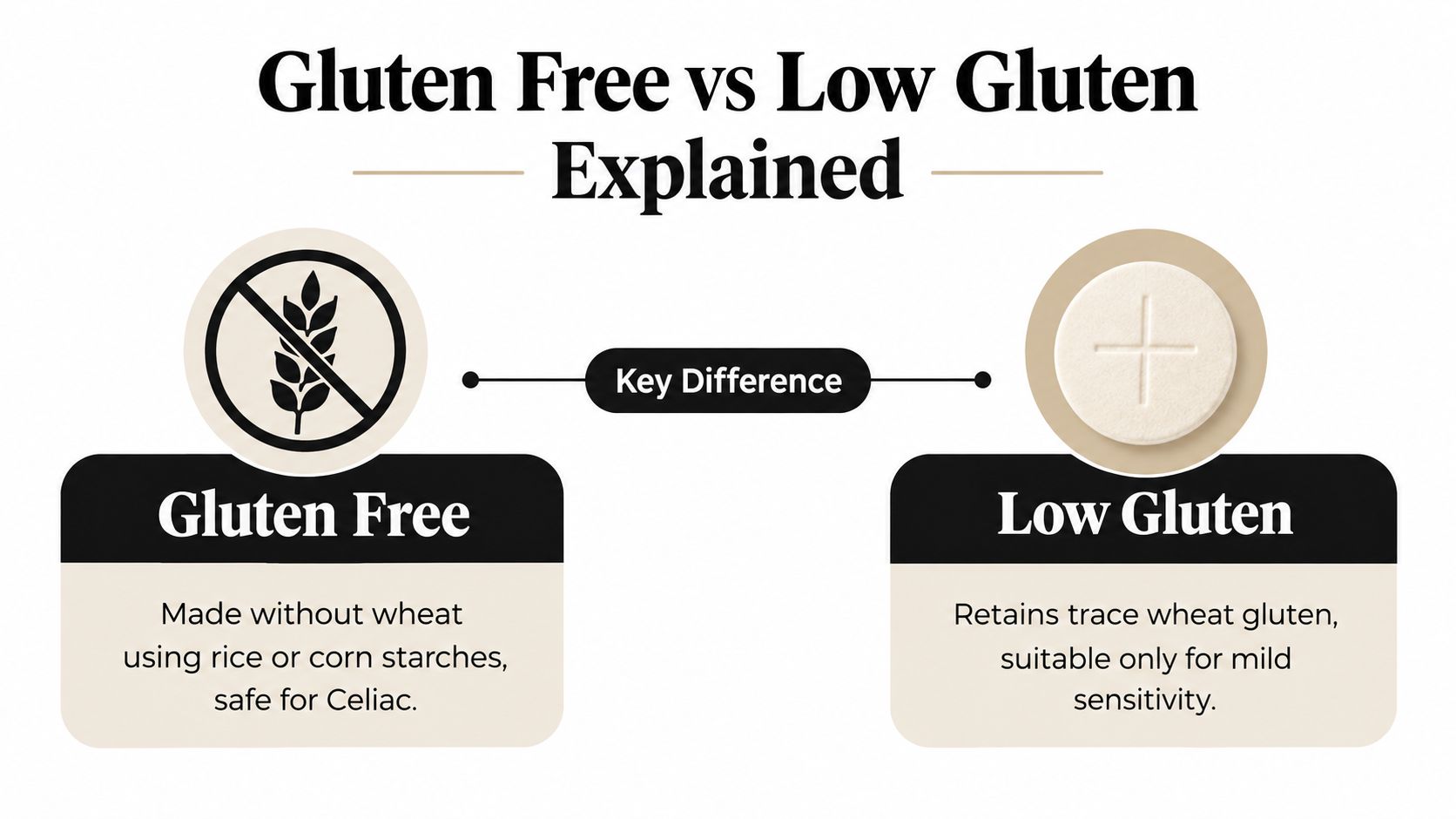
Start with the simplest distinction. A gluten-free wafer is made without wheat gluten, often from ingredients such as rice, corn, or other starches and grains. A low-gluten host remains a wheat-based bread product and retains enough wheat gluten to remain bread for Catholic sacramental purposes.
The difference isn't merely about how much gluten is present. It can change what the product is. Substituting the main grain in a recipe may produce a useful alternative food, but it may no longer be the kind of bread required by a particular rite. That analogy helps explain why a wafer can be appropriate for a person with celiac disease in one church and not be valid matter for a Catholic Eucharist.
The Catholic distinction
In 2003, the Vatican's Congregation for the Doctrine of the Faith ruled that hosts made entirely without gluten are invalid matter for the Catholic Eucharist. It also stated that low-gluten hosts can be valid when they contain enough wheat gluten to remain bread and are made without foreign materials or processes that change the nature of bread. The ruling was reaffirmed in 2017, as documented in the Vatican's guidance on hosts without gluten.
For a Catholic parish, the phrase “gluten-free communion wafer” can therefore create a theological problem. A fully gluten-free wafer may meet a food-related need but cannot serve as the Catholic host. The parish generally needs a low-gluten wheat host or must arrange Communion from the chalice, subject to the guidance of its clergy and diocese.
Why denomination matters
Other Christian denominations may permit or prefer a wafer made without wheat. Their rules can differ from Catholic requirements, so a fully gluten-free wafer may be the correct choice for their communion service. The same product can therefore be suitable in one congregation and unsuitable in another.
When comparing products, ask four direct questions:
- What is it made from? Is it wheat-based or made from non-wheat starches?
- What does “gluten free” mean on this package? Look for a finished-product specification, not just a marketing phrase.
- Is it intended for Catholic use? If so, seek the relevant ecclesiastical approval or guidance.
- Can the parish keep it separate? Packaging and handling affect practical exposure after manufacture.
A product guide about gluten-free wafer cookies may help explain food terminology, but communion purchasing requires the additional liturgical question. Never assume that a snack-style gluten-free label and a sacramentally valid Catholic host describe the same product.
How Much Gluten Is Actually in a Low-Gluten Host
Once a parish identifies a low-gluten host as theologically appropriate, the next question is exposure. Parts per million can sound abstract, so translate the laboratory result into the portion placed in a communicant's hand.
The National Celiac Association reports that Benedictine Sisters' low-gluten hosts were recently tested at 70 ppm. The reported wafer weighs approximately 0.2 grams, and the association estimates that one wafer contains about 0.14 milligrams of gluten. The source also cites research indicating that more than 50 milligrams of gluten per day was harmful for people with celiac disease. These figures appear in the National Celiac Association's discussion of gluten-free and low-gluten hosts.
The calculation in plain language
The arithmetic is straightforward:
- A concentration of 70 ppm means 70 parts of gluten per million parts of product.
- A wafer weighs about 0.2 grams.
- Applying that concentration to that portion gives approximately 0.14 milligrams of gluten.
- Compared with the more than 50 milligrams per day cited in the source, the estimated exposure from one wafer is roughly 357 times lower.
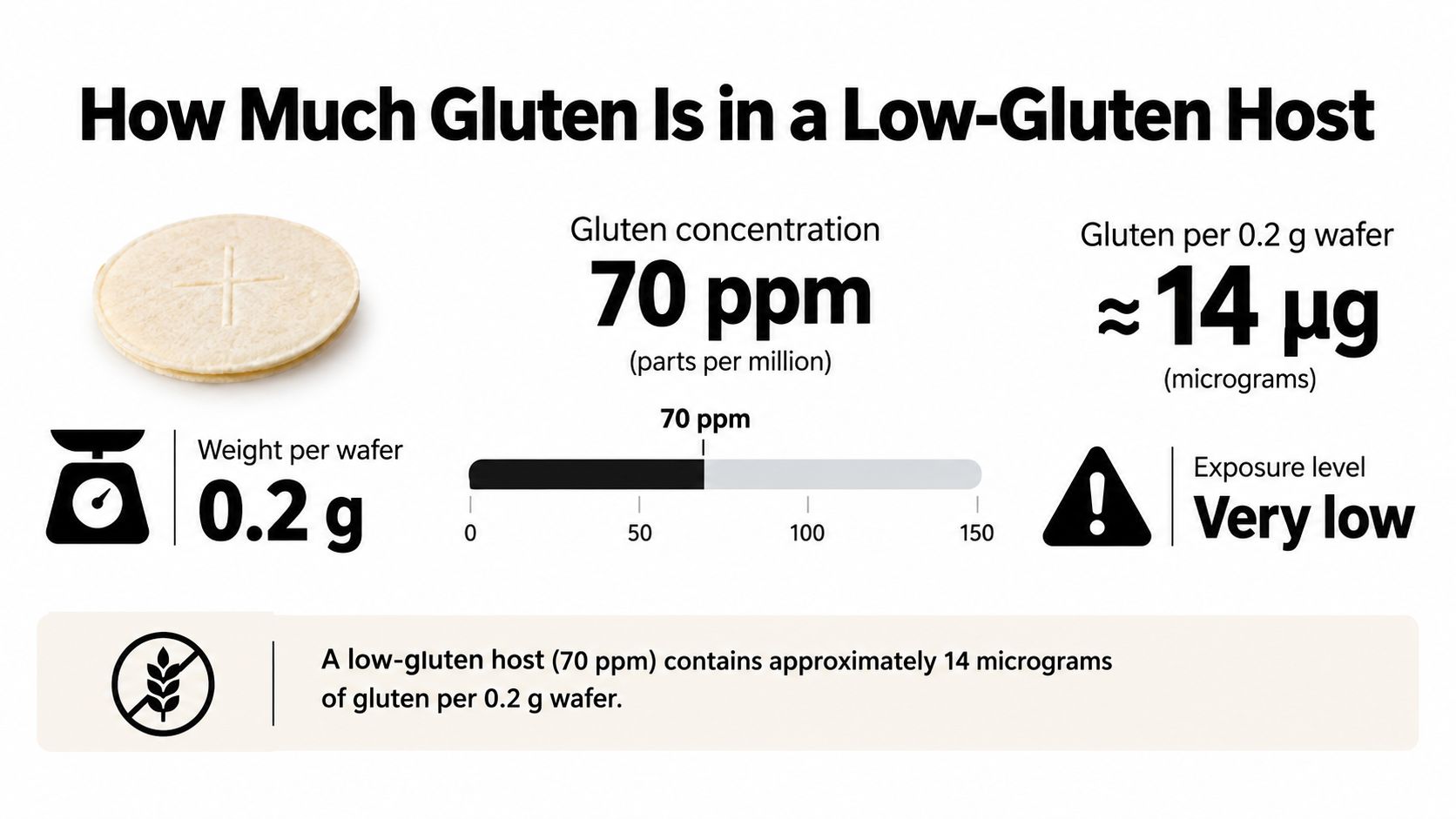
That comparison can help a parish explain a manufacturer's test result without treating “low gluten” as “no gluten.” The host still contains wheat-derived gluten. The calculation also describes the tested product and stated serving size, not every wafer from every supplier.
Why the result isn't a personal medical instruction
Individual medical risk varies. A person with celiac disease may have a physician's advice, a history of reactions, or a level of concern that requires a different accommodation. Production, storage, and distribution also matter because a low laboratory result doesn't protect a wafer that becomes contaminated later.
Ask the manufacturer for the test method or finished-product result, the lot or verification approach, and the cross-contact controls used during production. Then ask the communicant to consult their clinician when the choice isn't clear. A parish should offer a careful accommodation, not make a medical judgment on someone's behalf.
The practical conclusion is balanced: a measured low-gluten host may present a very small exposure in the stated portion, but it isn't gluten-free. The parish must communicate that distinction plainly before the person receives Communion.
What Individual Wrapping Does and Does Not Do
An individually wrapped wafer solves a handling problem. The wrapper keeps each portion closed until distribution, reduces direct contact, and makes it easier for a minister to identify and pass the designated host without reaching into a shared bowl of ordinary wheat wafers.
That separation can simplify the whole service. The altar guild can store the individually wrapped wafers in a labeled container, prepare only the number needed, and distribute them without using the same tongs or ciborium as the standard hosts. It also reduces transfer opportunities from hands, crumbs, serving cloths, and crowded preparation surfaces.
The wrapper is a barrier after packaging. It isn't a purification process.
The FDA meaning of gluten free
For U.S. retail or procurement decisions, the FDA says a gluten-free claim requires the finished product to contain less than 20 ppm of gluten. That threshold also applies to unavoidable gluten from cross-contact, and the FDA describes 20 ppm as the lowest level consistently detectable with valid scientific analytical tools. The regulatory explanation is available in the FDA's gluten-free food labeling guidance.
A wrapper can't correct gluten introduced during ingredient receiving, mixing, baking, cooling, or packaging. If a shared production line introduces gluten before the product is sealed, the sealed package preserves the contaminated product rather than making it safe.
Use packaging as one control
Buyers should request two documents:
- Finished-product specification: The measured gluten status of the wafer, with the relevant claim or test information.
- Cross-contact statement: The manufacturer's controls for shared equipment, rework, storage, and packaging lines.
Individual wrapping remains valuable because it limits later exposure and gives the altar guild a simple distribution method. It should sit alongside supplier verification, segregated storage, clean preparation, and a written service routine. Even packaging designed for convenient portions, such as resealable snack bags, illustrates the same operational principle: containment helps preserve a product's condition, but it doesn't change the product's formulation.
How to Choose and Order the Right Wafers
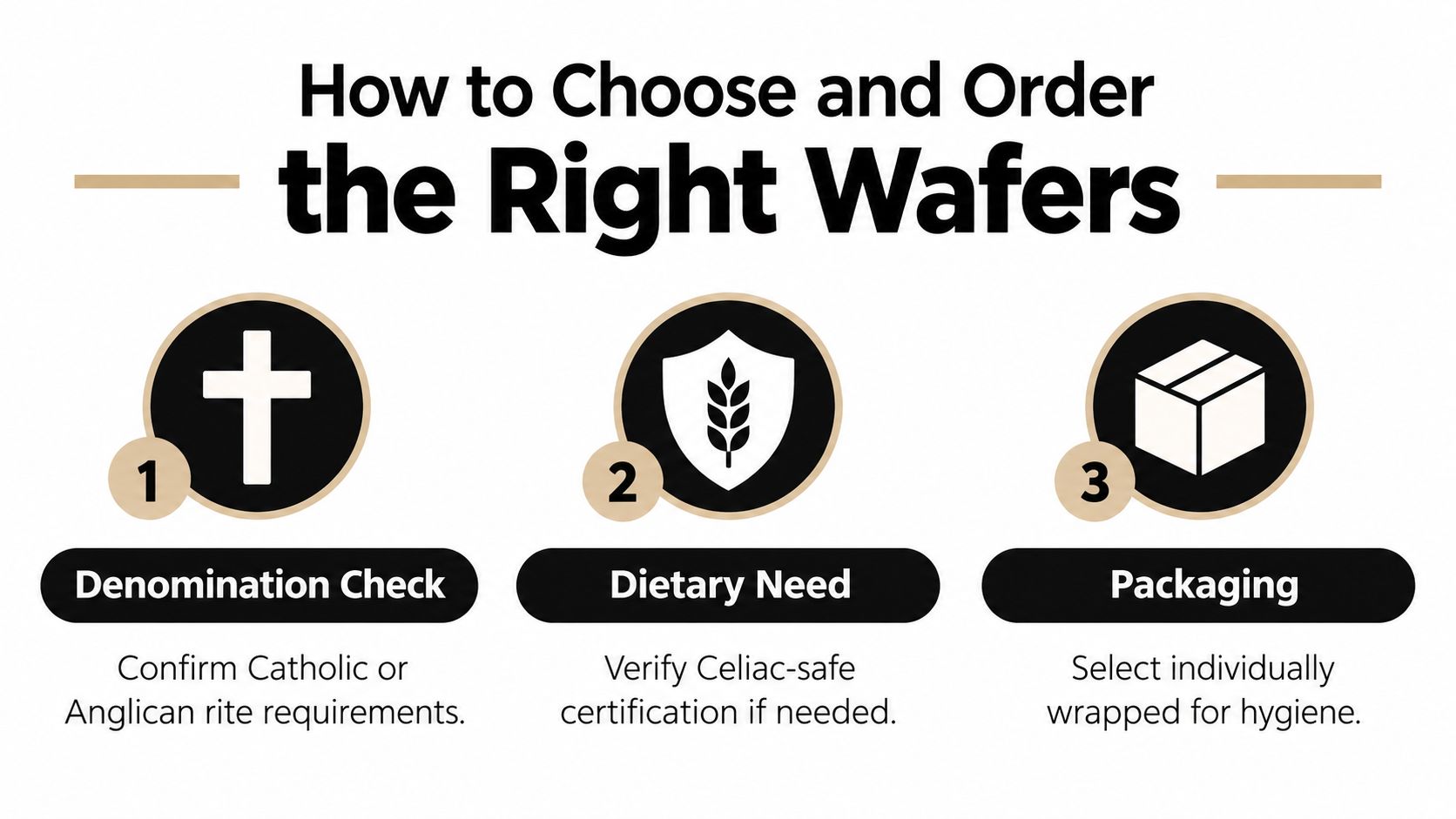
Before opening a supplier's order page, settle the church-use question. A Catholic parish needs to follow the requirements for wheat-based Eucharistic bread and should seek guidance from its clergy or diocese. Another denomination may permit a fully gluten-free wafer. The product's dietary status and its sacramental suitability must be checked separately.
Catholic canon law requires Eucharistic bread to be made only from wheat and recently made so there's no danger of corruption. Bread made entirely without gluten is invalid matter, while bread with a small amount of gluten may be valid if it remains wheat bread, as summarized in the FDA's educational material on gluten and food labeling.
Compare the evidence, not the front panel
| Verification Item | Why It Matters |
|---|---|
| Gluten status | Shows whether the wafer is gluten-free or contains wheat-derived gluten. |
| Sacramental suitability | Confirms that the product fits the denomination and rite using it. |
| Documentation | Gives the parish a finished-product specification and relevant testing information. |
| Cross-contact controls | Explains how the manufacturer manages shared equipment, storage, rework, and packaging. |
| Packaging format | Shows whether portions are individually wrapped or supplied in bulk for controlled handling. |
Build a purchasing checklist
Use this checklist in a supplier email or order review:
- Confirm the rite: Write down whether the order serves a Catholic Eucharist, an Anglican service, or another tradition.
- Identify the dietary requirement: Separate celiac disease, gluten sensitivity, wheat allergy, and preference. They aren't the same request.
- Request the specification: Ask for the finished-product gluten statement and any available verification documentation.
- Review production controls: Ask whether ordinary wheat hosts share equipment, storage, or packaging areas.
- Choose the service format: Select individual wrapping when controlled distribution and reduced handling are priorities.
- Plan stock: Estimate average attendance, the number of services, and the likely demand for the special option, then order enough for the service rhythm without allowing opened stock to sit unnecessarily.
- Record the decision: Keep the product name, supplier response, approval or guidance, and handling instructions with the altar guild records.
Recently made hosts matter within Catholic practice, so don't treat a large order as automatically efficient. A smaller, clearly managed supply may be easier to rotate and explain to volunteers. Store low-gluten or gluten-free products apart from ordinary hosts, and label the container so a substitute volunteer doesn't have to guess.
Handling Wafers Safely During Services
Sunday morning is where a good purchasing decision either works or fails. The altar guild needs a routine that a new volunteer can follow without interpreting theological language or remembering which package was selected months earlier.
Begin before the service. Keep individually wrapped wafers in a sealed, clearly labeled container that is separate from the main ciborium stock. Don't place the special wafers loose on the same tray, and don't open their wrappers during preparation unless the denomination and the communicant's needs require it.
A repeatable service routine
- Assign one preparation person. The sacristan or designated altar guild member retrieves the correct package and checks the label before setting out the wafers.
- Prepare a separate vessel or location. Use a dedicated small ciborium, tray, or clearly marked area. Keep it away from crumbs and ordinary wheat hosts.
- Tell the ministers the plan. The priest, deacon, and communion assistants should know how the special wafer will be identified and who will distribute it.
- Use a discreet request method. A communicant might arrange the accommodation with clergy in advance, speak to an usher, use a seat signal, or receive through a designated station.
- Keep the wrapper intact until delivery. The minister can hand over the sealed portion when that format is appropriate, avoiding direct contact with the host.
- Close the process carefully. Return unused portions to the labeled container, record any issue, and discard any portion whose wrapper is damaged or whose separation is uncertain.
A visitor shouldn't have to announce a medical condition in front of the congregation. A quiet conversation before worship is both more dignified and more reliable.
Ministers who handle ordinary wheat hosts should avoid touching a special host with the same hands or utensils without following the parish's established hygiene procedure. Washing hands and using separate serving equipment can reduce transfer opportunities, but the parish should also explain that a wrapper doesn't change the wafer's gluten content.
When the chalice is the better accommodation
For a Catholic communicant, Communion from the chalice may be an alternative when a fully gluten-free host is not valid for the Eucharist or when the person cannot use a low-gluten wheat host. The clergy should determine how the chalice is offered and what safeguards the communicant needs.
The key is advance planning. A person who waits until the rail may face a rushed decision, while a parish that records the arrangement can prepare a separate vessel, brief the minister, and offer the accommodation without drawing attention to it.
Frequently Asked Parish Questions
Can a person with celiac disease receive from the chalice?
They may be able to, depending on their medical needs and the church's practice. In a Catholic setting, the chalice can be an alternative to a fully gluten-free host, but clergy should discuss the arrangement with the communicant and follow diocesan guidance. A parish shouldn't assume that every person has the same level of tolerance.
What should a volunteer say when a visitor asks about gluten content?
Give the verified answer, not a guess. Explain whether the parish offers a fully gluten-free wafer, a low-gluten wheat host, or the chalice, and say that the visitor can speak privately with clergy before receiving. If the package or supplier documentation isn't available, don't promise that a wafer is safe.
Can individually wrapped wafers stay on hand for a long time?
They can remain part of parish inventory only when the parish follows the manufacturer's storage instructions and checks package integrity and dates. Keep them sealed, labeled, and separate from ordinary hosts. Order according to the congregation's real service pattern so stock doesn't become an unmanaged box in a sacristy cupboard.
Is a wheat allergy the same as celiac disease?
No. Both concerns require care, but the relevant trigger and medical risk may differ. A low-gluten wheat host still contains wheat, so someone with a wheat allergy may need a different accommodation even when a product's gluten level seems low. Ask the communicant to follow their clinician's advice and involve clergy before the service.
Rip Van offers portable wafers, wafer bars, cookies, and other better-for-you snacks for people who care about clear dietary choices and satisfying texture. Browse the range and explore options for your household or church community at Rip Van.
0 comments