

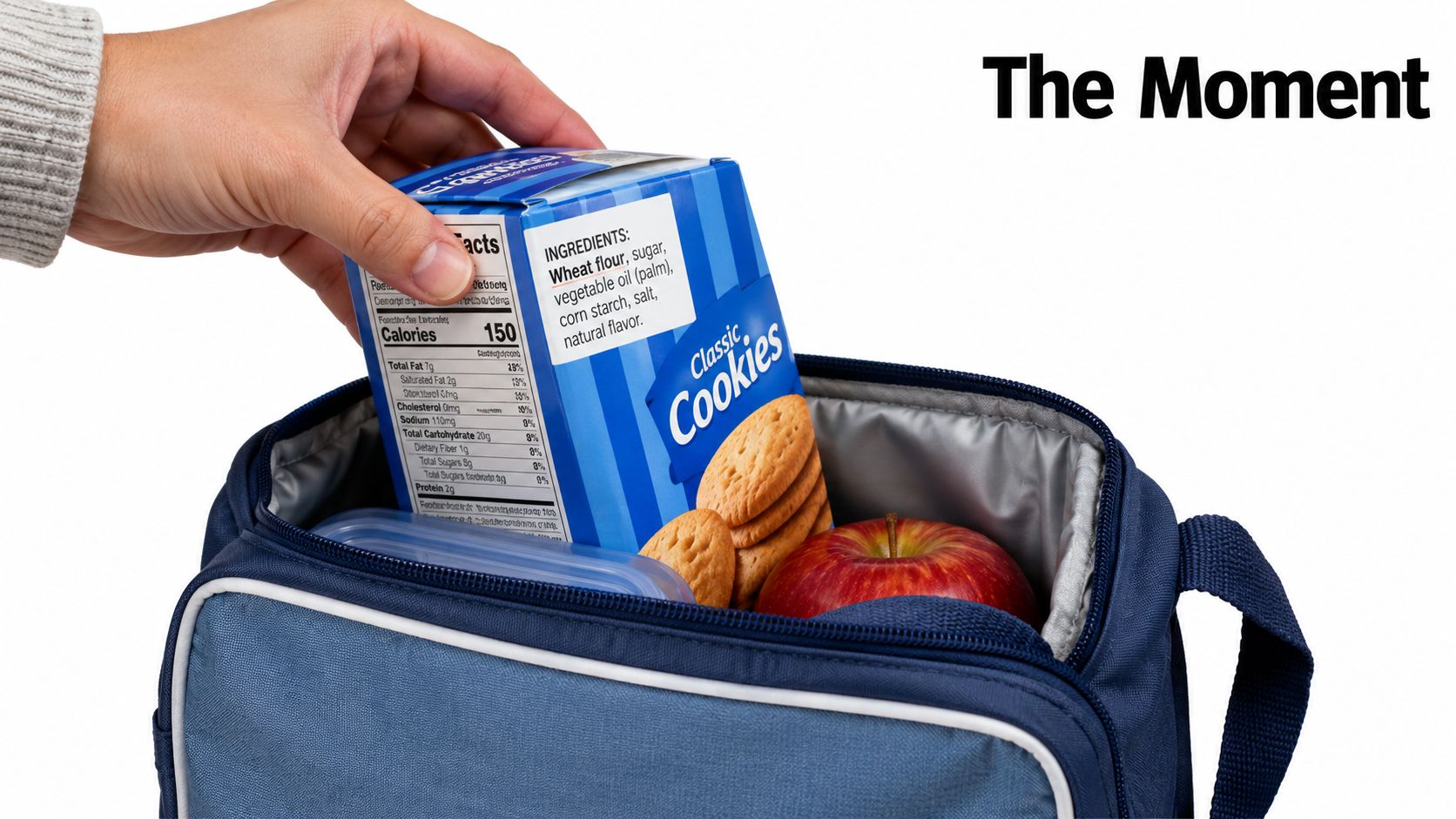
You grab the familiar blue-striped cookie box for a lunch bag, then stop at the ingredient panel. Wheat flour leads the list, and the cookie that once felt automatic no longer fits the person you're feeding. That moment is frustrating because the craving hasn't changed. You still want the crisp biscuit, chocolate stripes, and buttery fudge-cookie nostalgia.
The good news is that gluten free fudge stripe cookies do exist. The less convenient news is that “gluten free” solves only one problem. Many alternatives remain sweet, low in fiber, or engineered primarily to imitate texture. The smartest choice depends on whether your priority is celiac safety, a close match to the classic, fewer allergens, lower sugar, or a homemade ingredient list.
| Option | Best for | Main advantage | Main compromise |
|---|---|---|---|
| Certified gluten-free store cookie | Convenience and dietary safety | Ready to pack and serve | May still be sugar-forward |
| Specialty allergen-friendly cookie | Multiple food allergies | Broader allergen coverage | Texture can move further from the original |
| Homemade cookie | Ingredient control | Adjust sweetness, flour, and toppings | Requires technique and kitchen discipline |
| Low-sugar wafer alternative | Everyday snacking | Better fit for a lower-sugar routine | Less like a classic fudge stripe |
The Cookie You Grew Up On May Not Fit Anymore
A child spots the striped cookie in a lunch bag and expects the familiar crunch. A parent checks the label and realizes the old favorite cannot go along. For anyone with celiac disease or wheat sensitivity, nostalgia cannot override ingredient safety.
A successful substitute must earn its place on taste and practicality. It should deliver a clean snap, chocolate that tastes like chocolate, and a coating that does not feel waxy. It also needs to survive a lunchbox without turning into crumbs. Even then, a close match can create a new problem: a cookie may solve the gluten issue while still bringing a heavy sugar load.
What you're really comparing
Judge each gluten-free option on these points:
- The snap: It should break cleanly rather than crumble into sandy fragments.
- The chocolate: The stripe should provide real chocolate flavor, not only extra sweetness.
- The sweetness: Matching the shape does not justify a cookie that tastes excessively sugary.
- The handling: Lunchbox cookies need to withstand a bag, container, and routine movement.
- The label: Gluten-free certification and allergen controls matter more than familiar packaging.
- The daily fit: Check sugar and fiber before treating a nostalgic cookie as an everyday snack.
Classic Fudge Stripes remain a wheat-based product. Gluten-free versions are separate formulations, not the original recipe with wheat removed. That difference sets the right expectation: compare them with the classic for flavor and texture, then judge them independently for ingredient controls and nutrition.
Practical rule: Use the original as a taste reference, never as a safe starting point.
If the cookie is an occasional treat, prioritize the closest crisp texture and chocolate finish. If it appears in lunchboxes several days a week, choose more carefully. Gluten-free status addresses one dietary need, while sugar and fiber determine whether the replacement fits the rest of the snack routine. A cookie that recreates childhood nostalgia but leaves the lunchbox overloaded with sweetness is only a partial solution.
Why Classic Fudge Stripes Do Not Work for Gluten-Free Eaters
A familiar package can still create a serious problem. Classic Fudge Stripes are made with wheat, so they fail the gluten-free requirement. The mini-cookie product information identifies wheat and marks the product as not gluten free (Keebler mini-cookie product information).
That distinction matters for anyone with celiac disease. Appearance, the word “fudge,” and similar packaging do not confirm safety. Read the exact label, allergen statement, and certification mark whenever the product or package changes.
Label reading needs a strict routine
Start with declared gluten sources, then inspect less obvious ingredients. Malt, brewer's yeast, and some forms of modified food starch need closer checking because their sources can vary. “Made without wheat” does not automatically mean certified gluten free.
Use this routine:
- Read the current package, not an old product page or a remembered ingredient list.
- Check the allergen statement for wheat and other ingredients relevant to your household.
- Look for a clear gluten-free designation when cross-contact presents a serious concern.
- Contact the manufacturer if an ingredient source remains unclear.
- Keep separate kitchen habits when baking for someone with celiac disease.
Gluten-free status solves the wheat problem, but it can leave a sugar problem behind. Replacement flours, starches, binders, and fats change how a cookie spreads, breaks, and feels in the mouth. They also do not make a sweet snack automatically suitable for daily eating. Check sugar and fiber alongside the gluten-free claim.
A direct flour swap rarely reproduces the original's thin, crisp texture. That trade-off is acceptable for an occasional treat, but it deserves attention if cookies appear in the snack routine often.
Plan treats before the week becomes hectic. A resource for weekly gluten-free meal planning can help households build safer snack routines instead of making an improvised store choice.
Store-Bought Gluten Free Fudge Stripe Cookies Compared
You can find several gluten-free versions in the packaged-cookie aisle, but none should be judged as a perfect replica. MadeGood, Enjoy Life, Partake, and Katz make different trade-offs in allergen coverage, flour blends, sweetness, and texture. Private-label cookies may cost less or offer a convenient local option, though retailer availability and formulas can change.
Goodie Girl's gluten-free Fudge Striped Cookies provide a useful category benchmark. The 7 oz package lists at $4.53 at H-E-B and $4.98 at Walmart, or roughly $0.65 to $0.71 per ounce (product listing and pricing details). Gluten-free specialty cookies often cost more than everyday wheat-based versions because the formulation and dietary positioning require different production choices. The price may buy a closer nostalgic experience, but it does not make the cookie a lower-sugar snack.
| Brand | Taste match to original | Texture | Allergen coverage | Price per oz | Where to buy |
|---|---|---|---|---|---|
| MadeGood | Moderate, usually lighter and less buttery | Crisp but delicate | Often attractive for allergy-conscious households, verify each package | Check current retailer listing | Natural-food retailers and online shops |
| Enjoy Life | Moderate, with a strong allergy-friendly focus | Crisp, sometimes more fragile | A major reason shoppers choose it, verify the current label | Check current retailer listing | Major retailers and online shops |
| Partake | Moderate, cleaner-tasting but less nostalgic | Firm and crisp | Designed for broad dietary needs, verify the current label | Check current retailer listing | Natural grocers and online shops |
| Katz | Moderate to good, depending on the specific cookie | More substantial, though not always a stripe-cookie replica | Useful for gluten-free households, verify the current label | Check current retailer listing | Gluten-free retailers and online shops |
| Goodie Girl | Closest among the cited commercial examples for a dedicated fudge-striped format | Structured with a recognizable cookie snap | Check package-specific allergen details | About $0.65 to $0.71 per oz | H-E-B, Walmart, and other retailers |
| Private label | Unpredictable | Formula-dependent | Must be checked product by product | Often varies | Whole Foods, Trader Joe's, and regional stores |
My ranking for the first purchase
Goodie Girl gets the first try when your priority is a dedicated fudge-striped format with a familiar snap. It offers the clearest match among the commercial examples with verified category information. Treat it as a nostalgia purchase, not a nutrition upgrade, and check the sugar alongside the gluten-free claim.
Katz comes next for shoppers who prefer a substantial, bakery-style gluten-free cookie over an exact stripe-cookie match. Partake and Enjoy Life fit households that place broad allergen coverage ahead of recreating the classic bite. MadeGood works as a practical family option, but buy one package before committing to a larger order.
Buy one pack, then test the texture after opening and again the next day. A cookie that starts crisp but turns soft quickly may not deserve a repeat purchase, even if the chocolate stripes look right.
Baking Gluten Free Fudge Stripe Cookies at Home
Homemade cookies give you control that packaged products can't. You can reduce the sweetness, choose dairy-free fats, use a flour blend you trust, and make the chocolate stripe as thin or generous as you like. The method below aims for a crisp, shortbread-like cookie rather than a soft bakery biscuit.
Use a 1:1 gluten-free flour blend that contains a reliable binder, then add cornstarch for a cleaner snap. The dough should be firm enough to roll thinly between parchment, but not so dry that it cracks while cutting.
| Ingredient / step | Amount | Why it matters | Swap option |
|---|---|---|---|
| 1:1 gluten-free flour blend | 1 cup | Provides the main structure | A trusted oat-based blend if certified gluten free |
| Cornstarch | 2 tbsp | Encourages a lighter, crisper bite | Tapioca starch for a slightly different texture |
| Butter or vegan butter | 1/2 cup | Adds richness and helps the cookie brown | Plant-based baking stick |
| Powdered sugar | 1/3 cup | Dissolves smoothly for a less gritty dough | Finely ground cane sugar |
| Vanilla | 1 tsp | Rounds out the flavor | Almond extract, if safe for your household |
| Chocolate chips or chopped chocolate | 3/4 cup | Creates the fudge coating and stripes | Dairy-free chocolate |
| Neutral oil | 1 tsp | Helps the melted chocolate stay fluid | Cocoa butter |
| Chill, roll, and bake | See method | Controls spread and breakage | Chill longer if the dough feels soft |
Method that protects the texture
Cream the butter and sugar until smooth, then mix in vanilla. Whisk the flour blend and cornstarch separately, add them gradually, and stop mixing once the dough comes together. Wrap it and chill it until firm.
Roll the dough thinly between parchment sheets. Cut rounds, make a center hole if you want the familiar ring shape, and place the cookies on a lined tray. Bake until the edges are just golden. Overbaking creates a dry, fragile cookie, while underbaking leaves the center too soft to support the chocolate.
Melt the chocolate with the oil in short bursts, stirring between each one. Dip the cooled cookies or brush the underside, then pipe stripes from a zip-top bag with a tiny corner snipped off. Let the coating set before stacking.
For more technique ideas, browse gluten free baking tips before choosing a flour blend. You can also use this all-purpose baking mix guide to think through how different blends affect structure.
Texture fix: If the cookies spread, mix in a tablespoon more flour. If they crumble, shorten the bake time by one minute.
A sealed container with a paper towel helps manage moisture and restore crispness by the next day. For dairy-free baking, use vegan butter and dairy-free chocolate. For egg-free baking, this recipe already avoids eggs, so the main cross-contact checks involve the flour blend, chocolate, and decorations.
How the Nutrition Really Stacks Up
Gluten-free status doesn't tell you whether a cookie is nutritionally balanced. It tells you that the product meets a gluten-related requirement according to its labeling and formulation. A cookie can be suitable for a gluten-free diet and still deliver a familiar sugar-heavy treat with little fiber.
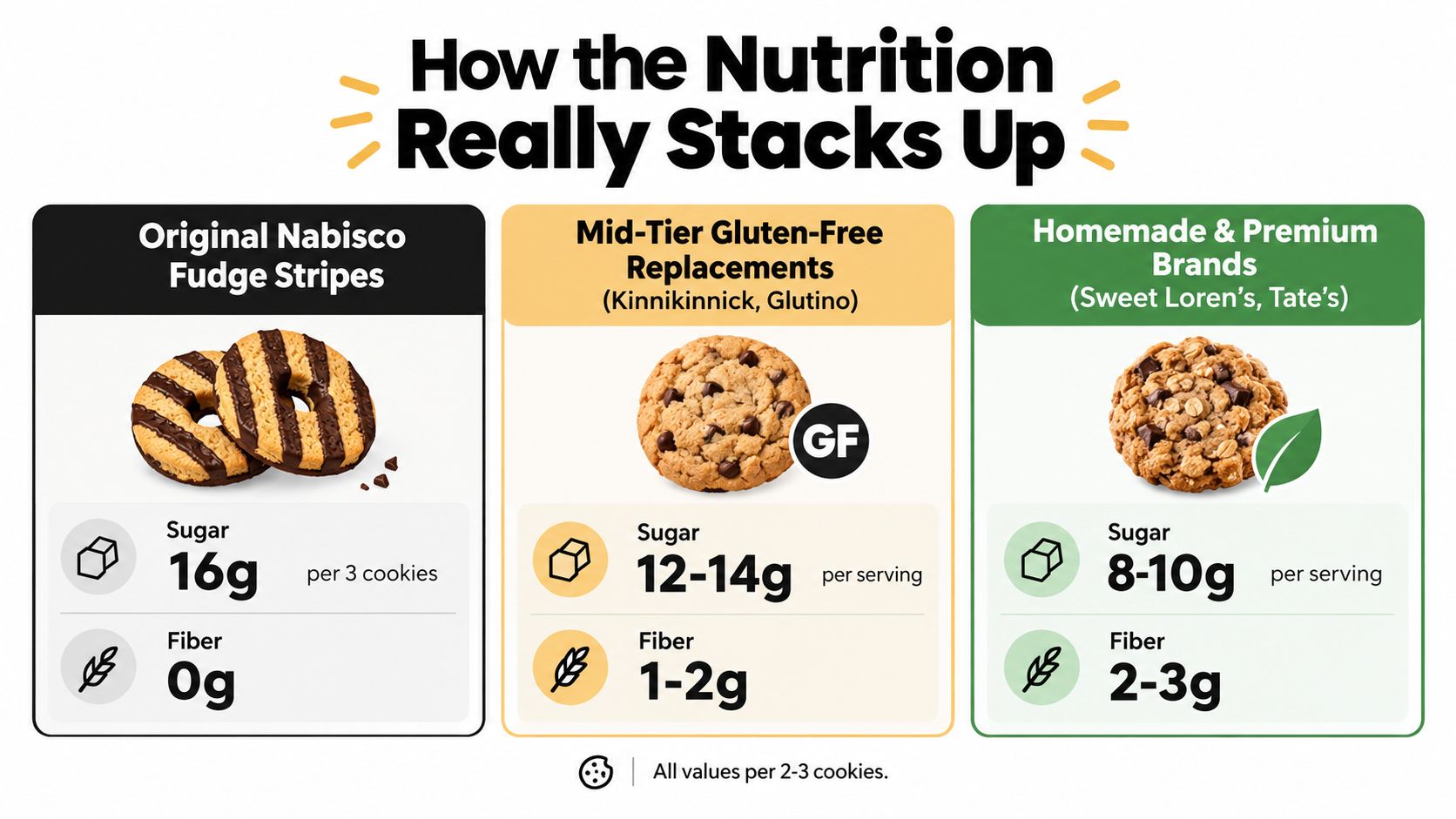
The comparison becomes clearer when you separate three groups. The original Fudge Stripes are the nostalgia baseline. Mid-tier gluten-free replacements try to reproduce the same role. Better-for-you cookies and wafers shift the goal toward lower sugar or more useful fiber rather than exact imitation.
The supplied comparison visualization presents 16 grams of sugar and 0 grams of fiber for the original category, 12 to 14 grams of sugar and 1 to 2 grams of fiber for mid-tier gluten-free replacements, and 8 to 10 grams of sugar and 2 to 3 grams of fiber for homemade and premium examples (nutrition comparison context). Treat those figures as category guidance, not a substitute for the label on the package in your hand.
Use the label in the right order
Start with serving size. Then check sugar and fiber together instead of looking at either number in isolation. A cookie with a slightly lower sugar number but no fiber may not be a meaningful everyday upgrade, while a higher-fiber option can feel more satisfying even when it still belongs in the treat category.
The verified product example from H-E-B lists 150 calories, 130 mg sodium, 0 mg cholesterol, 0 grams trans fat, 1.5 mg iron, and 10 mg calcium per serving (Goodie Girl nutrition and ingredients). Its ingredient system uses gluten-free oat flour, cane sugar, palm oil, brown sugar, invert syrup, leaveners, soy lecithin, and a confectionery chocolate coating. That structure can produce the expected snap and coating adhesion, but it doesn't automatically make the cookie low sugar.
A useful 30-second filter is simple: compare sugar with fiber, then check protein and the ingredient list. Don't treat a gluten-free badge as a health halo. Read the nutrition label guide before deciding whether a cookie belongs in a daily snack rotation or an occasional dessert slot.
When a Low-Sugar Wafer Beats a Gluten-Free Cookie
Sometimes the better choice isn't another gluten-free imitation. It's a different cookie category. Low-sugar wafers generally give up some of the dense, buttery shortbread identity, but they can fit a daily snack routine better when sugar is the main concern.
Rip Van's lineup includes gluten-free Dutch Caramel & Vanilla and Snickerdoodle wafels, alongside other wafer and cookie formats. Its better-for-you positioning centers on lower sugar, fiber, no corn syrup or artificial sweeteners, natural flavors, no artificial colors, and non-GMO ingredients, according to the publisher information provided for this article. Treat that as a product-positioning description, then verify the exact nutrition panel for the flavor you choose.
| Attribute | Gluten-free fudge stripe cookie | Rip Van-style low-sugar wafer |
|---|---|---|
| Main appeal | Familiar chocolate-striped crunch | Light, crisp wafer texture |
| Sugar strategy | Often formulated for classic cookie sweetness | Built for a lower-sugar snack profile |
| Ingredient experience | May rely on rice or oat flour, palm oil, syrups, and coating systems | Varies by product, so check the current panel |
| Nostalgia | Strongest match | More of a category change |
| Daily use | Better as an occasional treat for many shoppers | More suitable when sugar is a recurring concern |
| Pairing | Works alone or with milk | Pairs well with nut butter or fruit, if those fit your diet |
The trade-off is clear. Gluten-free fudge stripe cookies win on nostalgia, especially when the chocolate stripe and thin biscuit are the point of the snack. Low-sugar wafers win on sugar budgeting, portability, and the ability to add flavor with a topping rather than relying entirely on a sweet coating.
I'd make the category switch for anyone who eats more than a small portion at a time, packs sweet snacks repeatedly during the week, or manages blood sugar alongside celiac disease. A wafer won't fool a dedicated Fudge Stripes fan, but it may be the more sensible everyday choice. The low-sugar wafer cookie guide offers additional context for comparing that category.
Don't pair a lower-sugar snack with an unlimited topping and assume the total snack remains light. Nut butter, chocolate spread, and sweetened yogurt can quickly change the balance, so choose the pairing deliberately.
The Right Pick for Your Situation
Choose according to the problem you need to solve. A celiac parent, a low-sugar shopper, and a party host have different priorities, even when they search for the same gluten-free fudge stripe cookie. Gluten-free status handles one dietary need, but it does not automatically solve a high sugar load.
Five practical recommendations
- Newly diagnosed celiac parent: Start with a dedicated packaged gluten-free fudge-striped cookie such as Goodie Girl, provided its current label fits your household. It delivers the familiar lunchbox format. Check sugar, allergen details, and cross-contact information yourself before serving.
- Low-sugar eater managing glucose: Choose a Rip Van wafer instead of forcing a perfect stripe-cookie imitation. The format better suits a lower-sugar snack plan, but the exact product panel and serving size still matter. Expect a lighter wafer texture rather than the firm shortbread snap associated with classic fudge stripes.
- Party host serving mixed diets: Buy a clearly labeled packaged cookie and place it in its own dish with its own utensil. That setup limits mix-ups for guests. The trade-off is less ingredient control and a higher specialty-cookie cost.
- Scratch-baking purist: Use the homemade flour-and-cornstarch method above, then control the chocolate layer yourself. This gives you the most control over sweetness and allergens. Plan to adjust spread, thickness, or bake time after the first batch.
- Budget shopper: Compare package size and price per ounce before choosing a specialty brand. As noted earlier, the verified Goodie Girl example costs about $0.65 to $0.71 per ounce. A lower shelf price can still mean less fiber or a less flexible allergen profile.
Coffee can make a sweet cookie feel intentional rather than turning snack time into grazing. Use these ideas for finding the perfect coffee dessert pairings to match a crisp cookie with a roast that does not overpower it.
Use this decision rule. If gluten is the only concern, choose the brand with the strongest texture and label fit. If sugar also matters, stop chasing a perfect imitation and choose a better-for-you wafer instead. That switch accepts less nostalgia in exchange for more control over an everyday snack.
Rip Van offers gluten-free wafer options and other lower-sugar snack formats for people who want a portable choice without relying on a traditional fudge stripe cookie. Visit Rip Van to compare current flavors, nutrition panels, and dietary filters before choosing your next snack.
0 comments