

You're standing in the kitchen, thinking about chocolate. You want something rich and satisfying, but you're also trying to keep your carbohydrate intake lower. The package in your hand says sugar-free, keto, or low sugar, yet the nutrition panel tells a more complicated story. Should you eat the whole bar, one square, or choose a different snack altogether?
Low carb chocolate snacks can fit comfortably into a balanced eating pattern, but the useful skill isn't memorizing a particular product. It's learning how to read total carbohydrates, fiber, sugar alcohols, sweeteners, and serving size together. Once you understand that label math, you can assess a chocolate wafer, cookie, bar, spread, or homemade bite without depending on a bold claim on the front of the package.
This guide treats chocolate as a decision, not a moral test. A satisfying snack may involve trade-offs, including a smaller portion, stronger cocoa flavor, a firmer texture, or a sweetener that doesn't agree with everyone. You'll learn how cocoa percentage affects carbohydrate density, why low sugar doesn't automatically mean low carb, how to estimate net carbs, and how to fit a treat into your day.
The aim is simple: enjoy chocolate with more awareness and less guesswork. You can look for indulgent formats, including wafers, cookies, and crispy snacks, while still checking whether the serving matches your goals.
Introduction to Low Carb Chocolate Snacks Without the Guilt
The craving usually arrives at an inconvenient time. Maybe lunch is over, your afternoon energy has dipped, and a plain “healthy” snack doesn't sound appealing. You reach for chocolate because you want sweetness, richness, and a little crunch, not another lecture about willpower.
That desire doesn't make your eating plan a failure. It means the snack needs to do more than carry a health-oriented label. Taste, portion size, carbohydrate content, and satisfaction all matter. A product that fits your carb target but leaves you searching for another treat may not serve you as well as a deliberately portioned snack that feels complete.
Chocolate also creates confusion because the category includes very different foods. A high-cocoa square, a milk chocolate bar, a filled wafer, and a chocolate cookie may share a flavor profile while differing substantially in sugar, fiber, fat, and available carbohydrate. Even dark chocolate isn't automatically low carb. USDA-based nutrition data show that 100 g of 70% to 85% dark chocolate contains about 45.9 g of carbohydrates, including roughly 10.9 g of fiber and 24.1 g of sugars (USDA-based dark chocolate nutrition data).
A more useful way to think about indulgence
The practical question isn't “Is chocolate good or bad?” Ask instead:
- What does one serving contain?
- How much of that carbohydrate is digestible?
- Will the sweetener work for my body and palate?
- Can I stop at the stated portion?
Those questions turn a vague craving into a manageable choice. You may choose a small piece of intense dark chocolate, a chocolate snack with added fiber, or a crisp format that gives you more sensory satisfaction in a defined serving.
The low carb chocolate category has become commercially meaningful as shoppers look for lower-sugar indulgence. One industry estimate placed the global keto chocolate market at about $2 billion in 2023 and projected it to reach roughly $3.5 billion by 2028, with an estimated CAGR of about 12% (market overview of chocolate and keto trends). That expansion gives consumers more formats to compare, but it also makes label literacy more important.
You don't need to avoid chocolate to eat with intention. You need a method that helps you choose the portion and formulation that suit your personal goals.
What Makes a Chocolate Snack Truly Low Carb
A chocolate snack becomes lower carb through a combination of ingredients and portion size, not through the word “chocolate” or “dark” on the package. Think of cocoa percentage as a dimmer switch. Turning it higher generally reduces the room available for added sugar, but it doesn't turn the product into a carbohydrate-free food.
Cocoa solids bring the deep flavor associated with dark chocolate. They also contribute fat, fiber, and naturally occurring compounds, while sugar adds readily available carbohydrate. A peer-reviewed review reported that a 100-kcal portion of 70% to 85% dark chocolate contains about 1.7 g of fiber, compared with 1.2 g for semisweet chocolate and 0.6 g for milk chocolate. The same review noted that cocoa powder can contain up to 50 mg of polyphenols per gram (review of low-glycemic snack effects).
That doesn't mean higher cocoa chocolate is automatically suitable for every low carb plan. The label still decides the practical carbohydrate load.
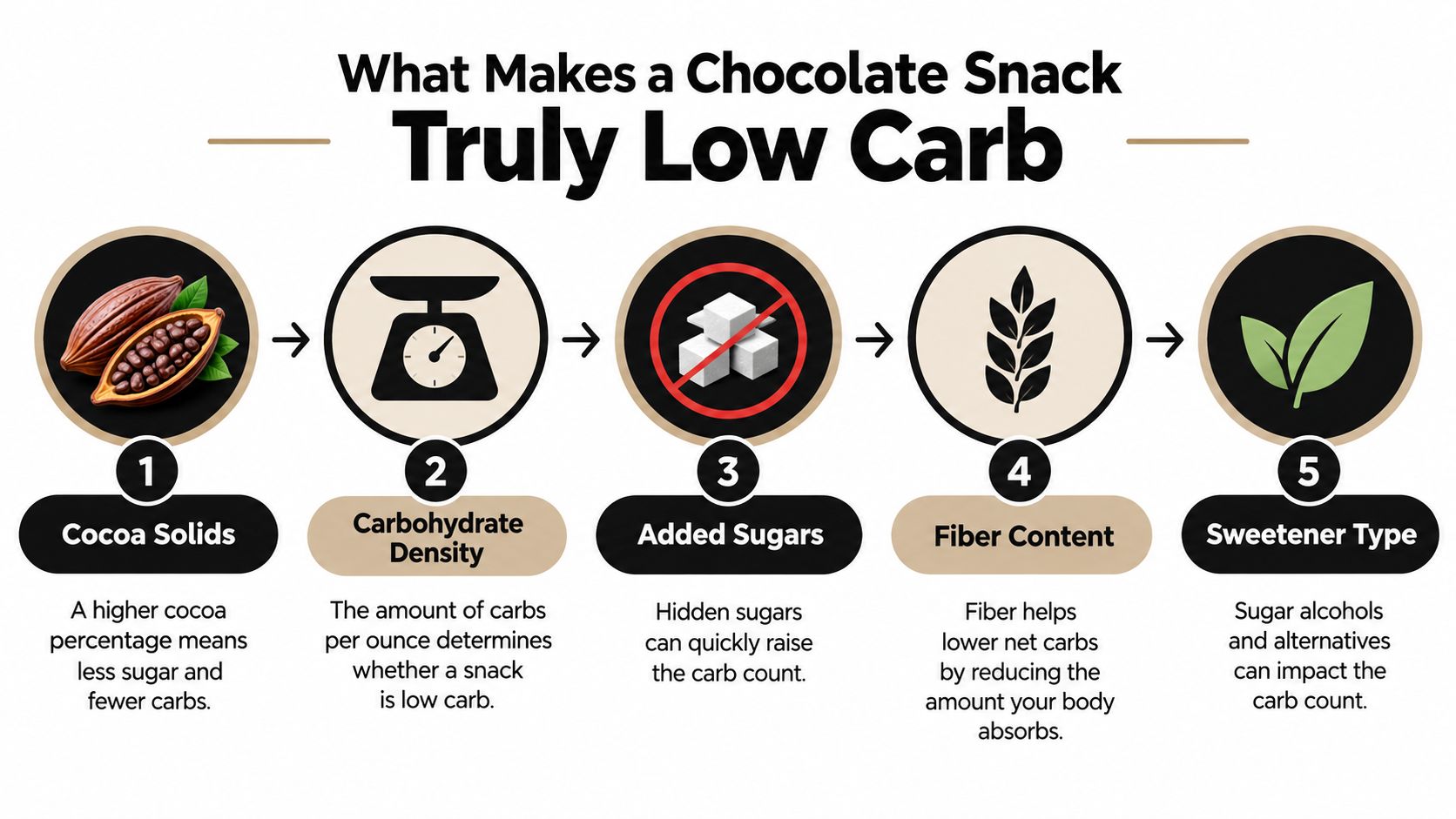
Use a five-part mental model
- Cocoa solids set the flavor and sugar balance. A higher percentage often means a more bitter taste and less space for sugar, though recipes vary.
- Carbohydrate density determines how quickly a portion uses your budget. Compare the amount listed for the actual serving, not just the percentage of cocoa.
- Added sugars can raise the total. Cane sugar, syrups, dextrose, and similar ingredients contribute carbohydrate even when the snack looks small.
- Fiber changes the net-carb calculation. Fiber is listed within total carbohydrates but generally isn't counted in the same way as digestible carbohydrate for net-carb estimates.
- Sweetener type affects both math and experience. Sugar alcohols and alternative sweeteners may lower the listed sugar, but they can change sweetness, cooling sensation, texture, and digestive comfort.
Portion size is the real lever
The difference between a manageable snack and a carbohydrate-heavy one may be the amount you eat. The same USDA-based nutrition reference places 1 oz, or 28 g, of 70% to 85% dark chocolate at around 170 calories, about 13 g of carbohydrates, and roughly 3 g of fiber (dark chocolate serving information). That serving leaves much less space for sugar than many people expect.
This is why low carb chocolate snacks often use small servings, higher cocoa solids, and substitutions such as fiber or sugar alcohols. A snack can taste indulgent while still requiring careful portioning. The right question is not whether the chocolate looks “healthy.” It's whether the serving gives you an amount of flavor and satisfaction that fits the carbohydrate content.
Practical rule: Treat cocoa percentage as a helpful clue, not a final verdict. The nutrition panel and your portion decide the outcome.
How to Read Labels for Net Carbs and Sweeteners
Label reading becomes easier when you treat it like a short calculation rather than a scavenger hunt. Start with total carbohydrates, then look for fiber and sugar alcohols. A common net-carb estimate is total carbohydrates minus fiber, and, where appropriate, minus sugar alcohols. The exact treatment can vary by sweetener and by individual tolerance, so use the package's information and your own response rather than assuming every “zero sugar” formula behaves identically.
For example, a chocolate snack could list total carbohydrates from cocoa, flour, fillings, and sweeteners. If the product also lists meaningful fiber, its estimated net carbs may be lower than the total. If it uses sugar alcohols, check which ones appear and how much is included. Erythritol, allulose, monk fruit, and stevia aren't interchangeable in taste or digestion.
Allulose often supports a sugar-like sweetness and soft texture, while monk fruit is commonly blended with other sweeteners to balance intensity. Stevia can work well for some people but may create an aftertaste in certain chocolate coatings. Sugar alcohols can also cause digestive discomfort for sensitive shoppers, especially when a person eats more than the stated serving.
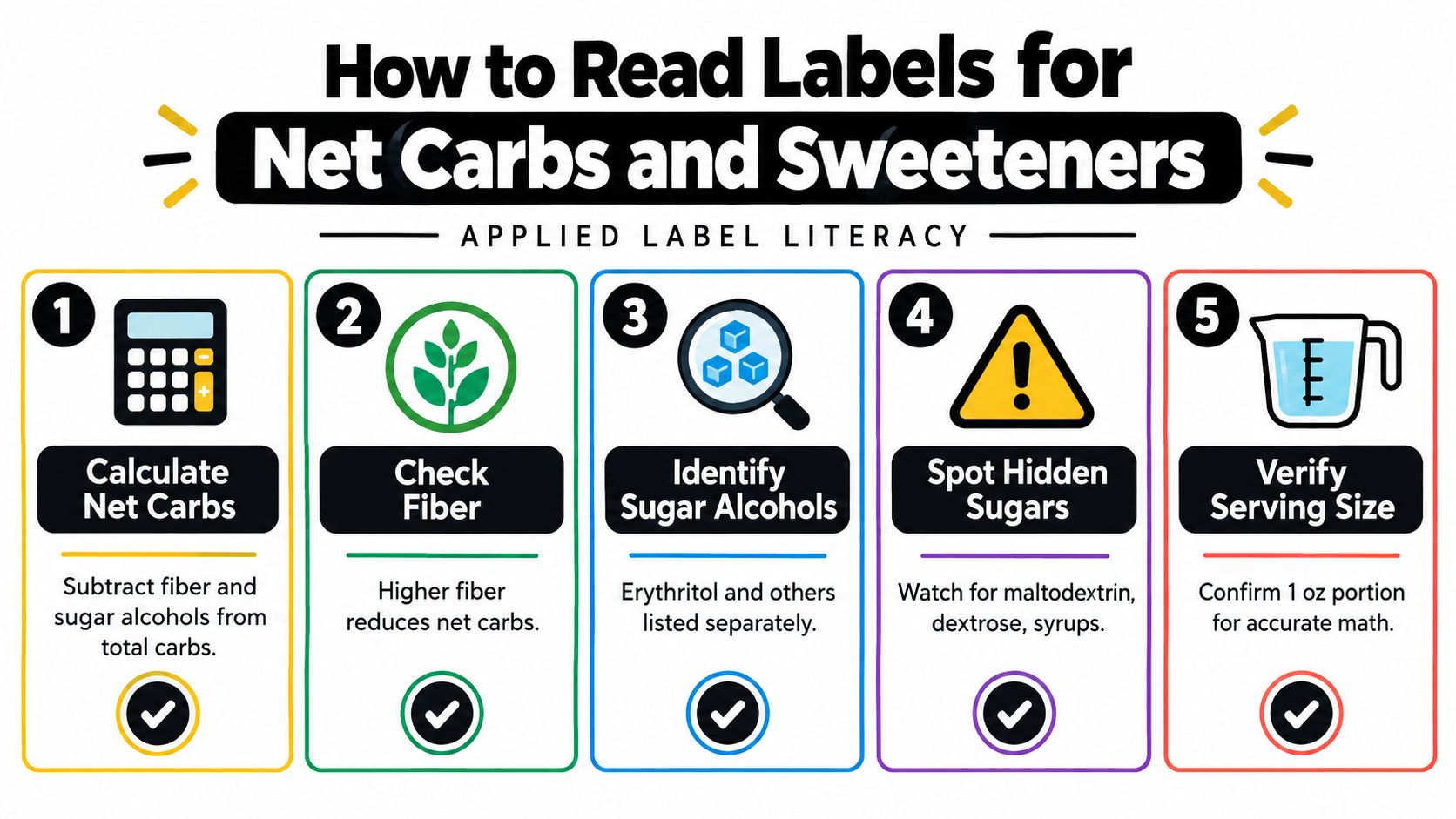
The label decoder
| Label Element | What to Look For | Why It Matters |
|---|---|---|
| Total carbohydrates | The amount per stated serving | This is the starting point for your calculation |
| Fiber | A clear fiber value within total carbs | Fiber can reduce estimated net carbs |
| Sugar alcohols | The specific sweetener and amount | Different sweeteners have different tolerance and taste profiles |
| Added sugars | Sugar, syrups, dextrose, or maltodextrin | A low-sugar claim can still hide other carbohydrate sources |
| Serving size | Grams, pieces, wafers, or squares | Eating multiple servings changes the calculation |
A “low sugar” badge isn't enough. Sugar may be replaced with starches, syrups, or other carbohydrate-containing ingredients, so scan the full ingredient list. Products with clean-label positioning, higher cocoa content, and transparent net-carb information are easier to compare because the package gives you more than a marketing shortcut.
For a plain-language walkthrough of serving sizes and panel details, use this guide to reading nutrition labels.
The video below offers another visual explanation of label analysis.

Before buying, ask whether the serving looks realistic. If the package defines one serving as a tiny portion but you'd naturally eat several portions, calculate the amount you're likely to consume. Honest math is more useful than an impressive front-of-pack claim.
Are Low Carb Chocolate Snacks Keto Friendly
Low carb and keto are related, but they aren't identical. A person following a general low carb pattern may have more flexibility with a chocolate snack, while someone trying to maintain ketosis usually needs to account for the snack within a stricter daily carbohydrate budget and a high-fat eating pattern.
A product marketed as keto-friendly may fit more easily when its serving contains only a small amount of estimated net carbohydrate. The infographic supplied for this guide uses under 5 g net carbs per snack as a practical keto-oriented comparison point, while showing a more flexible low carb category at up to 10 g net carbs per serving. Those are planning examples, not universal medical rules. Your daily target, meals, activity, medications, and health needs still determine whether a snack fits.
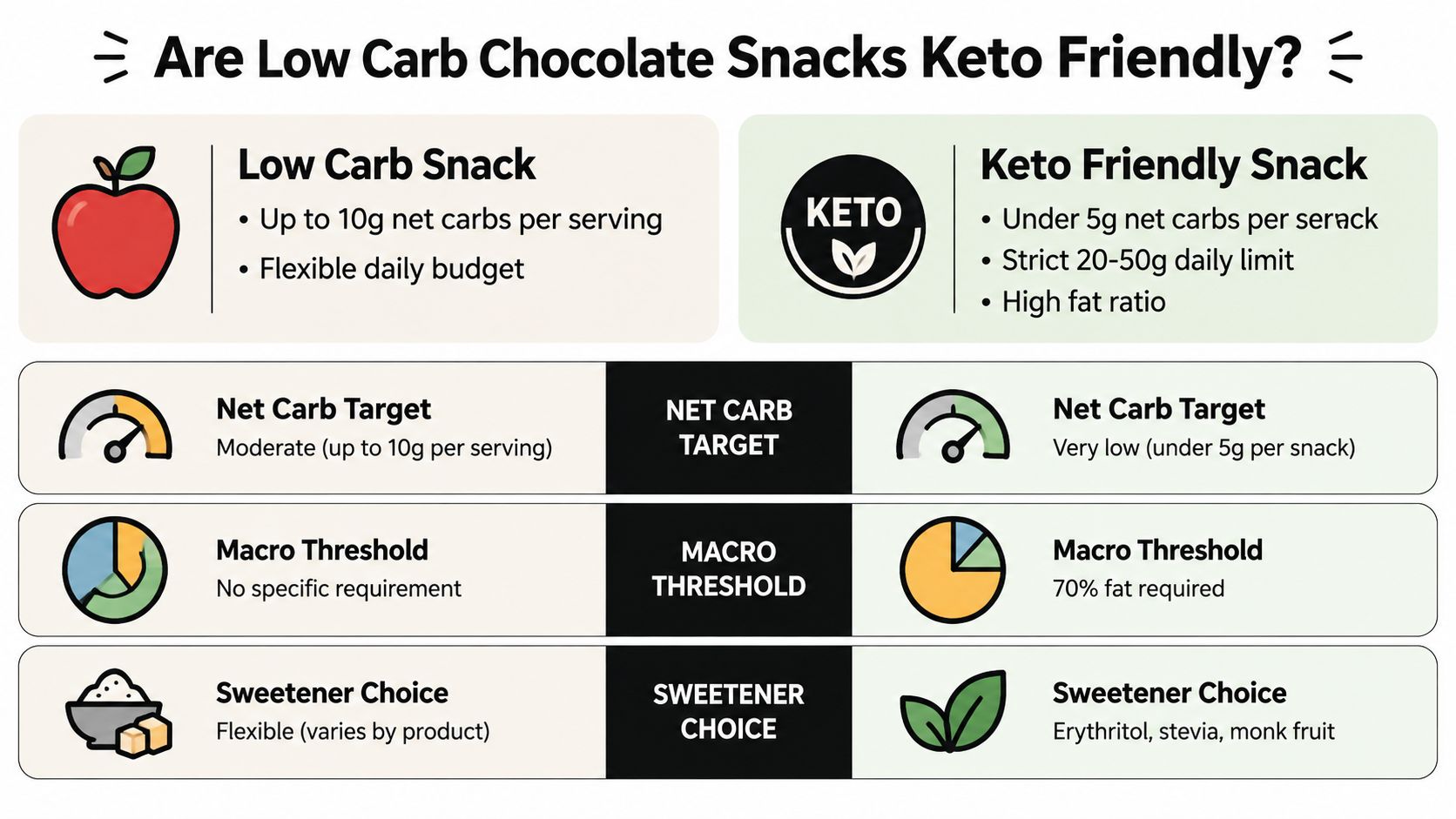
Compare the decision, not just the badge
A keto-friendly chocolate snack generally needs to work within a very low carbohydrate allowance, while a general low carb snack may replace a more sugary conventional treat. Keto planning also pays closer attention to the overall macro balance, including fat, protein, and carbohydrate across the day. A snack can have low net carbs and still be a poor fit if its portion is oversized, its sweetener causes discomfort, or it encourages grazing.
Controlled human data support the importance of available carbohydrate and serving design. A 2026 clinical study of a low-sucrose chocolate spread reported lower overall postprandial glucose excursions after reformulation, with a 50% reduction in carbohydrate content producing a more favorable glucose response (clinical study of a low-sucrose chocolate spread). The same source also discusses chocolate-format snacks with glycemic-load values around 5.5 to 5.7 per serving, depending on formulation and portion.
Those findings don't make every low carb product keto-compatible. They reinforce a practical point: portion size and available carbohydrate still matter after the marketing claim.
If you're learning the terminology, this explanation of what keto-friendly means can help you distinguish a dietary fit from a simple “sugar-free” promise. People managing blood glucose or insulin resistance may also benefit from discussing their approach with a qualified professional and reviewing educational resources such as how to reverse insulin resistance with Pause.
Portion Control and Macros That Keep You on Track
A low carb snack can stop fitting your plan when the portion expands. The package may list nutrition for one wafer, square, or bar, but your hand doesn't automatically measure that serving. Portion control turns the label from information into a useful boundary.
Start by choosing the amount before you begin eating. For dark chocolate, a 28 g, or 1 oz, serving is a clear reference point, and USDA-based nutrition data place that serving of 70% to 85% chocolate at roughly 170 calories, about 13 g of carbohydrates, and around 3 g of fiber (dark chocolate serving reference). The estimate is useful because it shows why even a small-looking amount deserves attention.
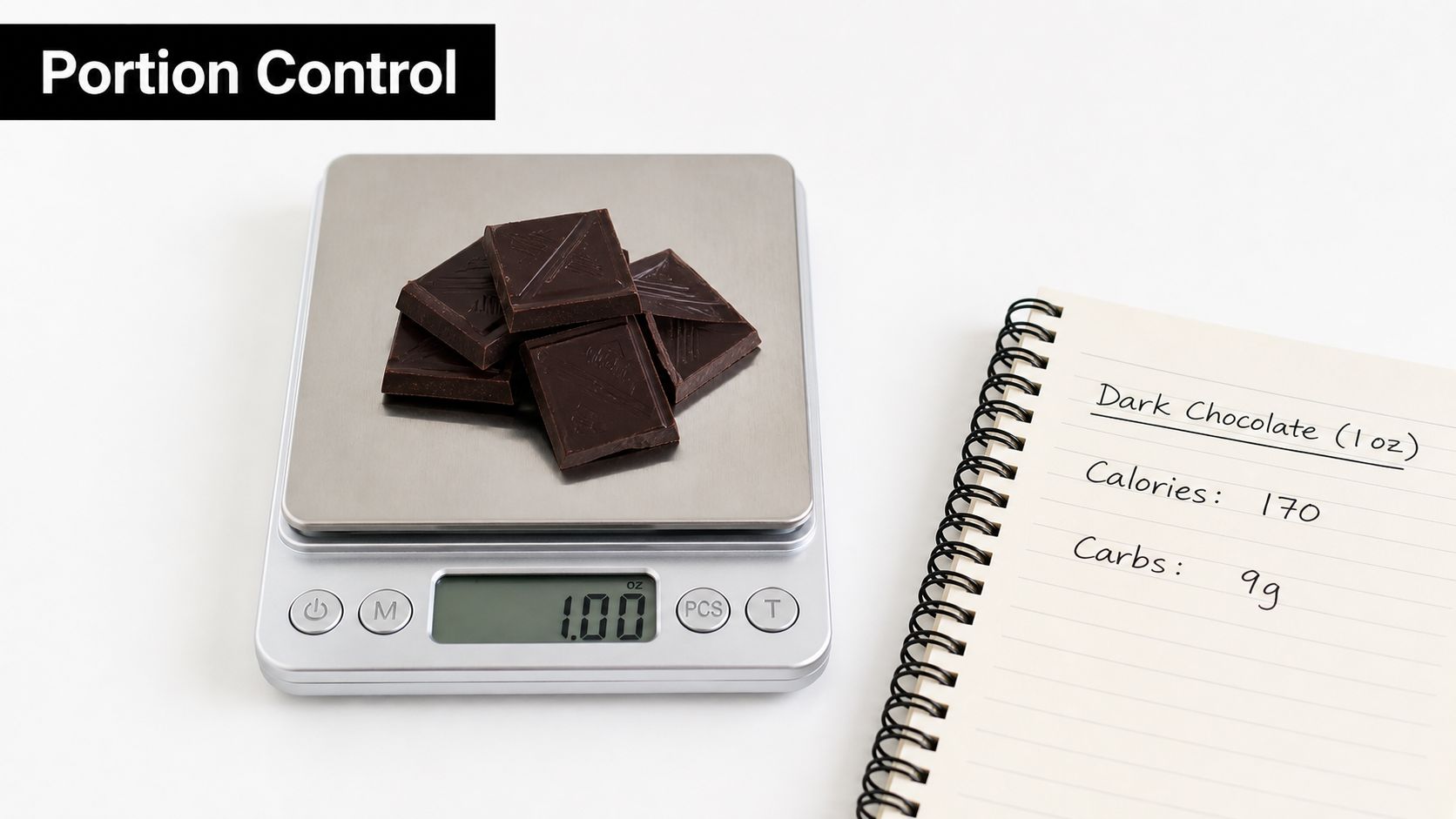
Build a portion you can see
Use a small plate, count the pieces, or weigh the first serving until your eye learns the size. If you're eating a packaged wafer or cookie, check whether the label defines one piece as one serving or whether the serving includes multiple pieces. A snack that feels modest in your hand can represent more than one listed serving.
Pairing also changes the experience. Chocolate alongside plain Greek yogurt, nuts, cheese, or another protein-containing food may feel more substantial than chocolate alone. Keep the pairing aligned with your goals, because adding a high-carbohydrate side can erase the advantage of the chocolate formulation.
Fit the snack into the day
Think of your carbohydrate budget as a series of envelopes. Breakfast uses one envelope, lunch uses another, and the snack gets its own amount. If you spend the entire snack envelope on chocolate, that can be intentional. If you eat the chocolate while also adding a sweet drink and a baked snack, the total may surprise you.
A simple routine works well:
- Pre-portion at home: Put the planned serving into a bowl or small container instead of eating from the package.
- Track the product as packaged: Record the listed serving, then adjust if you eat more or less.
- Notice your response: Pay attention to fullness, cravings, digestive comfort, and whether the sweetener leaves an unpleasant aftertaste.
- Choose the occasion: A planned afternoon snack may be more satisfying than unstructured nibbling throughout the evening.
The goal isn't to make every bite clinical. It's to make the portion visible enough that your choice stays deliberate.
Smart Shopping and Easy Low Carb Chocolate Snack Ideas
A useful shopping trip starts in the nutrition panel, then moves to the ingredient list and finally to the sensory question: Will I enjoy this serving? Look for the carbohydrate amount per piece, fiber, added sugars, cocoa content, and sweetener type. Then compare texture. A crisp wafer satisfies a different craving from a dense truffle or a soft cookie.
Rip Van offers chocolate-flavored wafers and other snack formats positioned around lower sugar and higher fiber, including products in its low carb collection. Its portfolio includes Dutch-style wafels, crispy wafers, wafer bars, LEOS and Romeos cookies, and Crispy Dunes and Crispy Choco varieties. Shoppers can also filter options by benefits such as gluten free, keto, and vegetarian, while product pages provide the serving information needed for personal label math.
For broader ideas, explore these low carb sweet treats, then compare any recommendation against your own serving target rather than accepting the category label automatically.
Match the snack to the craving
- For crunch: Choose a crisp wafer or make a small bowl of cocoa-dusted nuts. Crunch can make a modest portion feel more complete.
- For creaminess: Stir unsweetened cocoa into thick yogurt with a suitable alternative sweetener, then chill it until the texture firms.
- For a quick bite: Combine nut butter with cocoa and enough ground flax or chia to create small, portioned bites. Check the carbohydrate content of each ingredient if you're tracking closely.
- For a dessert feel: Layer cocoa yogurt with a few berries and chopped high-cocoa chocolate. Keep the fruit amount intentional, since it contributes carbohydrate.
Sweetener choice can change the entire experience. Allulose may provide a softer, more sugar-like result, monk fruit can contribute concentrated sweetness, and stevia may work best when balanced with cocoa and other flavors. Some shoppers prefer erythritol's sweetness, while others dislike its cooling sensation. Sugar alcohols may also cause digestive discomfort for certain people, so start with a modest serving and see how you respond.
Shop by priority
If keto compatibility matters most, start with net carbs per serving and verify the daily context. For gluten-free needs, check the product's specific labeling and manufacturing information rather than assuming every chocolate snack qualifies. For simpler ingredients, look beyond “sugar-free” and identify the actual sweeteners, fibers, oils, and flavorings.
Some specialty products also combine chocolate with functional ingredients. For example, shoppers comparing unusual formats may encounter Hemp Well Ireland chocolate. That kind of product deserves the same careful review of serving size, carbohydrate content, ingredients, and personal suitability as any other snack.
Enjoy Chocolate While Staying Low Carb
The most useful shift is to stop chasing a perfect chocolate product. Low sugar is a clue, not a conclusion. A snack earns its place through the complete picture: available carbohydrate, serving size, sweetener tolerance, texture, and whether it satisfies you enough to end the craving.
Use a three-question check whenever you shop:
- What is the actual serving? Count the pieces or weigh the portion.
- What are the estimated net carbs? Review total carbohydrate, fiber, and any listed sugar alcohols.
- How does my body respond? Consider taste, digestion, hunger, and whether the snack encourages you to keep eating.
That process works across chocolate bars, wafers, cookies, spreads, and homemade desserts. It also leaves room for enjoyment. You may prefer intense cocoa, a crispy filling, a soft cookie, or a chocolate snack made with an alternative sweetener. Your best choice is the one that fits your goals and feels satisfying enough to eat intentionally.
If cravings feel persistent, address the wider pattern rather than blaming the chocolate. Meal composition, sleep, stress, and habit cues can all affect appetite, and practical resources such as this guide to stop sugar cravings naturally may give you additional strategies to consider.
Chocolate doesn't need to disappear from a low carb lifestyle. Read the label, choose the portion, test your tolerance, and let the snack be enjoyable without turning it into an all-or-nothing decision.
Rip Van offers chocolate-flavored wafers and other indulgent snack formats designed around lower sugar and higher fiber, with options to review by dietary preference. Visit Rip Van to compare products, check serving details, and choose a low carb chocolate snack that fits your routine.
0 comments