

At 3 p.m., the spreadsheet is still open, your attention is fading, and the break-room cookie jar suddenly looks more appealing than lunch did. The vending machine is closer than the nearest supermarket, while the snack you packed is either buried in your bag or sitting warm in a car. Low carb snacks for work only help when they fit the way your workday operates.
A practical approach combines nutrition with logistics. You need a snack with a sensible carbohydrate profile, but you also need to know whether it can stay in a desk drawer, whether it needs a cold pack, how easy it is to portion, and whether it works within your office's sharing and allergy rules.
Why the Office Is the Hardest Place to Snack Well
The office creates a steady stream of eating cues. Someone brings pastries to a meeting, a colleague opens a bag of candy, and the break room offers coffee before it offers a satisfying food choice. By mid-afternoon, hunger, habit, visibility, and convenience all point in the same direction.
A peer-reviewed analysis of adult food diaries found an average of 1.7 snacking occasions per day, with nearly half classified as unhealthy snacks. After relevant factors were considered, eating at work was associated with approximately 1.5 times greater odds of snacking than eating at home, with a reported 95% confidence interval of 1.1 to 2.0. The analysis of workplace snacking patterns helps explain why office eating requires more than willpower.

Convenience changes the decision
At home, you can reach for leftovers, prepare vegetables, or make a deliberate cup of tea. At work, the available choice often wins. A shared box of cookies requires no planning, while a refrigerated snack may require a container, a cold source, and a trip to an overcrowded communal fridge.
The workplace also blends food with social behavior. Declining a treat can feel awkward, and eating while answering messages makes it easy to lose track of portion size. Coffee routines add another complication. If your office setup encourages sweetened coffee drinks, a carefully selected snack may still be accompanied by liquid added sugar. The Dietary Guidelines report that sugar-sweetened beverages and sweetened coffees and teas contribute over 40% of daily added-sugar intake for the U.S. population (2020–2025 Dietary Guidelines for Americans).
Build a system, not a wish list
The solution isn't a drawer full of foods you won't want to eat. It's a small system that gives you a reliable choice before hunger becomes urgent. Keep one or two shelf-stable options at your desk, pair indulgent items with a more filling food when needed, and reserve refrigerated snacks for days when you can control the temperature.
Your beverage setup matters too. If coffee is part of your afternoon routine, reviewing practical Keurig and Ninja solutions from PureHQ Inc. can help you make unsweetened coffee easier to prepare at work. For more ideas that account for shared spaces and employee needs, use this guide to healthy office snacks for employees.
Practical rule: The snack you can reach safely and portion deliberately will usually outperform the theoretically perfect snack you forgot to pack.
What Makes a Good Low-Carb Work Snack
At 3 p.m., the snack that looks good on the package often fails at your desk. A “low-carb” candy can leave you hungry again in an hour. A cheese stick may fit your carb target but do little for fullness if it is the only thing you eat. For work, the better standard is carbohydrate quality, fiber, and staying power, filtered through real office limits like storage, fridge access, and food-safety rules.
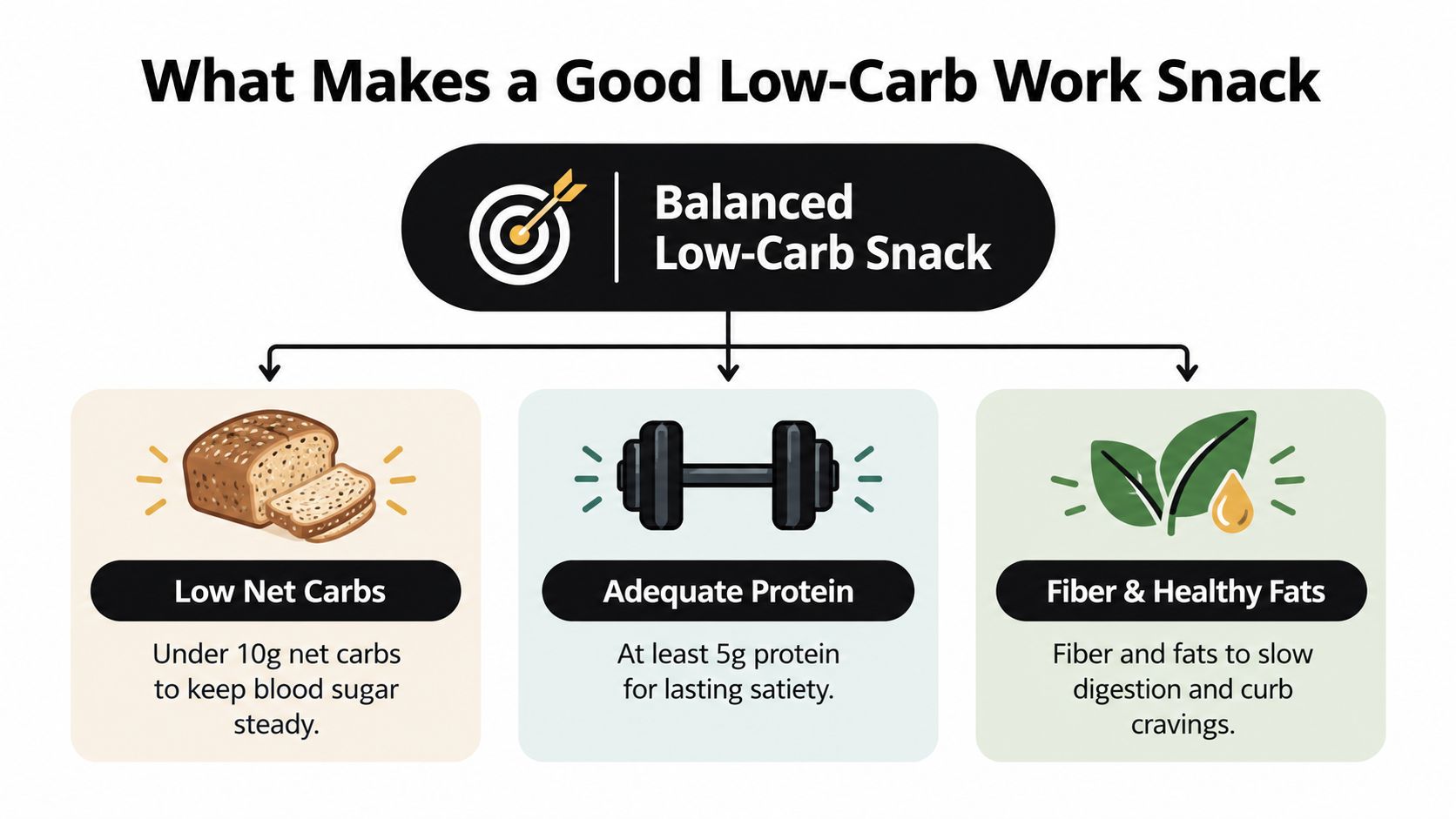
Start with the label, not the front of the pack
Front-of-pack claims are marketing. The Nutrition Facts panel is where a work snack earns its place.
Net carbohydrate is commonly estimated by subtracting dietary fiber from total carbohydrate:
Net carbohydrate = total carbohydrate minus dietary fiber
That shortcut can help, but it is only one screen. The FDA sets the Daily Value for fiber at 28 grams and explains that fiber can support bowel regularity, blood-glucose management, cholesterol management, and lower calorie intake within an overall eating pattern (FDA guidance on the Nutrition Facts label). If you want a practical walkthrough, see this guide to how to read nutrition labels.
Use this checklist before a snack goes into your drawer, tote, or lunch bag:
- Total carbohydrate: Check the full amount instead of relying on a “keto” badge.
- Dietary fiber: Look for a meaningful contribution, and note whether the product leans heavily on isolated fibers.
- Added sugar: Lower-sugar options usually work better when the snack is replacing cookies, candy, or a sweet drink.
- Protein and unsaturated fat: These often make a small snack more filling than a sweet, airy product eaten on its own.
- Sodium and saturated fat: A low-carb claim does not cancel out either one.
- Serving size: Confirm whether the pack is one portion or several.
Fiber helps, but it is not enough on its own
Many office workers need two things from a snack. Less added sugar, more fiber. That is a useful direction, but it does not mean every high-fiber packaged food will hold you comfortably to dinner.
One longitudinal nutrition analysis found that higher total carbohydrate, glycemic load, and total fiber were associated with increased subjective hunger over three years, while glycemic index alone was not associated with that outcome (nutrition analysis of hunger and carbohydrate quality). In practice, I see the same trade-off at work. A fiber-rich wafer, cracker, or bar often performs better when it is paired with almonds, cheese, plain yogurt, or a boiled egg.
The pairing still has to fit the workplace. Nuts are easy to store but may conflict with office allergy rules. Yogurt, eggs, and cheese can work well, but only if you have dependable refrigeration or an insulated bag that keeps them cold. A good low-carb work snack is not just nutritionally sound. It is one you can store safely, portion easily, and finish without creating a bigger problem an hour later.
Building Your Desk Snack Kit Step by Step
Start with the workplace, not the grocery list. A snack plan for a private office with a dependable refrigerator differs from one for a shared workspace, a long commute, or a job that keeps you away from a desk.
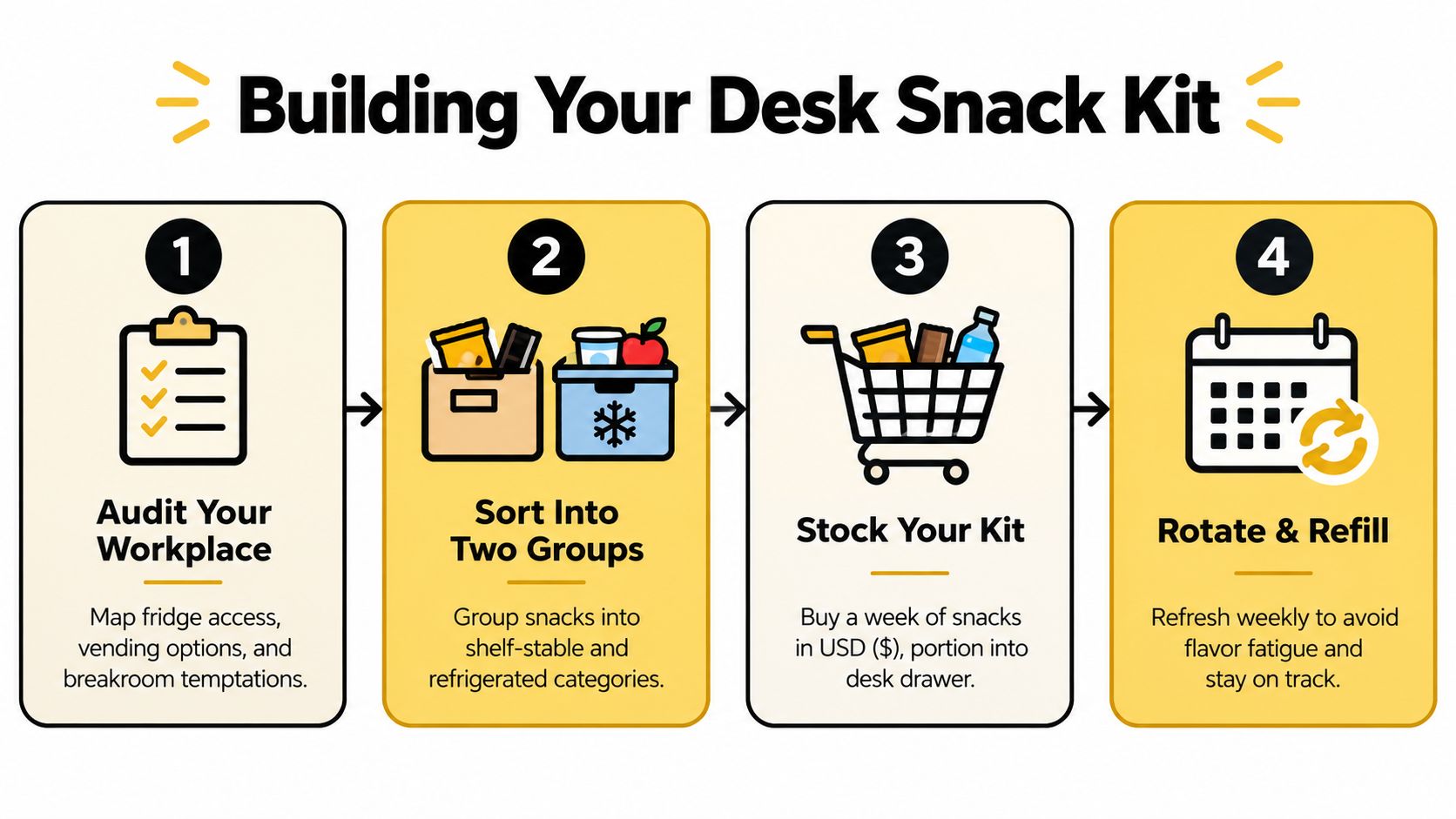
Step 1, audit the environment
Check whether you have reliable refrigerator access, freezer space, a clean place to store food, and permission to keep snacks at your desk. Note the points where you usually buy food, such as the vending machine, reception area, or café. Also check workplace allergy policies before storing nuts in a shared environment.
Your commute matters. A snack that leaves your home chilled but spends hours in a hot car shouldn't be treated as shelf-stable. Choose a desk-drawer option instead, or carry refrigerated food in an insulated bag with a cold source.
Step 2, divide food by storage requirement
Shelf-stable choices are simplest for unpredictable workdays. Individually wrapped wafers, suitable packaged bars, nuts, seeds, and some whole fruits can live in a drawer or bag without depending on a communal fridge. Their practical advantage is consistency, not nutritional perfection.
Perishable foods need a different plan. Yogurt, boiled eggs, deli meat, cheese, cut vegetables, and dips belong in an insulated container with a cold source when refrigeration isn't immediately available.
USDA guidance identifies 40–140°F (4.4–60°C) as the food-safety danger zone. Perishable foods shouldn't remain unrefrigerated for more than 2 hours, or more than 1 hour when the ambient temperature exceeds 90°F (32.2°C). Cold foods should be maintained at or below 40°F (4.4°C) (USDA food-safety guidance for packed lunches).
A modest packaged snack that stays safe and portioned is more useful than a fresh snack that spends the day warm.
Step 3, create pairings you'll actually eat
Think in pairs rather than complicated recipes. Combine a lower-sugar, fiber-containing packaged snack with almonds or seeds for crunch and unsaturated fat. Add cheese or a boiled egg when you have dependable cold storage and want more protein. Keep a whole fruit option available if it fits your personal carbohydrate goals, rather than treating every carbohydrate source as interchangeable.
Portioning also protects your budget. Buy larger packages when they cost less per serving, then divide them at home into small containers or bags. If individual portions are affordable and easier to manage, use them for high-risk foods such as nuts, where eating directly from a large bag can turn a planned snack into repeated grazing. A simple three-compartment food container can separate a packaged treat from a dry pairing and prevent crushed food in your work bag.
Step 4, rotate before boredom takes over
Keep more than one flavor and texture available. A crisp snack, a savory option, and a refrigerated choice create variety without requiring a daily decision from scratch. Refill on a consistent schedule, and remove products you repeatedly ignore. A drawer full of “healthy” foods you dislike won't compete with the cookie jar.
Rip Van Products for Your Low-Carb Workday
Packaged indulgences can fit a low-carb workday when you treat them as one component, not a complete meal. Rip Van makes Dutch-style wafels, crispy wafers and wafer bars, LEOS and Romeos cookies, and Crispy Dunes and Crispy Choco varieties. The company positions these products around low sugar, no corn syrup or artificial sweeteners, higher fiber than many popular alternatives, natural flavors, no artificial colors, and non-GMO ingredients.
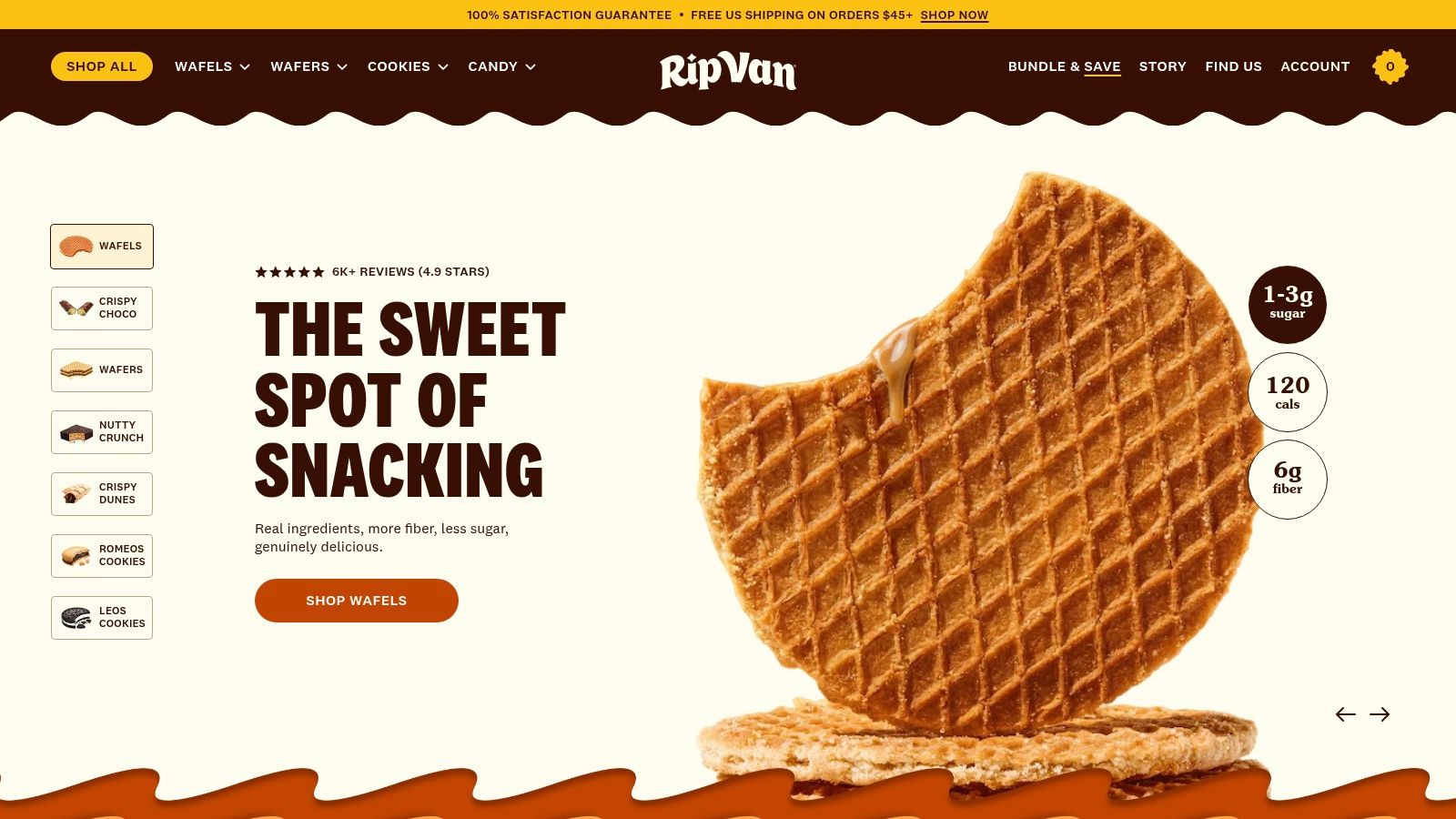
The practical question is how a product performs against the criteria above. Read the package for total carbohydrate, fiber, added sugar, serving size, and any dietary filters relevant to you. The brand offers browsing categories such as gluten free, low sugar, keto, and vegetarian, which can narrow the selection, but a category label still shouldn't replace the Nutrition Facts panel.
An individually wrapped wafer can suit a desk drawer because it limits handling and makes portioning straightforward. It also works well when your main problem is a sweet craving rather than substantial hunger. If you need the snack to carry you through a delayed meeting, pair the wafer with a dry food such as almonds or seeds. For a refrigerated pairing, add cheese or plain yogurt only when you can control temperature.
Use packaged treats strategically: Let the sweet item solve the craving, then add a food that solves the hunger.
A packaged snack doesn't automatically provide enough protein, and lower sugar doesn't automatically mean low sodium or minimally processed. It also shouldn't displace vegetables, fruit, eggs, yogurt, nuts, seeds, or other whole-food choices across the workweek. The strongest use case is a planned portion in a desk kit, especially when the alternative is an unplanned vending-machine purchase.
This short video offers another way to see how a portable wafer can fit into a workday snack routine.
Common Workplace Snack Mistakes and How to Avoid Them
Most office snack problems come from mismatched expectations. People choose a product for one attractive feature, then discover that it fails on storage, satiety, portion size, or taste.
| Common mistake | Why it fails | More practical correction |
|---|---|---|
| Trusting the front label | “Low carb,” “keto,” or “zero sugar” can hide inadequate fiber, high sodium, or limited satiety. | Read total carbohydrate, fiber, added sugar, protein, fat, and serving size together. |
| Packing only perishable foods | A boiled egg, yogurt, or deli-meat roll-up becomes a safety problem if it sits warm. | Carry a cold source, use an insulated container, or keep shelf-stable backups. |
| Eating from a family-sized bag | The package makes repeated handfuls feel like one serving. | Portion nuts, seeds, and crisps at home before bringing them to work. |
| Choosing taste without checking composition | A snack can satisfy a craving while contributing little fiber and too much sodium or saturated fat. | Keep the preferred flavor, then pair it with a more nourishing food or rotate in a whole-food option. |
A cheese stick illustrates the first trade-off. It can be convenient and low in carbohydrate, but it doesn't contribute fiber. Sugar-free candy creates a similar problem from the opposite direction, it may satisfy a sweet taste without providing the protein, fat, or fiber that would make the eating occasion more substantial.
Storage mistakes need a hard boundary
Don't leave meat, eggs, prepared dishes, yogurt, or cut vegetables in a desk drawer just because the office feels cool. Air conditioning isn't a substitute for temperature control. If the refrigerator is full, unreliable, or shared with unclear date practices, choose an ambient-stable option instead.
Portion mistakes are often packaging mistakes
A large bag of nuts can be economical, but it requires a portioning routine. A small container or pre-filled bag gives you a stopping point before you start answering messages and eating automatically. The same principle applies to cookies, wafers, and cheese crisps. Keep one planned portion accessible and store the rest out of immediate reach.
Myths About Low-Carb Office Snacking That Are Holding You Back
Myth one, low carb means eliminating enjoyable food. A planned sweet snack can fit a structured workday, particularly when you pair it with a more filling food instead of treating it as the entire snack.
Myth two, you need perfect refrigeration. Shelf-stable options can make a sensible desk kit possible when the office fridge is crowded or your schedule changes.
Myth three, homemade is always better. Homemade food gives you ingredient control, but a portion-controlled packaged snack may be more realistic than a homemade option that gets forgotten, crushed, or stored unsafely.
Myth four, “keto” and “zero sugar” guarantee quality. FDA labeling guidance makes clear that you still need to examine serving size, fiber, and the broader Nutrition Facts panel. Low carbohydrate doesn't automatically mean low sodium, low saturated fat, or nutritionally complete.
Myth five, low-carb snacking is only for dieters. The useful principle is broader: choose a snack that matches your hunger, nutrition goals, storage conditions, and workday. The best plan is the one you can repeat without relying on perfect circumstances.
Rip Van offers portable wafels, wafers, wafer bars, cookies, and crispy snack varieties designed for lower-sugar, convenient snacking, with product pages that help you review dietary details. Visit Rip Van to explore options for your desk drawer, commute, or planned afternoon snack, then pair your choice with the storage and nutrition strategy that fits your workday.
0 comments