

You're standing in the snack aisle, looking for something familiar, portable, and easy to share. A package of vanilla sandwich cookies seems harmless because the flavor is simple and the cookies are small. Yet the same product can function as a quick sweet bite, a lunchbox treat, or a dessert depending on its sugar, fiber, portion size, and overall formulation.
That distinction matters. Vanilla sandwich cookies remain popular because they combine a crisp biscuit with a smooth vanilla creme, but “vanilla” and “reduced fat” don't automatically mean nutritionally light. The smarter question isn't whether you can ever eat them. It's whether the cookie fits the job you need it to do.
Why Vanilla Sandwich Cookies Still Win Hearts
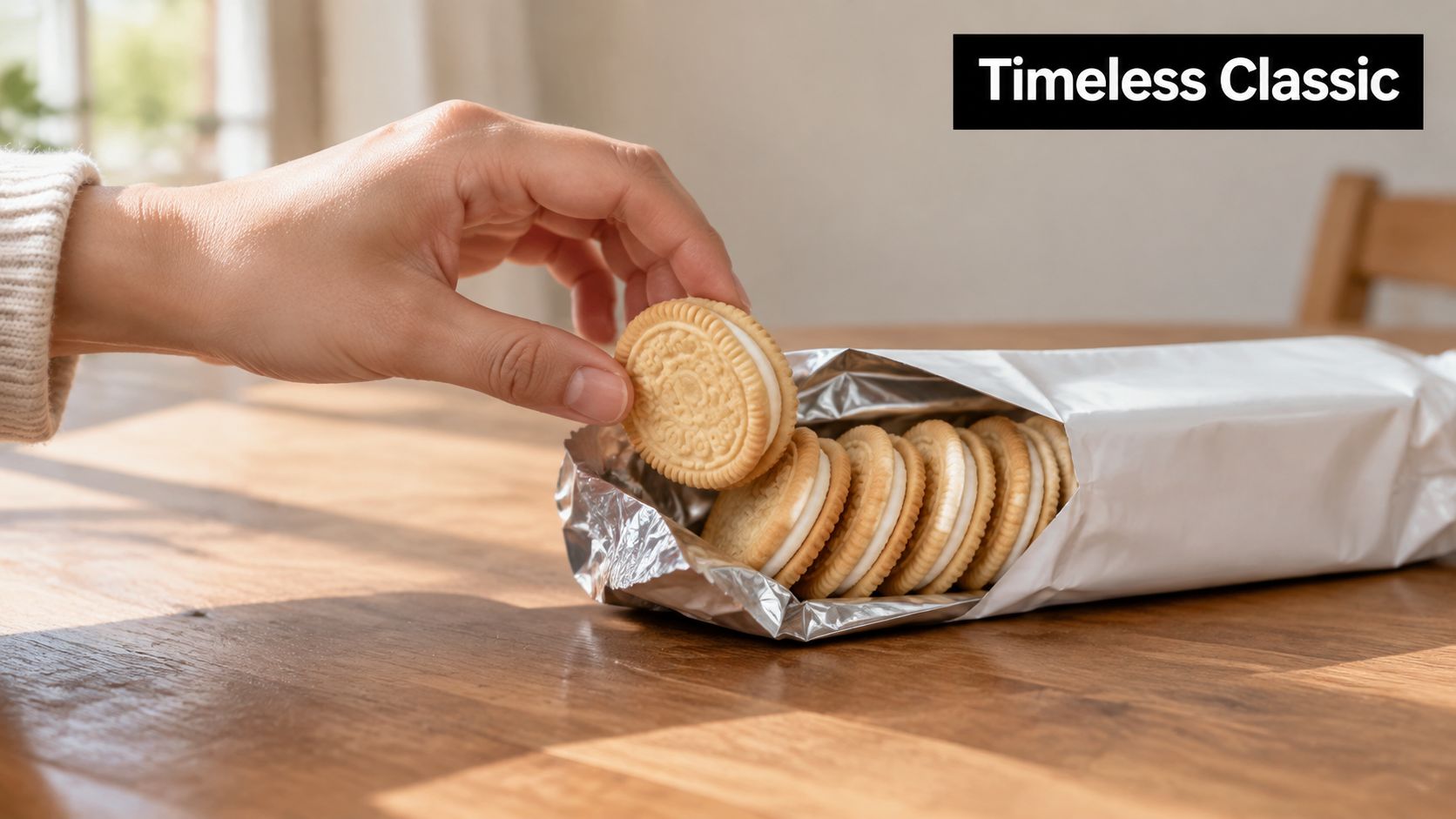
A child opens the pantry after school. An adult reaches for the same package during an afternoon slump. The appeal is immediate: two crisp rounds, a sweet center, and a texture that travels well in a lunchbox, desk drawer, or car bag. Vanilla sandwich cookies offer a predictable taste, which is one reason they keep returning to shopping lists even as consumers pay closer attention to sugar and ingredients.
Their staying power also reflects the scale of the category. The global cookie market was estimated at $39.6 billion in 2023 and is projected to reach $54.9 billion by 2030, with a projected 4.7% CAGR, according to Grand View Research's cookies market analysis. North America represented a reported 38% regional share, while sandwich cookies accounted for about 29% of the overall cookies market in the same broader market context.
That makes the sandwich format more than a nostalgic curiosity. Another industry source places sandwich cookies at 25% of U.S. cookie sales and reports annual cookie consumption of about 6.1 pounds per person in the United States, compared with a global average of 2.3 pounds. These figures help explain why a familiar cream-filled cookie still has a strong role in developed snack markets.
Familiarity is part of the product
Vanilla works because it's broadly recognizable and easy to pair with coffee, milk, tea, fruit, or ice cream. It also leaves room for different textures, from firm and crisp wafers to softer biscuits and thick creme centers. A related filled-snack format, the stroopwafel, shows how the sandwich idea can evolve without losing its basic appeal.
Sweet cravings can also arrive after a meal, when people want a small sensory finish rather than a full snack. Readers interested in the biology and timing of that experience can explore this overview of craving sweets post-meal biology.
The useful mindset is balanced. Vanilla sandwich cookies can stay enjoyable, but their packaging, serving size, and nutrition label deserve as much attention as their flavor.
What Makes a Vanilla Sandwich Cookie
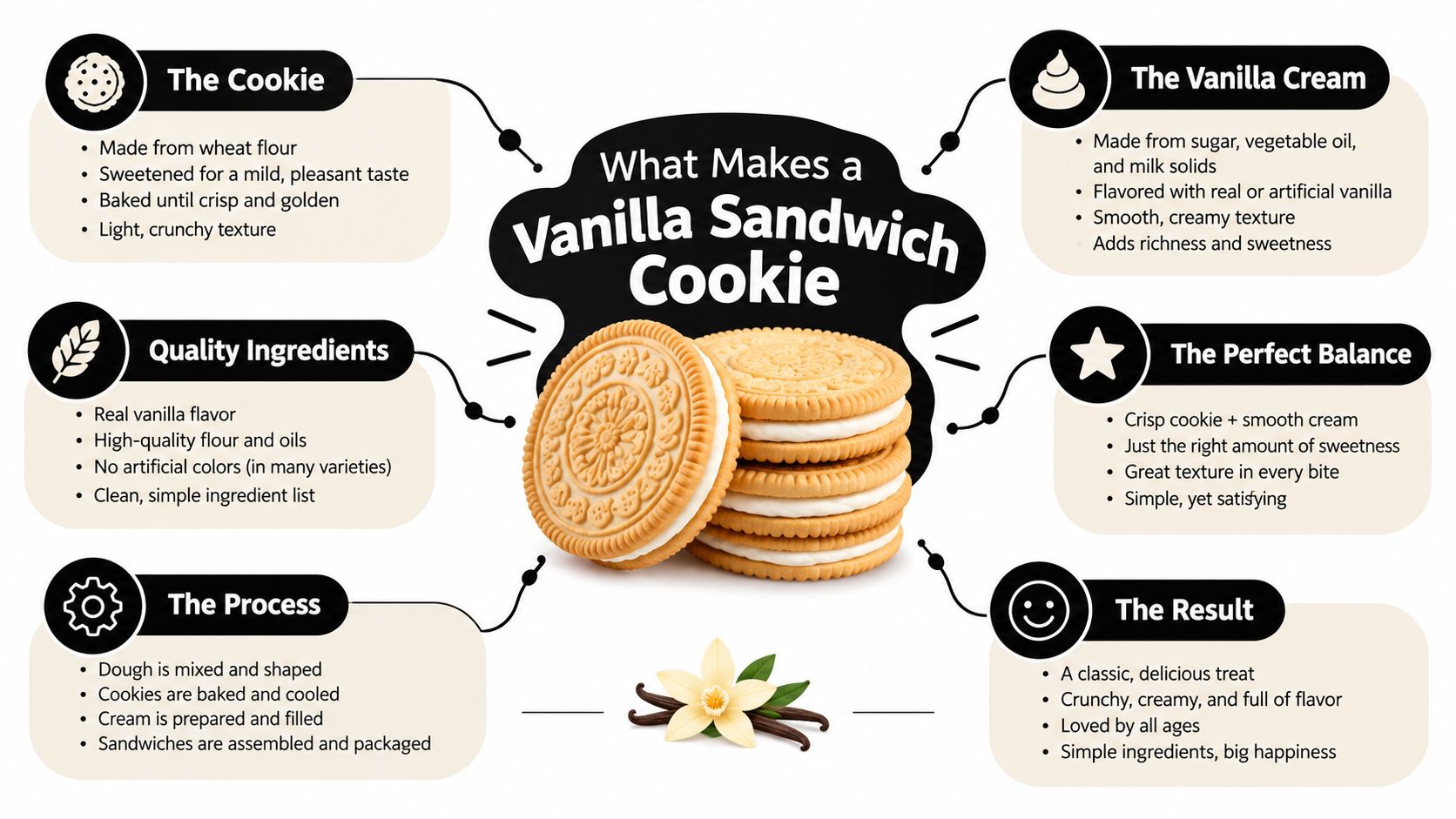
At its simplest, a vanilla sandwich cookie is a small edible sandwich. The biscuit or wafer provides structure and crunch, while the creme filling supplies sweetness, fat, smoothness, and the central vanilla flavor. The final experience depends on how those two parts are balanced.
Start with the biscuit
The outer layers may be made from a baked flour-based dough or a thinner wafer-style mixture. Their job is to stay intact during handling and provide contrast against the filling. A drier, crisper shell gives a clean snap, while a softer biscuit creates a more cake-like bite.
The biscuit also carries much of the cookie's carbohydrate content. Ingredients such as flour, sugar, and added fat shape its browning, tenderness, and resistance to breakage. The exact recipe varies, but the principle stays the same: the shell must be sturdy enough to hold the creme without becoming unpleasantly hard.
Then consider the creme
The center isn't “vanilla flavor.” It contributes sweetness, smoothness, aroma, and mouthfeel. Fat helps create a creamy texture, while sweeteners provide the familiar dessert-like taste. Vanilla may come from an extract, natural flavor, or a more specific vanilla ingredient, so the ingredient list tells you more than the front label.
Think of the filling as the spread in a sandwich. A thin layer lets the biscuit dominate. A thicker layer makes the cookie softer, sweeter, and more filling-like in texture, but it can also increase the contribution from sugar and fat.
Texture depends on moisture
A packaged cookie is designed around stability. The biscuit must remain crisp while the creme stays smooth, so manufacturers manage moisture and packaging carefully. Once a package is opened, moisture from the surrounding air can migrate into the crisp shell. That softens the biscuit and changes the intended cookie-to-creme contrast.
The result is why a cookie can still be safe to eat yet taste stale or chewy. Product design isn't only about ingredients. It's also about how the cookie behaves from the factory to your pantry.
The Nutrition Reality Behind the Sweetness
Most vanilla sandwich cookies are better understood as small desserts than as filling snacks. A typical 1 ounce, or 28 gram, serving averages about 137 calories, 6 grams of fat, 20 grams of carbohydrate, 11 grams of sugar, 1 gram of protein, and 0.4 grams of fiber, according to the nutrition data summarized by Eat This Much.
Those numbers tell a clear story. The cookie supplies energy mainly from carbohydrate and fat, while protein and fiber remain low. Because protein and fiber often help a snack feel more substantial, a few cookies may satisfy a sweet craving without keeping hunger away for very long.
A separate USDA-derived entry lists about 48 calories per round, with roughly 2 grams of fat, 7.21 grams of carbohydrate, 0.15 grams of fiber, and 0.45 grams of protein per cookie. The serving format changes the arithmetic, so don't compare products until you've converted them to a similar amount.
Sugar density matters more than the flavor name
“Vanilla” describes taste, not nutritional quality. One USDA-sourced entry lists 493 calories, 46.7 grams of sugar, and 0.5 grams of fiber per 100 grams for a vanilla sandwich cookie with creme filling, as reported by Nutriverdict's nutrition entry.
A reduced-fat version in the same source lists 423 calories, 78.2 grams of carbohydrate, 354 milligrams of sodium, and 2.1 grams of fiber per 100 grams. Reduced fat may sound healthier, but replacing fat can leave a product with substantial carbohydrate or sugar. The label needs to confirm the tradeoff rather than the claim doing it for you.
Label lesson: A better-for-you cookie should earn that description through its sugar and fiber profile, not through words such as “vanilla,” “light,” or “reduced fat.”
Shelf stability changes the bite
Commercial sandwich cookies are generally shelf-stable, but opening the package starts a quality countdown. Shelf-life guidance summarized by Cooklist's sandwich-cookie information places unopened products around the printed date, commonly 6 to 9 months, while opened packages are typically best within 1 to 2 weeks when tightly sealed. Freezing can extend usable life to roughly 3 to 4 months.
That guidance concerns quality as well as storage. An airtight container helps limit moisture migration, preserving the crisp shell and the contrast that makes the sandwich format enjoyable. For nutrition decisions, focus first on serving size, added sugar, fiber, and protein.
Traditional Versus Better For You Alternatives Compared
The meaningful difference between a traditional vanilla sandwich cookie and a better-for-you alternative usually appears in the formulation, not the flavor description. A classic cookie may prioritize sweetness, crispness, and a long pantry life. A reformulated option may use more fiber, less sugar, or a different sweetening system to make the snack more compatible with portion-conscious eating.
The comparison below is a decision framework, not a claim that every product in either category follows one exact recipe.
| Attribute | Traditional Vanilla Sandwich Cookie | Better For You Alternative |
|---|---|---|
| Sugar | Often a major source of calories and sweetness | Looks for a lower-sugar profile, checked against the serving size |
| Fiber | Commonly low, with little effect on fullness | Adds meaningful fiber as part of the recipe |
| Protein | Usually modest | May remain modest, so pairing can still matter |
| Sweeteners | May rely heavily on added sugar | May use a lower-sugar sweetening approach |
| Ingredients | Formulated primarily for familiar taste and texture | May emphasize simpler positioning, natural flavors, or selected exclusions |
| Portion design | Often sold as a standard cookie serving | May use smaller or individually convenient formats |
| Best role | Dessert or occasional sweet snack | Treat-like snack that may fit portion-controlled routines |
Why the serving panel comes first
A front-of-pack claim can't tell you how much sugar or fiber you'll consume. Compare the serving size, then examine total carbohydrate, added sugar, fiber, and protein. If the label uses a small serving that doesn't match how you eat, calculate the amount for your realistic portion.
Fiber deserves special attention because it changes the density of the snack. A cookie with more fiber may be more satisfying than a nutritionally similar cookie with little fiber, but it still belongs in the context of your overall diet. “Higher fiber” isn't permission to ignore sugar or eat without limits.
Where product examples fit
Rip Van's LEOS and Romeos illustrate the type of product positioning shoppers may encounter in this category. The brand describes these cookie lines around lower sugar, higher fiber, and exclusions such as corn syrup and artificial sweeteners. Treat that information as a starting point, then verify the current package label because recipes and serving panels can change.
The broader snack aisle also includes other recognizable formats. If you're comparing vanilla sandwich cookies with coffee-shop accompaniments, this guide to make your café a Biscoff destination offers useful context on how another biscuit format is positioned for pairing and serving.
A practical comparison rule: Choose the product whose nutrition panel matches your goal, not the package whose health language sounds most reassuring.
When and How to Enjoy Them Without Overdoing It
Vanilla sandwich cookies work best when you give them a clear role. In a lunchbox, they can be a sweet element alongside fruit and a more substantial food. At an office desk, they may be an intentional treat rather than an automatic response to every afternoon craving. The same cookie feels different when you eat it mindfully with a drink instead of repeatedly reaching into an open package.
Match the format to the occasion
Snack trends increasingly favor portable, bite-size, mini, and hybrid baked goods. Mondelēz reported that the share of global consumers eating biscuits or cookies at least weekly increased by 5% in the last year, and Baking Business summarized the survey as 66% of adults across 13 international markets eating biscuits or cookies weekly or more often, as reported in the company's State of Snacking survey release.
That shift creates an opportunity, but convenience doesn't automatically create balance. Smaller formats can make portions easier to see and carry, while higher-fiber and lower-sugar formulations can improve the nutritional tradeoff. A mini cookie is useful when it helps you decide how much to eat, not when it encourages repeated handfuls.
Try these practical pairings:
- For a lunchbox: Add a cookie to fruit and a meal or snack that offers more protein.
- For an afternoon break: Pair the cookie with milk or yogurt, then eat it seated rather than from the package.
- For travel: Use a small container or pre-portioned packet so the serving is decided before hunger takes over.
- For dessert: Put the cookie on a plate and enjoy it as the sweet finish, instead of treating it as an invisible extra.
The infographic recommends a small portion and a pairing that adds substance. That's especially helpful for children, who may enjoy the cookie intensely but not recognize how quickly portions grow.
Keep the texture worth eating
After opening, transfer cookies to a tightly sealed container. Moisture migration can soften the biscuit, so airtight storage protects the crispness and keeps the filling-to-cookie contrast more appealing. If you freeze them, use packaging that limits air exposure and allow them to return to room temperature before judging texture.
The right question isn't “Can this be an everyday food?” It's “What does this snack need to accomplish today?” If you need lasting fullness, a cookie alone may not be enough. If you want a measured sweet bite, a deliberate portion can work well.

How to Choose a Smarter Vanilla Sandwich Cookie
A smarter choice starts with the label, not the package design. Read it in a consistent order: serving size, sugar, fiber, protein, then ingredients. This sequence helps separate a useful swap from a cookie that only sounds healthier.
Use this quick label sequence
- Find the serving size. Check whether it matches the amount you would eat. If you expect to have more, adjust the nutrition numbers mentally before comparing products. The serving size is the ruler for every value that follows.
- Check added sugar. Vanilla flavor does not reveal how sugar-dense a cookie is. Compare products using similar serving sizes, then look for a lower-sugar option that still fits your taste and routine.
- Look for fiber. Fiber can make a cookie's nutrition profile more substantial than one built mostly around refined carbohydrate and fat. It does not make a cookie a complete meal, but it can matter when comparing everyday snack options.
- Review protein realistically. Many sandwich cookies contain little protein. If staying satisfied matters, consider whether the cookie will be eaten with milk, yogurt, nuts, or another protein-containing food.
- Read the ingredient list. Identify the sweeteners, fats, flavorings, and ingredients you prefer to limit. “Natural” and “reduced fat” describe selected features, not the whole recipe, so check those claims against the full panel. For a broader checklist, see this guide to better-for-you cookies.
- Consider the format. Individual packs, smaller cookies, and resealable packaging can make a portion easier to see and follow. They are helpful tools, not proof that a cookie is nutritionally better.
For a detailed explanation of serving sizes, daily values, and ingredient panels, use this practical guide on how to read nutrition labels.
Rip Van offers LEOS and Romeos as examples of products positioned around lower sugar and higher fiber, with no corn syrup or artificial sweeteners according to the brand's product information. Since the company sells through its website and retail partners, compare the current package details with other choices before buying.
A useful final check is simple: Does this cookie support my goal, or does the packaging merely sound supportive? The answer should come from the serving size, sugar, fiber, and ingredient list.
Final Thoughts on Snacking Smarter With Vanilla Favorites
Vanilla sandwich cookies don't need to disappear from your pantry. They need a more accurate label in your mind. Treat them as sweet, energy-dense foods whose usefulness depends on the portion, the formulation, and what you eat alongside them.
The most valuable shift is from flavor-first thinking to sugar-and-fiber-first thinking. Vanilla tells you what the cookie tastes like. Sugar, fiber, protein, serving size, and ingredients tell you how well it fits your snack routine.
Format matters, too. Portable and portion-controlled cookies can suit lunchboxes, commutes, and office breaks, but convenience works best when the serving is visible and intentional. A cookie paired with fruit, yogurt, or milk may feel more complete than cookies eaten alone from a large opened package.
Better-for-you claims should still receive scrutiny. Look for lower sugar, useful fiber, a serving size you can follow, and an ingredient list that matches your preferences. Then enjoy the cookie without turning a practical food decision into an all-or-nothing rule.
If vanilla sandwich cookies are part of your routine, compare a traditional option with a lower-sugar, higher-fiber alternative and notice how each fits your hunger, cravings, and schedule. That small experiment can turn the snack aisle from a source of confusion into a place where you choose deliberately.
Rip Van offers portable LEOS and Romeos cookies alongside other lower-sugar snack formats, with product information focused on higher fiber and no corn syrup or artificial sweeteners. Visit Rip Van to compare current options and choose a vanilla-style treat that fits your portion and snacking goals.
0 comments