

The global wafer biscuits market was estimated at USD 58.7 billion in 2024, with a projected 5.6% CAGR from 2024 to 2030, according to Strategic Market Research's wafer biscuits market analysis. That scale changes how we should think about wafer bars. They aren't just small chocolate treats from a vending machine. They're part of a mature, worldwide snack category shaped by portability, portion control, texture, and increasingly, demands for lower sugar, more fiber, and better satiety.
The more useful question isn't whether a wafer bar looks light. It's whether its crisp structure, filling, wrapper, and nutrition label work together to make a sensible snack. Once you understand why wafers soften, you can read the ingredient list and packaging with much sharper judgment.
A Snack That Clicks
You tear open a bar between meetings. The first layer makes that clean, delicate snap, followed by the softer give of cream underneath. It's a satisfying contrast, and it explains why wafer bars occupy such a distinctive place between a cookie, a candy bar, and a granola snack.
A wafer bar usually consists of thin, crisp baked sheets stacked with a flavored cream or spread. The finished bar may receive a chocolate, yogurt-style, or other coating. Some versions are airy and delicate, while others use denser fillings, nuts, cocoa, or protein ingredients to create a more substantial bite.
That familiar vending-machine wafer tends to emphasize sweetness and chocolate coating. Newer options take a different approach, using smaller portions, more fiber, less sugar, or alternative sweeteners. The result still feels indulgent, but the label may fit more comfortably into a snack routine.
The important distinction: A wafer bar's light texture doesn't automatically make it nutritionally light.
The category has deep roots and broad reach. Wafer biscuits originated in Europe and developed from simple layered biscuits into many shapes, flavors, and coated formats, helping them spread into major international markets, as described in Research and Markets' overview of wafer biscuits. Europe represented about 32% of the global wafer biscuit market in 2024, while Asia-Pacific accounted for roughly 27%, and coated wafers made up around 41% of product-type share in that market report.
That combination of tradition and flexibility gives wafer bars unusual staying power. They can serve as a nostalgic chocolate treat, a lunchbox snack, a coffee companion, or a better-for-you product designed around fiber and lower sugar.
The practical questions are straightforward. What's inside a wafer bar? And how can you tell whether a supposedly smarter option offers meaningful nutritional advantages or wears healthier-looking packaging?
How a Wafer Bar Is Built
A wafer bar starts with a thin batter, not a conventional cookie dough. Flour, water, and sometimes milk powder are mixed into a fluid base, then baked between hot plates. The heat drives off moisture and creates a delicate sheet filled with tiny air spaces.
The finished wafer is technically a highly aerated, anisotropic foam. In everyday language, that means gas cells are dispersed through a gelatinized starch matrix, producing low density and a crisp bite. Technical research describes flat and hollow wafers with specific gravity at or below 0.2 g/cm³, while residual moisture after baking typically sits around 1% to 2% in the technical review of wafer structure and texture.
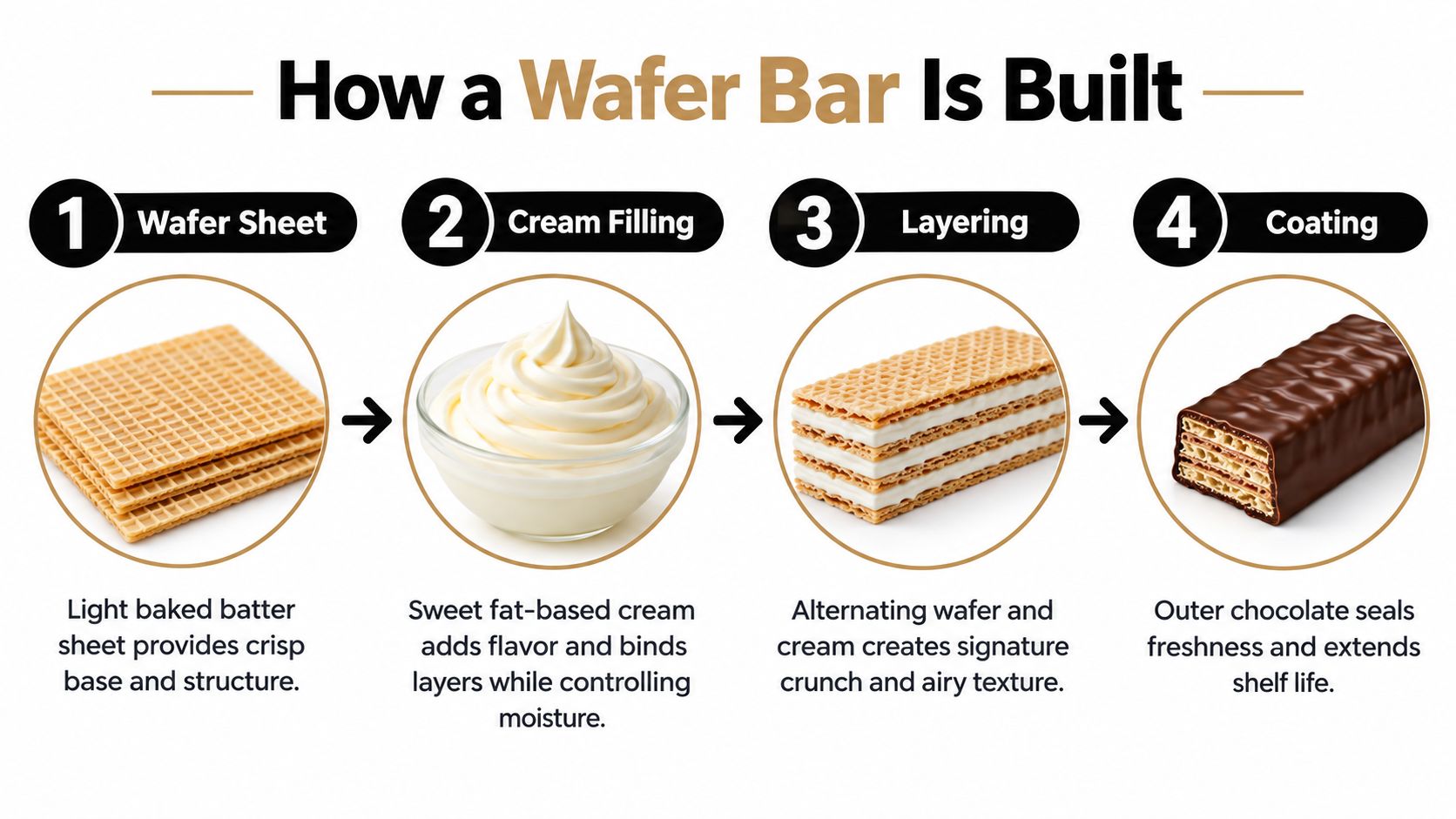
Four layers, four jobs
- The wafer sheet provides the airy crunch. Its low moisture is essential, but it also makes the sheet vulnerable to humidity.
- The cream filling bonds the layers and supplies most of the flavor. Cocoa, hazelnut, vanilla, fruit flavorings, nuts, and other ingredients are commonly carried in a fat-and-sugar matrix.
- Layering creates the signature alternating texture. Each bite moves between brittle wafer and smoother filling, rather than chewing like a solid cookie.
- The outer coating, when present, adds flavor and a second textural contrast. Chocolate or a yogurt-style coating can also slow moisture movement, depending on the formulation and package.
The science explains why a bar can taste fresh on one day and soft on another. When moisture rises to about 6% to 7%, the starch-protein matrix leaves its glassy state and becomes mechanically softer, so the wafer loses its crispness. Moisture uptake, rather than ordinary staling alone, is the central failure mode for many wafer products.
Packaging therefore does more than make a bar look tidy. Flow-wrap film, sealed cups, and intact seams help control water-vapor exposure and headspace humidity. A torn seal can let humidity reach the wafer quickly, especially during storage in a warm or damp environment.
For a useful visual explanation of the layers, Rip Van's inside-the-wafer guide offers a closer look at how the format is assembled.
The manufacturing story continues after baking. Producers stack the sheets, spread or deposit the filling, cut the slab into portions, apply the coating if needed, and seal the finished pieces. This short video showing wafer production helps connect the crisp bite in your hand to the controlled baking and packaging steps behind it.
What Better-for-You Really Means
“Better-for-you” can describe a meaningful improvement, or it can describe a smaller-looking treat. The wafer itself offers little nutritional benefit, and many conventional versions remain centered on refined carbohydrates, sugar, and fat. Independent nutrition guidance on a Kit Kat wafer bar nutrition profile illustrates why shoppers need to look beyond the airy texture.
For comparison, a mainstream chocolate wafer bar may provide roughly 200 to 230 calories, 10 to 13 grams of added sugar, and only 1 to 2 grams of fiber per 40-gram bar. Those figures don't make the food forbidden, but they do position it closer to a conventional candy treat than a sustaining snack.
A better-for-you design aims to improve the balance. A low-sugar bar might target 5 grams of sugar or fewer, while a higher-fiber version may provide 3 or more grams of fiber. A shorter ingredient list can also help shoppers understand what they're buying, though ingredient count alone doesn't determine nutrition.
| Nutrient per 40g bar | Mainstream Wafer Bar | Low-Sugar Wafer Bar | High-Fiber Wafer Bar |
|---|---|---|---|
| Calories | Roughly 200 to 230 | Check the package | Check the package |
| Added sugar | Roughly 10 to 13g | 5g or fewer as a useful target | Compare with the full label |
| Fiber | Roughly 1 to 2g | Look for a meaningful contribution | 3g or more as a useful target |
| Protein | Often limited | Varies by formulation | Varies by formulation |
The trade-offs matter
Sugar alcohols and allulose can reduce the amount of conventional sugar in a recipe, but they aren't automatically comfortable for everyone. Larger amounts may cause digestive discomfort, and the verified guidance for this comparison flags potential gut effects above 15 grams per day. Check the quantity, not just the marketing claim.
Keto shoppers should examine net carbohydrates, while anyone seeking fullness should check protein and fiber together. Also scan for hydrogenated oils, high-fructose corn syrup, and artificial colors if those ingredients don't fit your preferences.
A lower sugar number is useful, but it isn't the whole story. A bar can advertise low sugar while contributing little fiber or protein, leaving you with the same short-lived satisfaction as a standard sweet.
For a practical look at how low-sugar wafer recipes approach sweetness and texture, explore Rip Van's low-sugar wafer cookie discussion. Use it as a formulation reference, then verify the numbers on the package in front of you.
Wafer Bar Formats Worth Knowing
The better-for-you wafer aisle doesn't contain one single formula. It includes several design strategies, and each one solves a different shopper problem. Keto bars prioritize low net carbohydrates, low-sugar bars reduce conventional sweeteners, and high-fiber bars try to make a light snack more filling.
| Format | Typical Net Carbs | Typical Added Sugar | Typical Fiber | Primary Fat Source | Texture Cue |
|---|---|---|---|---|---|
| Keto | Under 5g as a formulation target | Low or reduced | Varies | MCT or cocoa butter may appear | Dense snap, often less airy |
| Low-sugar | Varies by recipe | About 5 to 8g in representative formulations | Moderate or variable | Depends on filling | Airier wafer with a thin cream layer |
| High-fiber | Varies by recipe | Varies by recipe | About 5 to 10g in representative formulations | Depends on wafer and filling | Chewy-crisp when fiber is prominent |
These are formulation patterns, not universal guarantees. Always use the product's nutrition panel because two bars in the same category can have very different sugar, fiber, protein, and calorie profiles.
What changes in the bite
Keto formulas may use cocoa butter or MCT-rich fats to keep the product cohesive while limiting carbohydrate-heavy ingredients. That can create a firm, dense snap rather than the fragile crunch of a traditional wafer.
Low-sugar bars often preserve the airy structure by using a thinner filling and alternative sweeteners such as monk fruit, allulose, or erythritol. The flavor may feel less immediately sweet, with cocoa, nuts, salt, and vanilla doing more of the sensory work.
High-fiber products can go in either direction. Fiber baked into the wafer may retain some crispness, while fiber added through a filling can produce a slightly chewy finish. Ingredients such as chicory root, inulin, or whole-grain layers may help the fiber number, but they can also affect texture and digestive comfort.
Shopping cue: Choose keto for carbohydrate control, low-sugar for sweetness management, and high-fiber when fullness is the main goal.
The setting matters, too. A gym vending program may need individually wrapped snacks that tolerate transport, offer recognizable nutrition cues, and fit different dietary preferences. Expert tips on vending for gyms can help facility managers think through placement, assortment, and practical stocking decisions without treating every customer as if they wants the same kind of bar.
How to Choose a Smarter Wafer Bar
Start with the ingredient list, not the front of the package. Marketing language highlights what the manufacturer wants you to notice, while the ingredient panel shows the recipe in descending order by weight.
Look for recognizable ingredients such as cocoa, oats, nuts, cocoa butter, eggs, or other familiar components. A long list isn't automatically bad, but a formula dominated by syrups, maltodextrin, and palm oil deserves closer inspection, especially if the nutrition panel offers little fiber or protein in return.
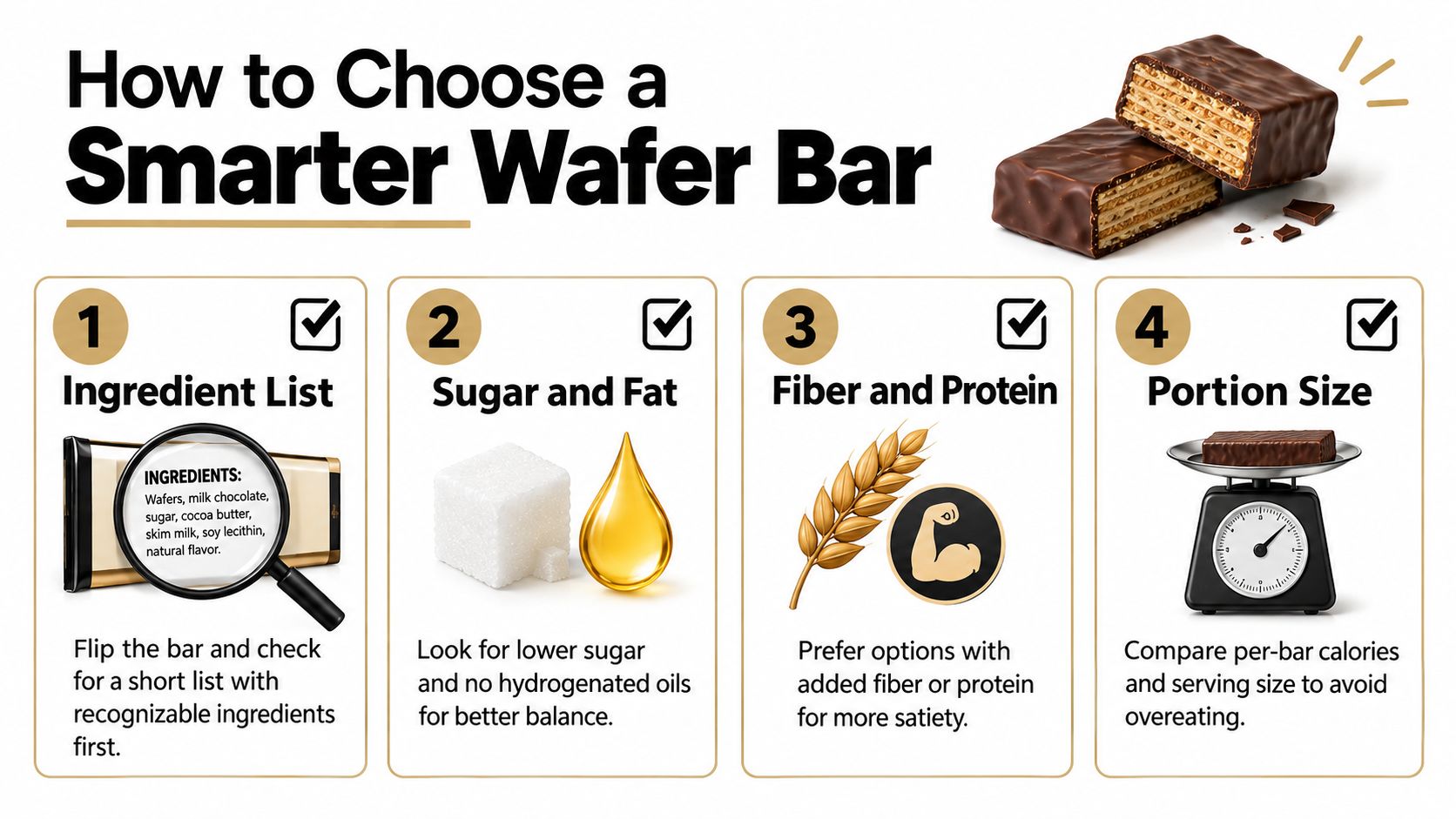
A label-first routine
- Check the serving size. Confirm that the listed values describe one bar, not half a bar or a serving that's easy to exceed. A single-serve wrapper can make the portion clearer and protect the wafer from humidity.
- Review added sugar and fiber. As a practical screen, look for added sugar under 6 grams and fiber above 3 grams when those goals match your diet. These are decision targets, not universal rules.
- Consider fat quality and calories together. Saturated fat may fit comfortably in one person's eating pattern and not another's. Compare the total with the rest of your day rather than judging the word “fat” in isolation.
- Inspect the package. An intact seal, individual wrapping, and a clear best-by date support freshness. A damaged seam can compromise crunch regardless of how appealing the nutrition claims look.
Three green flags and three red flags
Green flags
- Meaningful fiber or protein: The bar contributes something beyond sweetness and refined starch.
- Transparent portioning: The serving size matches the actual bar you'll eat.
- A protected package: The wrapper feels sealed, clean, and undamaged.
Red flags
- Health language without substance: “Light” or “fit” claims paired with minimal fiber and high sugar.
- A syrup-heavy recipe: Multiple sweetening ingredients can make the front-of-pack claim look better than the overall formula.
- Stale texture: A soft, leathery wafer may signal moisture exposure, even if the date hasn't passed.
You can also compare brands by looking at wafer cookie brand differences, but the package in your hand remains the final authority. Formulas change, and the label tells you what that particular product contains.
Why Rip Van Wafer Bars Stand Out
The useful way to evaluate Rip Van is to apply the same criteria used for any other wafer bar. Its Crispy Dunes and Crispy Choco products are built around thin wafer layers, cream fillings, and individually wrapped portions, while the product range includes flavors such as dark chocolate, hazelnut, and vanilla.
That structure responds directly to the food science of crispness. Thin layers create the delicate bite people expect from wafers, while individual packaging limits repeated exposure to humid air after opening. The wrapper can't rescue a poorly formulated product, but package integrity gives a low-moisture wafer a better chance of staying crisp through storage and transport.
Rip Van's stated approach also emphasizes low sugar, higher fiber compared with many popular alternatives, natural flavors, no artificial colors, and no corn syrup or artificial sweeteners, as outlined in the brand information provided for this guide. Those claims should still be checked against the current package, especially because individual flavors can differ.
Where the design choices connect
A wafer bar succeeds when its sensory and nutritional decisions support one another. A thin, airy layer can make a portion feel satisfying without requiring a heavy base. A cocoa-butter-based filling or nut-centered flavor can add richness while helping the bar maintain a clean layered structure.
Dark chocolate, hazelnut, and vanilla work particularly well in this format because they complement the contrast between crisp sheet and smooth cream. Nut pastes and cocoa-butter-style fillings can be engineered into thin layers without introducing the same moisture concerns associated with wetter fruit fillings, although the finished package still needs strong protection.
From a label perspective, the relevant questions remain practical:
- Does the bar keep added sugar controlled?
- Does it provide useful fiber?
- Does the fat source fit your preferences?
- Is the portion individually wrapped?
- Does the ingredient list match the promise on the front?
That framework keeps the comparison grounded. Rip Van presents one example of a wafer-bar design that brings texture, portioning, packaging, and nutrition positioning into the same conversation. It doesn't mean every flavor suits every diet, and it doesn't eliminate the need to read the label.
Are Wafer Bars Actually a Smart Snack
A lighter bite can be useful, but “lighter” and “healthier” aren't synonyms. A wafer bar earns a place in your routine when its portion, sugar, fiber, protein, ingredients, and packaging make sense together.
Ask three questions before you buy or open one.
The three-question filter
Is the sugar load reasonable for the portion? A small bar with a concentrated filling can deliver more sweetness than its size suggests. Compare added sugar with the actual amount you plan to eat, not with the visual impression created by the airy wafer.
Does it offer fiber, protein, or both? These nutrients can make a snack more substantial than refined carbohydrate alone. If the bar contributes neither, treat it as a dessert-style snack.
Does the wrapper protect freshness? A sealed, individual package helps preserve the crisp texture that defines the product. If the seal is damaged or the wafer feels soft, the bar may no longer deliver the experience you expected.
A wafer bar can fit before activity when you want a portable carbohydrate source and don't need a full meal. It can work in a lunchbox when the portion is clear and the rest of the meal supplies more substantial nutrition. At a midafternoon desk slump, pairing it with milk, coffee, fruit, or yogurt may create a more balanced break than eating it alone.
Fruit or Greek yogurt may be the smarter choice when you need hydration, protein, or greater fullness. A wafer bar is still a reasonable option when you want crunch and chocolate, provided you recognize the role it plays rather than asking a confectionery-style snack to behave like a complete meal.
Storage and frequency matter. Keep the wrapper intact until you're ready to eat, avoid saving an opened bar for long, and use the nutrition panel to guide your portion. The honest verdict is simple: wafer bars can be smart snacks when the label supports the goal, but their delicate texture and appealing size should never substitute for nutritional scrutiny.
Rip Van offers individually wrapped wafer snacks and bars designed around crisp layers, smooth fillings, and lower-sugar, higher-fiber positioning across flavors such as chocolate, hazelnut, and vanilla. Visit Rip Van to compare the current options and choose a wafer bar that fits your own snack goals.
0 comments