

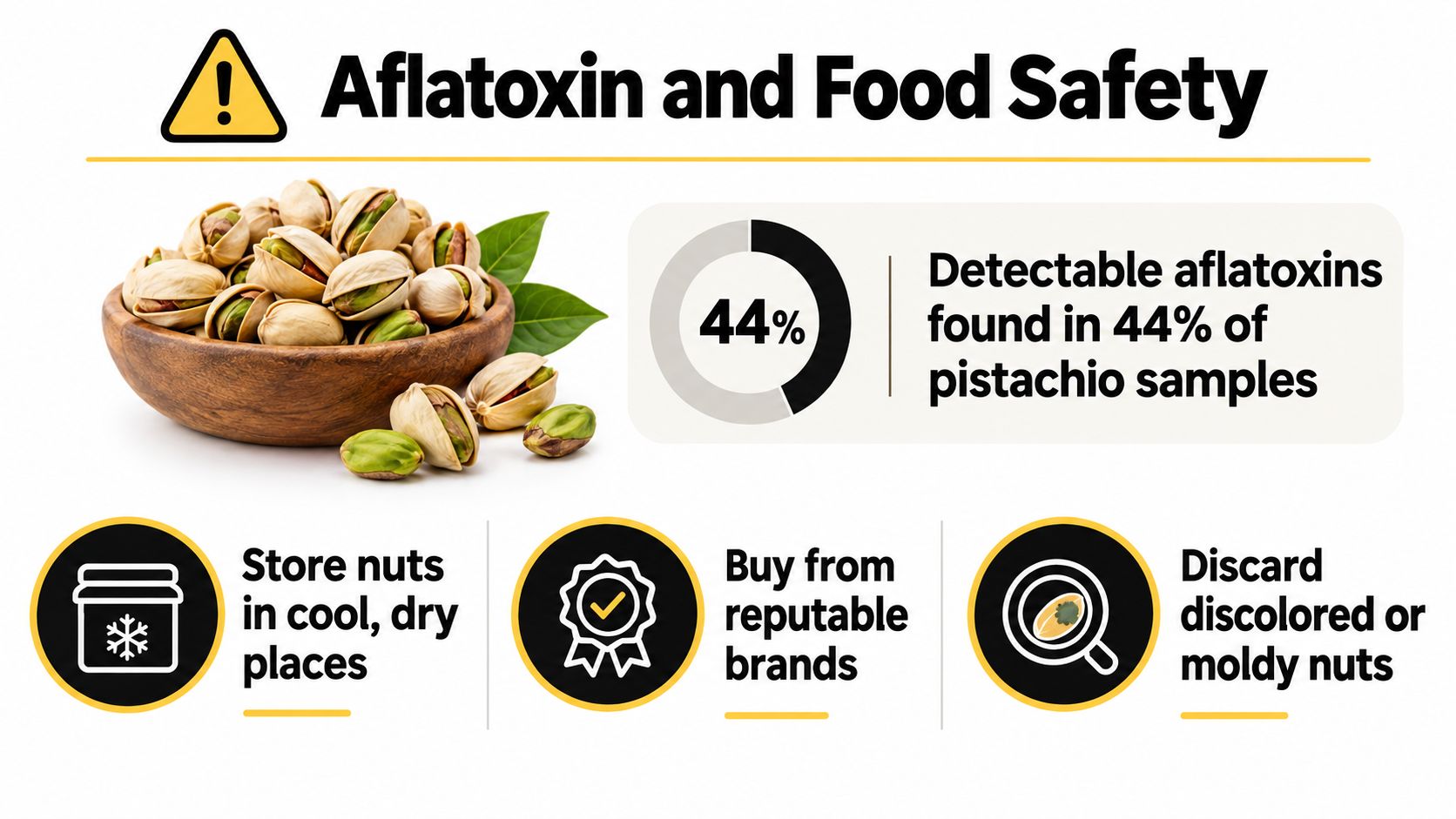
Aflatoxins were detectable in 44% of tested pistachio samples, compared with 10% of cashew samples. That result does not mean a package of pistachios is unsafe. It does show that comparing these nuts involves more than flavor and nutrition: growing, processing, storage, and related allergies also matter. Published testing on aflatoxins in pistachios and cashews offers a useful reminder that a “healthy snack” label alone is not a complete safety check.
Each nut also brings something different to the table. Pistachios offer a crunchy, fiber-rich option; cashews add creaminess to sauces and savory coatings. Knowing these differences can help you choose a snack or ingredient that suits your needs, shop thoughtfully, and recognize when allergy or food-safety questions call for professional advice.
Where Cashews and Pistachios Come From
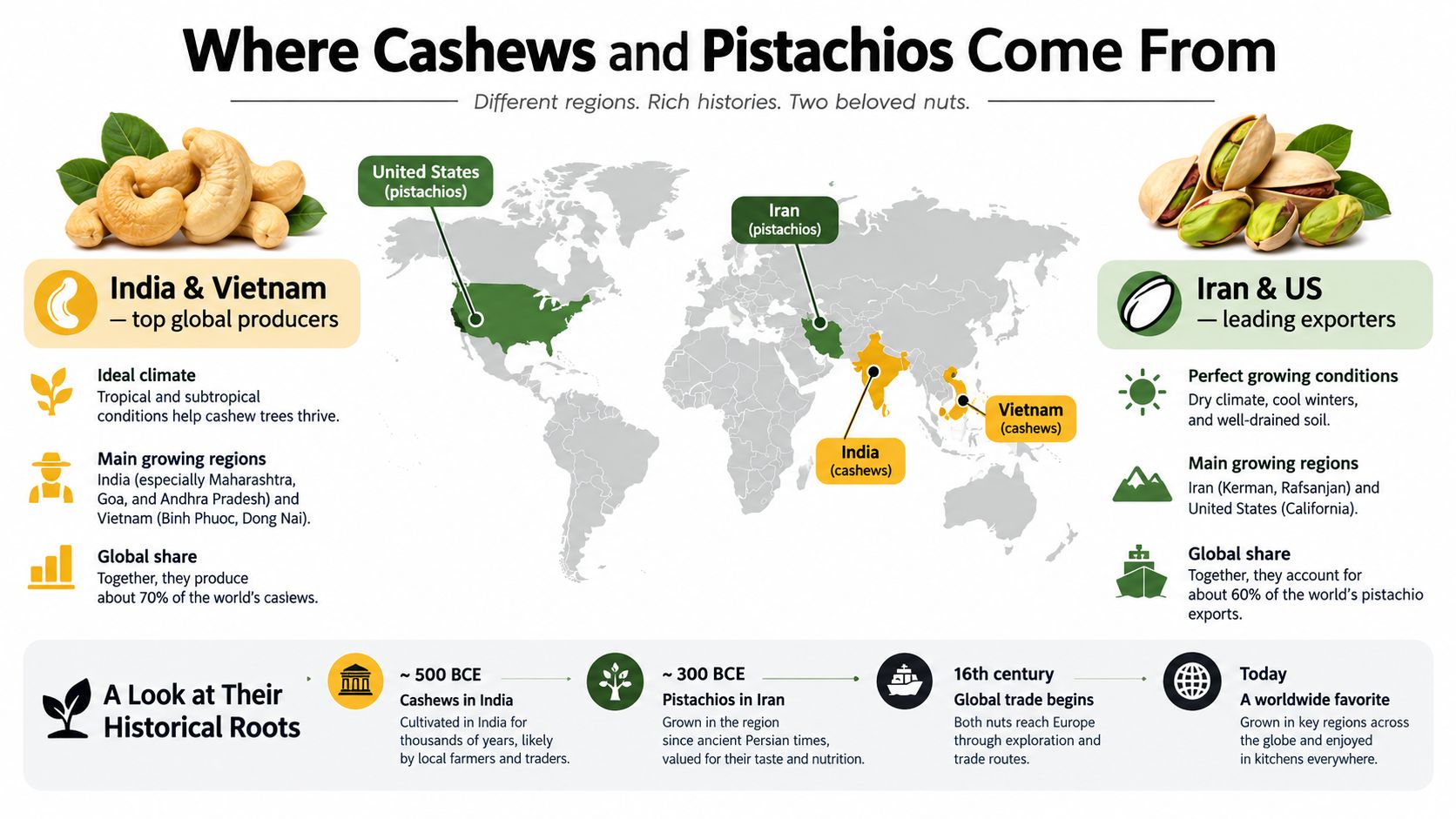
For the 2025/26 marketing year, global pistachio production was forecast at approximately 1.1 million metric tons, down 8% from the previous year. The outlook also projected U.S. output rising 43% to a record 713,000 metric tons, while production in Iran was projected to fall 11% to 200,000 metric tons amid heat and drought stress. These are forecasts, not final production results, and they show how conditions in a small group of growing regions can influence global supply. USDA's 2026 tree-nut market reporting also forecast record global pistachio exports of 683,000 metric tons, connecting producing regions with consumers around the world.
Different crops, different growing conditions
Pistachio trees need a dry climate with hot summers and cool winters. Production is concentrated in the United States, Iran, Türkiye, and Syria, so weather in those regions can have an outsized effect on the crop. Pistachios can also experience alternate-bearing cycles, meaning harvests may vary from year to year. For shoppers, that can help explain why availability and prices shift even when the nuts occupy the same grocery aisle.
Cashews follow another path. They're predominantly cultivated in tropical regions, especially West Africa, India, Vietnam, and parts of East Africa. Their growing conditions and production geography differ substantially from pistachios, so the two nuts don't share the same supply pressures.
A long history behind familiar snacks
Pistachios were domesticated in the Persian Empire roughly 3,000–4,000 years ago, in areas corresponding broadly to present-day Iran and neighboring Central Asia. Archaeological remains reported in Afghanistan and southeastern Iran point to consumption before systematic orchard cultivation. The crop later spread west through trade and empire-building, with historical accounts connecting its arrival in the Mediterranean to Roman expansion during the beginning of the Christian era. Scientific and archaeological literature on pistachio history also describes the cashew's different origins: the tree came from northeastern Brazil and spread through Portuguese colonial trade, especially to India and East Africa.
These histories help make sense of today's supply chains. A label naming a growing region isn't just a detail; it tells you something about the crop's journey to your pantry.
Nutrition Compared Side by Side
A fair comparison starts with the same portion: one ounce, or 28 grams. The reference values below are per serving, based on USDA FoodData Central. Specific products can differ with preparation and added ingredients, so check the package when comparing seasoned or roasted nuts.
| Nutrient | Cashews | Pistachios |
|---|---|---|
| Calories | 157 | 159 |
| Protein | 5.2 g | 5.7 g |
| Total fat | 12.4 g | 12.9 g |
| Saturated fat | 2.2 g | 1.7 g |
| Carbohydrate | 8.6 g | 7.7 g |
| Fiber | 0.9 g | 3.0 g |
| Sugar | 1.7 g | 2.2 g |
| Standout minerals | Copper, magnesium | Potassium, phosphorus |
The table is a comparison, not a scorecard. For example, pistachios provide more fiber per ounce, while both nuts offer protein and unsaturated fats. Check that packages use the same serving size, then scan the ingredients for salt, sweeteners, or oils. Plain and honey-roasted nuts are different products, even if they feature the same nut.
Reading the numbers in context
Nutrition facts describe what's in the portion, not what that food replaces in your eating pattern. A handful of nuts might replace a refined-carbohydrate snack, or it might be added to an already filling meal. The portion is the same, but the overall choice is different.
Pistachios have also been studied as part of diets that may support improvements in blood lipids. A meta-analysis of 12 randomized controlled trials found that eating pistachios at approximately 32–126 g per day for 3–24 weeks reduced total cholesterol, LDL cholesterol, and triglycerides compared with control diets. The researchers suggest that substitution may help explain the results: pistachios can replace snacks rich in refined carbohydrates or saturated fat while providing unsaturated fats, plant sterols, fiber, and protein. The pistachio meta-analysis does not show that adding pistachios to any diet will produce the same effects.
Practical rule: Compare equal portions, then consider what the nuts replace. That gives the nutrition label more meaning than a broad “healthy” claim on the package.
Keto, Low-Sugar, and High-Fiber Fit
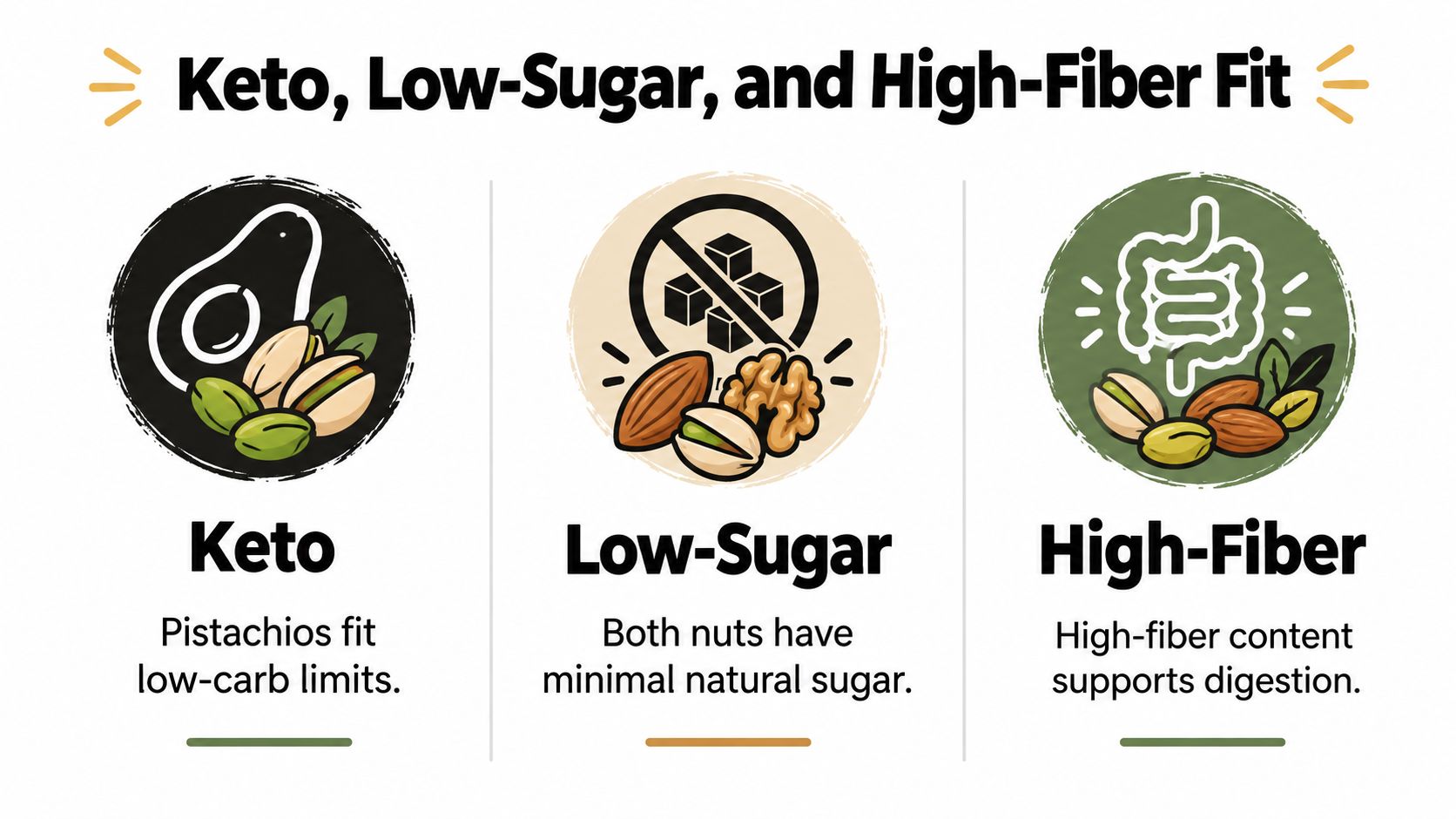
“Good for keto” and “low in sugar” aren't interchangeable claims. If you follow a specific eating pattern, check the nutrition panel on the product you're buying and decide how it fits your own daily targets. Seasonings and coatings can change a plain nut into a substantially different snack.
Start with the eating pattern
For a low-sugar choice, look beyond the nut itself to the full ingredient list. Honey-roasted or sweetened varieties can add sugar, while plain nuts offer a straightforward option. If sugar matters for your plan, compare the total sugar and ingredients on each package rather than relying on “natural” or “lightly sweetened” language.
For keto or lower-carbohydrate eating, check total carbohydrate and fiber on the label. Some people use total carbs to plan their meals; others track net carbs, commonly calculated by subtracting fiber from total carbohydrate. Because product values and serving sizes differ, avoid assuming one nut always fits better without checking the package and your own carb target.
The same label-first approach works for high-fiber goals. Nuts can contribute fiber, but the amount depends on the product and serving. Pairing a measured portion with other fiber-containing foods, such as fruit or vegetables, can make a snack more satisfying without turning one ingredient into the whole plan.
Build a snack around the label
A measured serving is more useful than an untracked handful, especially when you're balancing carbohydrate, fiber, and overall intake. Try plain nuts with fresh fruit, or add a small portion to unsweetened yogurt. If you're looking for more ideas that fit a low-carb approach, these high-fiber, low-carb snack ideas can help you think beyond nuts alone.
The most reliable comparison is the one you can repeat: pick a portion, check the label, and see how the snack fits your eating pattern. If a product's coating adds sugar or its serving size is smaller than you expected, adjust your choice accordingly.
Aflatoxin and Food Safety Considerations
Aflatoxins are contaminants that can form when certain molds grow on food. In the samples tested, pistachios showed detectable aflatoxins more often than cashews, a difference that matters when comparing the nuts but does not predict what is in any particular package. A separate market study of imported nuts also found pistachios had the highest contamination rate among the categories examined. The experimental aflatoxin evidence offers a useful reminder: detecting aflatoxins in samples does not mean every product is unsafe.
What shoppers can and can't tell
Commercial food systems use screening and regulatory controls to manage contamination risk. At home, choose nuts from sellers and brands you trust, and check that the packaging is sealed and intact. Discard nuts that look moldy, discolored, shriveled, or otherwise unusual. Don't taste a suspect nut to test whether it is safe.
Smell can reveal staleness or rancidity, but it cannot confirm that a nut is free of aflatoxins. Roasting also should not be treated as a reliable way to remove contamination. A package that looks normal cannot show how a crop was grown, dried, transported, or stored.
Protect freshness at home
Once opened, transfer nuts to a clean, airtight container and keep it in a cool, dry place away from light and heat. Refrigeration or freezing can help preserve quality during longer storage. Keep moisture out, and avoid adding fresh nuts to a container with old crumbs or residue.
A sensible safety check: Buy from trusted suppliers, store nuts dry, and discard anything visibly moldy or off. The findings are a reason to handle nuts thoughtfully, not to assume every package is unsafe. They also show why pistachios and cashews should not be treated as having identical contamination profiles.
Allergy Cross-Reactivity Between the Two Nuts
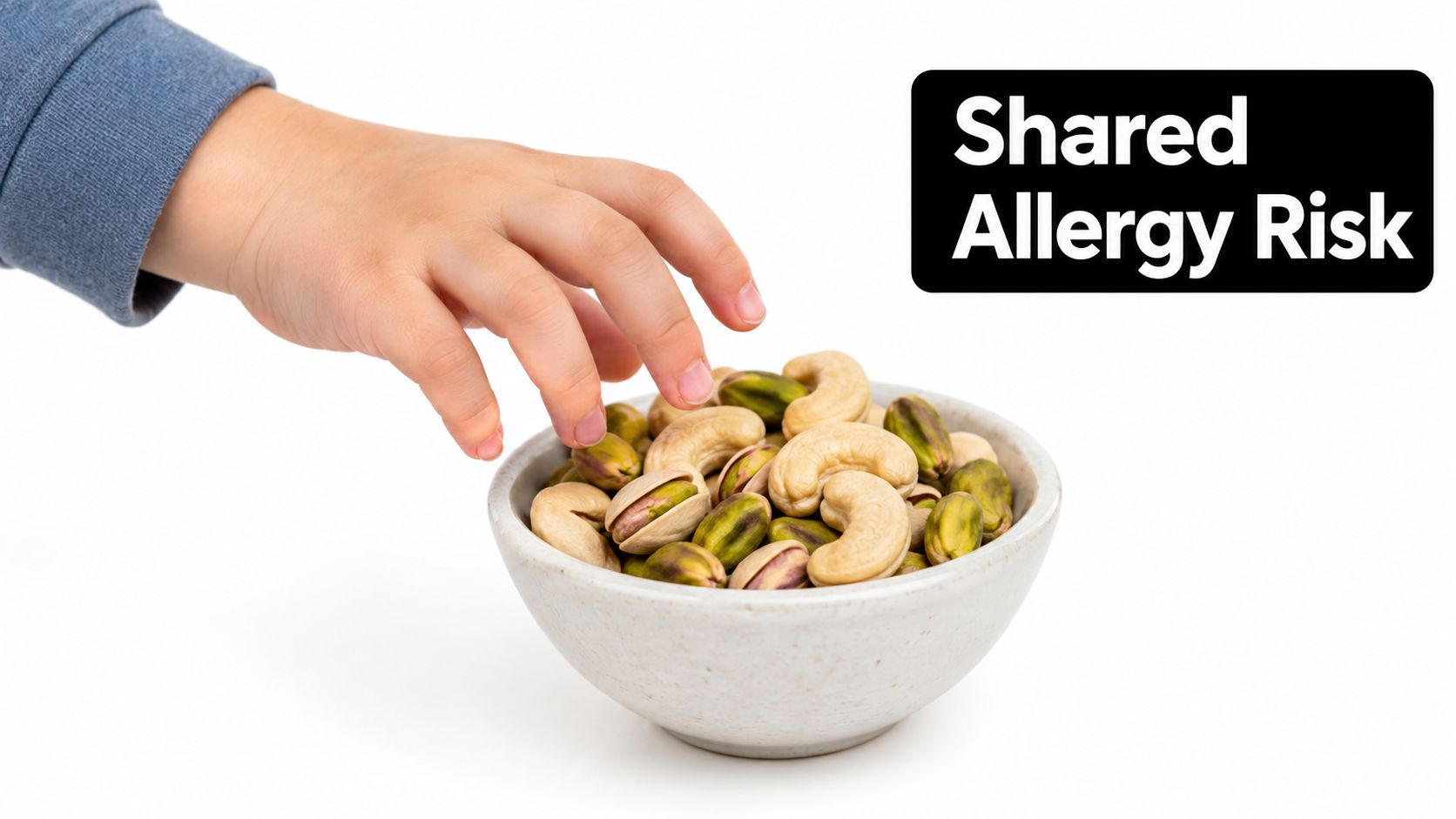
Cashew and pistachio allergies are closely linked. A person allergic to one may also react to the other, so someone with a confirmed allergy shouldn't try the second nut at home to see what happens. At the same time, cross-reactivity doesn't mean every person allergic to cashews will necessarily have a clinical allergy to pistachios. The distinction matters, and an allergist is the right person to guide testing and food decisions. The allergy and cross-reactivity discussion in the cited review supports taking the relationship seriously without treating it as a diagnosis.
Diagnosis and labels answer different questions
An ingredient list tells you what the manufacturer says is in the product. It doesn't tell you whether a person has an allergy, how severe a reaction might be, or whether a shared production environment could create a cross-contact risk. Read the full label, including precautionary statements about shared equipment or facilities, and ask the manufacturer if the wording leaves an important question unanswered.
For a child with a known nut allergy, families and schools should follow the child's clinician-provided plan rather than making decisions based on a broad “tree nut” category. A confirmed diagnosis, a precautionary label, and a history of reaction are different pieces of information. An allergist can help interpret them together.
Raw versus roasted isn't a home test
Roasting shouldn't be assumed to make a nut safe for someone with an allergy. Whether raw or roasted nuts are appropriate depends on the person's clinical history and specialist advice. Don't test the difference by serving a small amount; allergic reactions can be serious, and an informal taste test can't establish safety.
For more background on food allergy, this video may be a useful conversation starter. It doesn't replace advice from an allergist who knows the person's history.
When a package contains mixed nuts, assume that more than one nut may be present unless the label and manufacturer confirm otherwise. If someone has a known allergy, get professional guidance before serving either nut or a product made in a shared facility.
Snack and Recipe Ideas for Both Nuts
Cashews and pistachios shine in different kitchen roles. Cashews turn creamy when blended and take on savory seasonings well, while pistachios add a distinct crunch and color as a topping. Here are practical ways to use them without treating one as a substitute for every purpose.
Everyday snack combinations
For a trail mix, combine a measured portion of pistachios with a smaller amount of cashews for a richer bite. Add unsweetened coconut or roasted seeds if you like, and keep dried fruit modest if you're limiting added or concentrated sugars. Check whether the ingredients are salted or sweetened before mixing.
A snack plate can be as simple as a small handful of either nut with cheese, cut vegetables, or fruit. If you're building a spread for guests, this guide to BBQ grazing board party snacks offers ideas for arranging a variety of flavors and textures.
Add crunch to meals and treats
Stir chopped cashews into a vegetable stir-fry, or pulse them into coarse crumbs to coat fish before baking. The crumb coating gives a savory dish texture without relying on packaged breadcrumbs, though it won't behave exactly like bread: it can brown differently, so keep an eye on it as it cooks.
Pistachios work well scattered over a salad, stirred into a cookie dough, or sprinkled on a bar for a sweet-and-savory contrast. For a quick dessert plate, serve a small portion of pistachios or cashews alongside fruit and a low-sugar treat. You can also browse simple recipes with five ingredients or fewer for ideas that keep prep manageable.
The easiest way to make these suggestions fit your routine is to portion the nuts before serving. Put the amount you plan to eat in a bowl, then return the bag to the cupboard; eating from the package makes it harder to notice how much you've had.
Buying and Storing Nuts for Freshness
Freshness starts with the package. Choose nuts in a sealed pack with a clear date, and avoid packaging that looks damp, damaged, or exposed to heat. If you can see the nuts, check for unusual discoloration or a dusty, damaged appearance. A tidy package is a useful first check, though it cannot confirm everything about the product.
A quick label and packaging check
Read the ingredient list before buying. Plain nuts should have a short list, while flavored varieties may contain salt, sweeteners, seasoning blends, or oils. If you're watching sugar or sodium, compare the nutrition panel and ingredients; a flavor name alone doesn't show how much has been added.
“Dry-roasted” means the nuts are roasted without added oil, while oil-roasted nuts are cooked with oil. That can affect the finished product's fat profile, so compare labels if it matters to you. Roasting also involves heat. In a controlled study of pistachio roasting, higher temperature, longer roasting time, greater electrical power, and higher voltage increased acrylamide formation under the tested conditions. The findings don't show that every roasted product has the same level, so treat roasting methods as distinct rather than interchangeable.
Portion and storage habits
For a consistent snack, measure a serving instead of estimating by eye. About 28–30 g is a practical portion anchor discussed in pistachio formulation guidance. The pistachio meta-analysis cited earlier used a broader daily intake range, so this serving size is not a promise of a particular health outcome.
After opening a package, move the nuts to an airtight container. Store it away from sunlight, moisture, and sources of heat, such as an oven or sunny counter. For a portable snack, portion nuts into small containers or bags; what to look for in nuts in a bag can help you compare options.
Shop-and-store checklist
- Check the label: Compare serving sizes, added ingredients, and nutrition facts.
- Inspect the package: Look for a good seal, a clear date, and no visible damage.
- Keep nuts dry: Seal the container after each use and keep it away from heat and light.
- Use your senses, with limits: Discard nuts that look moldy or smell rancid. A normal appearance and smell cannot rule out aflatoxins.
Choosing Between Cashews and Pistachios
The better choice depends on what you want the nut to do. Reach for pistachios when you want their characteristic flavor and crunch in a snack, salad, or dessert topping. Choose cashews when you want a creamy base for a blended sauce or a mild, buttery taste in a stir-fry or coating.
Neither nut needs to win every comparison. Keep both if you enjoy them, and let the recipe, label, allergy guidance, and storage conditions shape your decision. The supply story matters too: pistachios rely on particular dry-climate growing regions, while cashews come from a different tropical production network. Those differences can affect availability, but they don't determine which one belongs in your next meal.
For a simple grocery-store rule, pick plain or lightly seasoned nuts when you want more control over ingredients, then portion them before serving. If you're choosing for someone with a known tree-nut allergy, pause and follow their allergist's advice rather than relying on a general nutrition comparison.
Rip Van offers Dutch-style wafels, wafers, wafer bars, cookies, and other treats designed for people looking for lower-sugar snack options; its Crispy Choco Dubai Choco variety includes pistachio. Pair a treat with a measured serving of cashews or pistachios, and visit Rip Van to explore the range.
0 comments