

Is a crispy wheat and raisin snack genuinely a smart choice, or can a wholesome-looking cereal hide more sugar than shoppers expect? The answer depends less on the words whole grain, fruit, or natural on the front of the pack and more on what the ingredient list, nutrition panel, and texture reveal together.
Crispy wheat brings structure, toasted flavor, and often useful fiber. Raisins add sweetness, acidity, aroma, and chew. That combination can work well, but it also creates two practical trade-offs: fruit sugar can make the total-sugars line look higher than expected, and moisture from raisins can gradually soften the wheat component. A good buying decision starts by treating these snacks as engineered foods, not automatically healthy foods or automatic sugar traps.
What Makes Crispy Wheat and Raisin Snacks So Addictive
A handful of crispy wheat pieces with raisins feels satisfying because it alternates two very different textures. The wheat fractures quickly between the teeth, while the raisin compresses and stretches before releasing its concentrated sweetness. That contrast keeps each bite interesting in a way that a uniformly crunchy or uniformly soft snack often doesn't.
The crisp component typically comes from a wheat structure that has been shaped and dried under controlled processing conditions. In an extruded product, pressure and heat transform the wheat mixture, then pressure release helps create expansion and air pockets. Those pockets reduce the force needed to break the piece, producing the familiar snap.
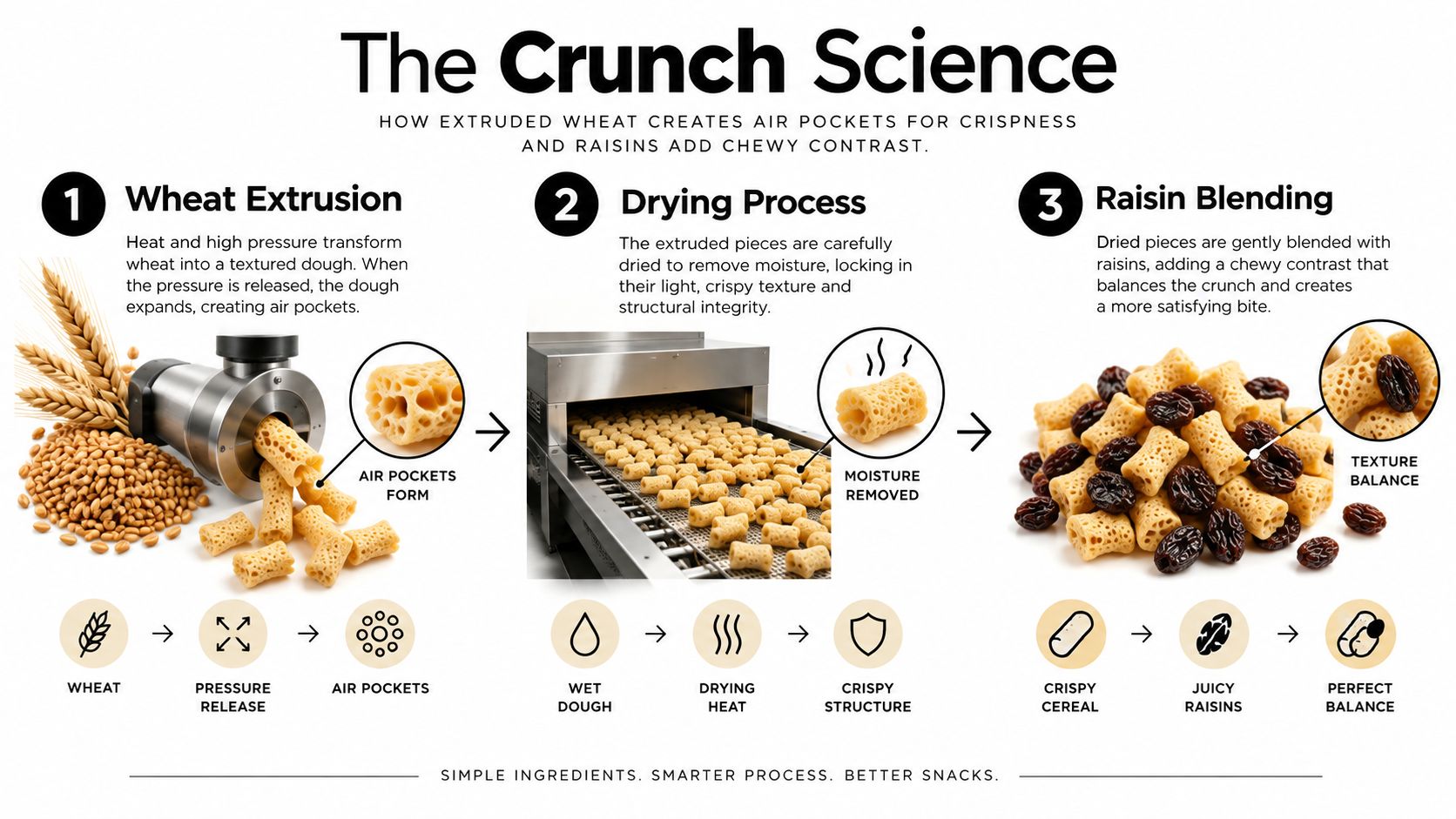
Why the crunch changes in the bag
Food developers don't judge crispness by moisture content alone. Water activity, which describes how available the water is for physical and chemical changes, predicts texture more reliably in a dry extruded wheat matrix. Research on extruded starch foods reports that crispness declines sharply when water activity reaches approximately 0.31, because absorbed water plasticizes the amorphous starch structure, lowers its glass-transition temperature, and reduces fracture force (research on water activity and extruded starch texture).
That explains why a snack can look dry yet taste stale or soft. The issue isn't only how much water the product contains. It's how that water interacts with the starch structure.
Practical rule: Lasting crunch requires a dry wheat structure and packaging that limits humidity uptake.
Feed moisture also matters during manufacturing. Higher moisture generally produces denser, less expanded, harder pieces, while higher screw speed can modestly reduce density and hardness. A serious product-development screen measures water activity, bulk density, expansion ratio, and breaking force rather than relying only on a tasting panel.
Why raisins make the experience work
Raisins provide the counterpoint that makes crispy wheat less monotonous. Their acidity keeps sweetness from tasting flat, and their aroma becomes more noticeable as the piece warms in the mouth. The result is a snack that can feel more indulgent than its simple ingredient list suggests.
That sensory appeal can encourage grazing. The wheat offers a quick crunch, then the raisin delivers a concentrated sweet finish. If the product also includes syrups or sugar coatings, the same texture balance can make the added sweetness easy to overlook.
Understanding the Nutrition Facts Behind These Snacks
The front of a package may highlight wheat, raisins, or fiber, but the nutrition panel tells a more useful story. Wheat supplies the cereal base and can contribute fiber, while raisins contribute concentrated carbohydrate and sweetness. Neither ingredient automatically determines whether the finished snack fits your eating pattern.
The first question is whether the product contains only the sugars naturally present in the raisins or also includes added sweeteners. A raisin-wheat cereal listed 6.4 grams of sugar and 4.6 grams of fiber per 45-gram portion, according to the product information from Kellogg's Raisin Bran. That pairing looks different from a product where sugar rises but fiber remains modest.
Use the panel, not the health halo
Read the ingredients before deciding what the total-sugars line means. Raisins may appear as raisins, raisin paste, or another dried-fruit preparation. Added sweeteners can appear separately as sugar, syrup, molasses, honey, or another ingredient. The total-sugars number includes sugar from the fruit and any added sources, so it can't answer the question by itself.
A useful comparison starts with the serving size. A bowl that looks small on the label may become much larger when poured freely. Compare products using the same serving basis, then look at sugar and fiber together.
| Product Type | Sugar per serving | Fiber per serving | Calories |
|---|---|---|---|
| Raisin-wheat cereal example | 6.4 g | 4.6 g | Not provided |
| U.S. raisin-bran product example | Not provided | 26% of daily value | 190 per cup |
The second example shows why labels can be difficult to compare. One panel reports grams of sugar and fiber for a defined portion, while another emphasizes calories and daily fiber value. Don't treat a larger serving as proof of better nutrition. For a broader way to think about energy across meals and snacks, these calorie-packed meal hook ideas can help put snack choices in context.
A practical label-reading sequence
Use this order when you evaluate a box or bar:
- Check the serving size. Decide whether the stated portion resembles what you typically eat.
- Find raisins in the ingredients. Note whether they're the only obvious sweet ingredient.
- Scan for syrups and sugars. Fruit sweetness and added sweetness are separate questions.
- Compare fiber with sugar. A product with meaningful fiber may be more filling than one built mostly around refined sweeteners, but fiber doesn't erase sugar.
- Review the entire pattern. Calories, protein, fat, sodium, and portion size still matter.
For a useful primer on the mechanics of a nutrition panel, see this guide to how to read nutrition labels. The goal isn't to reject every sweet cereal. It's to know exactly what you're choosing.
The Moisture Migration Problem Most Shoppers Miss
A fresh crispy wheat and raisin product can lose its appeal during storage without showing obvious spoilage. The reason is moisture migration. Raisins naturally hold more available water than the dry wheat matrix, so water can move from the chewy fruit into the surrounding crisp pieces.
A USDA-published raisin industry document reports raisin water activity of approximately 0.51 to 0.62, finished moisture of 15% to 17%, and pH of 3.5 to 4.0 (USDA raisin industry document). Those conditions inhibit the growth of most harmful bacteria, but they don't prevent water from changing the texture of a neighboring cereal matrix.
The texture trade-off
Think of the package as containing two climates. The wheat pieces need a dry environment to stay brittle. The raisins contain a more humid environment and gradually release some of that moisture. Direct contact accelerates the problem, especially when the package has already absorbed humidity after opening.
That creates a frustrating result: the product may remain microbiologically stable while becoming less crunchy. Safety and quality are separate judgments. A soft cereal isn't automatically unsafe, but it may no longer deliver the texture the manufacturer intended.
Storage insight: A resealable package helps limit repeated humidity exposure, but it can't reverse moisture that has already moved into the wheat.
Packaging choices therefore matter more than many shoppers realize. A strong moisture barrier, a tight seal, and sensible storage in a cool, dry place can protect texture. If you regularly carry snacks in a warm bag or leave the package open, choose formats designed for repeated opening and closing. This guide to resealable snack bags offers useful packaging context, although no package can eliminate the underlying moisture gradient.
A practical comparison is straightforward. A product with separate fruit pieces may preserve contrast better than one where raisins are pressed directly into a crisp matrix. A product with a glossy coating may resist moisture briefly but can also introduce added sugar. The best choice depends on whether your priority is maximum crunch, a softer chew, a shorter ingredient list, or lower added sweetness.
Gluten, Vegan Status, and Allergen Considerations
A wheat-based snack shouldn't be treated as suitable for everyone just because it contains fruit. Wheat is the principal grain in crispy wheat products, so people with celiac disease or a wheat allergy need a product specifically formulated and certified for their requirements. A general “natural” or “whole grain” claim doesn't change that.
“Wheat-free,” “gluten-free,” and “vegan” describe different things. Wheat-free concerns the grain. Gluten-free concerns gluten proteins and contamination controls. Vegan status depends on the complete ingredient list and manufacturing details, including whether the product contains milk, whey, honey, or other animal-derived ingredients.
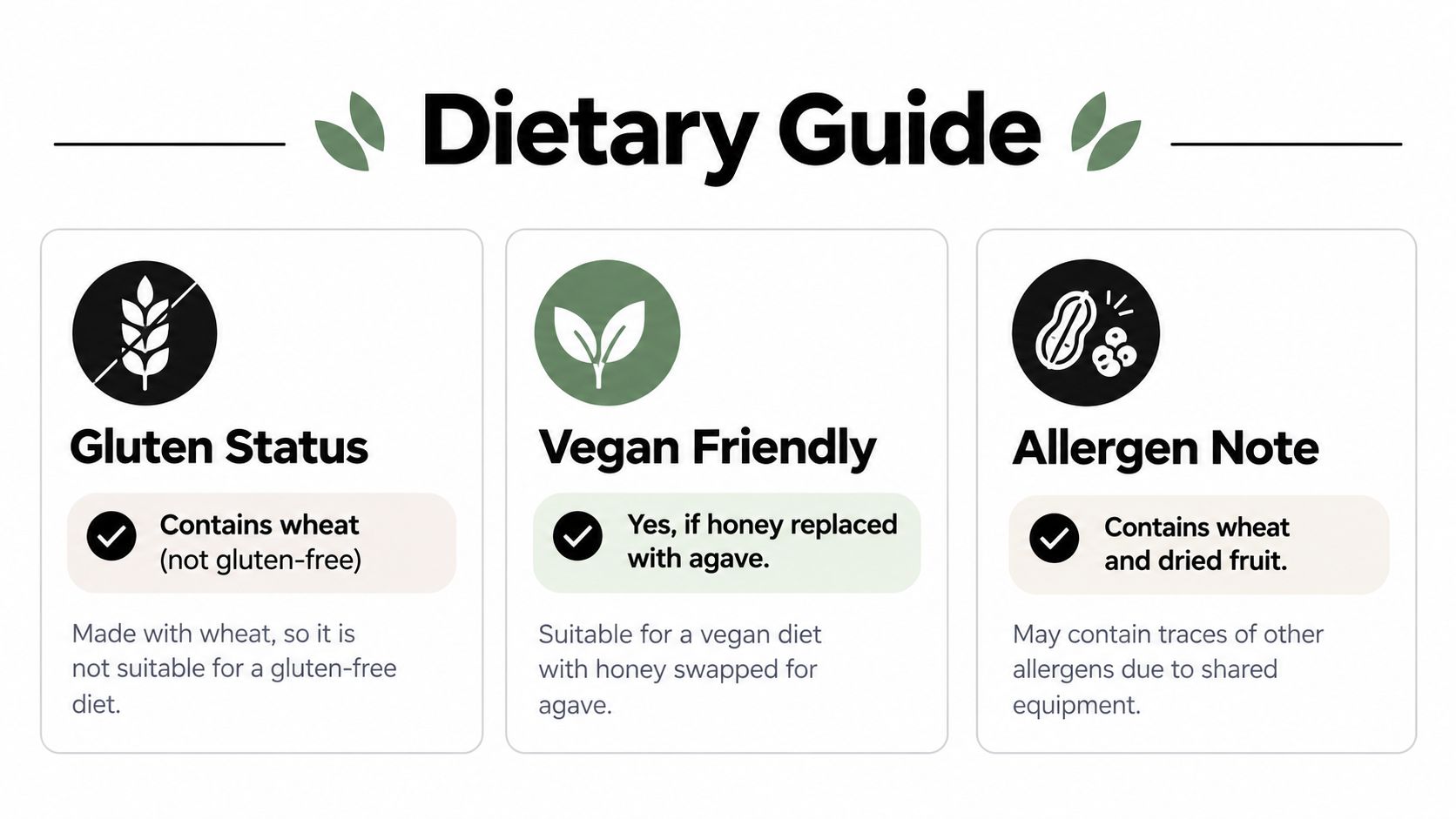
A safer decision tree
Use the package in this order:
- Medical wheat or gluten avoidance: Look for the required certification and a clear allergen statement. Don't rely on a marketing phrase.
- Vegan eating: Check for milk ingredients, honey, and shared manufacturing statements. A raisin cereal can be vegan, but raisins and wheat alone don't prove it.
- Nut concerns: Review peanut and tree-nut warnings, including possible cross-contact language. Comparable raisin-wheat products can differ substantially in their warnings.
- Family shopping: Read the current package every time. Formulas, suppliers, and facility statements can change.
The strongest assumption to challenge is that gluten-free automatically means nutritionally superior. A 2024 comparison of 39 gluten-free products with gluten-containing counterparts found that gluten-free products averaged less protein and more sugar and calories, while also costing more (the 2024 gluten-free product comparison). That doesn't make gluten-free products poor choices. It means the substitution should solve a medical or personal need, not serve as an automatic upgrade.
For shoppers who need alternatives, this guide to the best gluten-free snacks can help generate ideas, but certification and the actual label remain decisive.
How to Build Better-For-You Snack Plates
Crispy wheat and raisins work best as one component of a snack, not as a complete nutrition strategy. The wheat and fruit provide carbohydrate, crunch, and sweetness. Add a food that contributes protein or fat, then include something fresh if you want more volume and contrast.
Start with the label. A 45-gram portion can contain both useful fiber and measurable sugar, so portion size sets the context. Pouring directly from a large bag makes it harder to distinguish a planned serving from incidental eating.
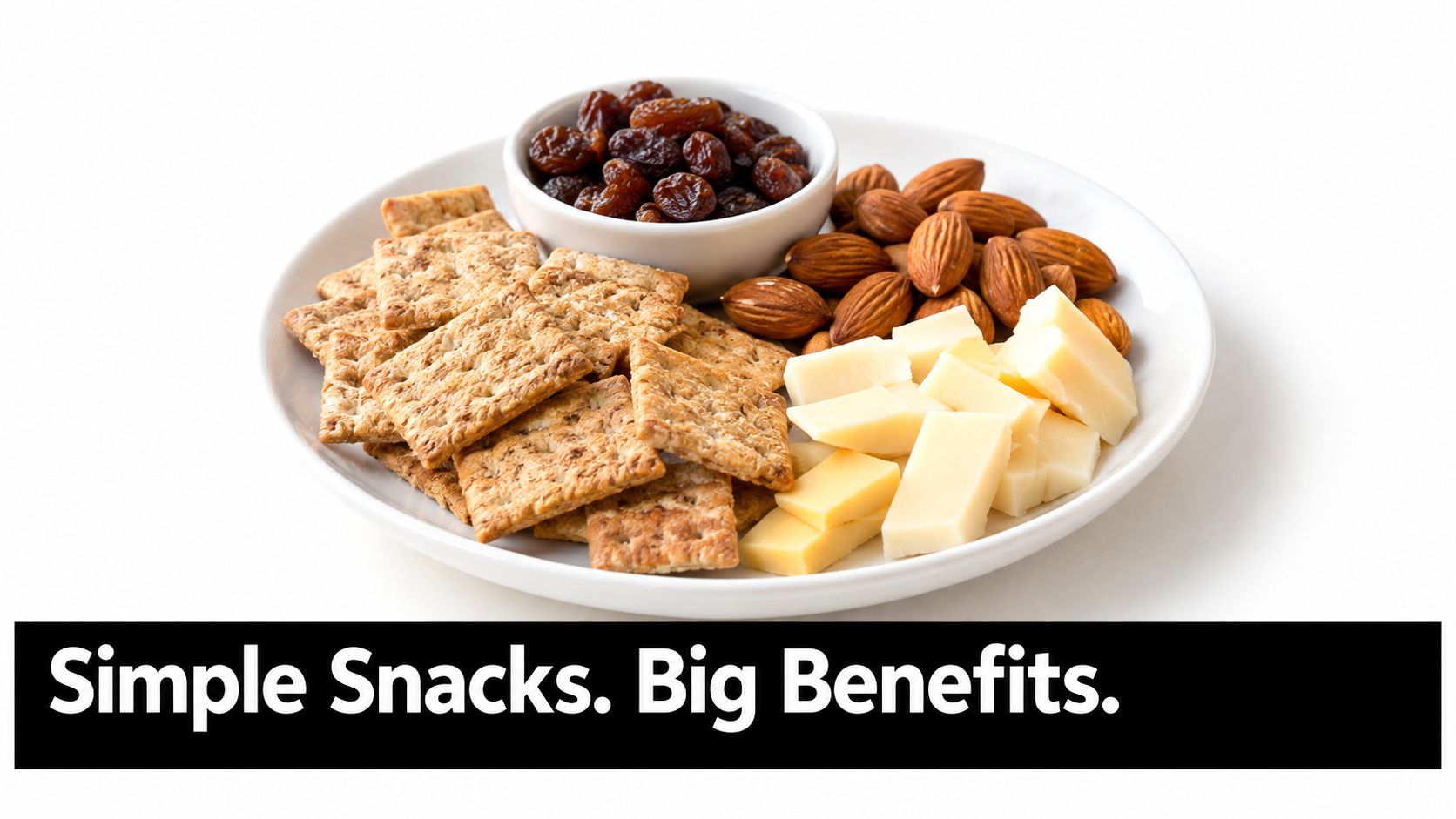
Build the plate in a deliberate order
- Choose the crispy base. Put a measured portion of the wheat-and-raisin snack on the plate rather than eating from the package.
- Add protein or fat. Nuts, seeds, yogurt, or cheese can make the snack feel more complete than cereal alone.
- Add freshness when useful. Fruit with high water content or sliced vegetables can offset the dense sweetness of dried fruit.
- Recheck the ingredient list. If the snack already contains syrup or a sugar coating, keep the rest of the plate less sweet.
- Match the plan to the person. A child's snack, a desk snack, and a pre-exercise snack may need different portions and pairings.
The pairing doesn't magically cancel sugar, and it shouldn't be described as a way to erase the carbohydrate contribution of raisins. Its practical purpose is satiety and balance. A bowl of yogurt with a measured sprinkle of crispy wheat and raisins serves a different role from repeatedly eating handfuls from a bag.
Better question: Not “Can I eat this?” but “What role does this portion play in the snack I'm building?”
For parents, the label check also helps separate a fruit-forward product from one that uses raisins to support a sweeter formula. For people monitoring carbohydrate intake, dried fruit deserves attention even when the product contains no refined sugar. For busy professionals, pre-portioning prevents the texture contrast from turning into automatic grazing.
Making Your Own Crispy Wheat and Raisin Treats
Homemade versions give you control over the exact balance that packaged products must standardize. You can use a wheat base, add raisins for chew, and decide whether the formula needs any syrup or extra sugar at all. The central challenge remains the same: keep the wheat dry enough to stay crisp while managing the moisture carried by the raisins.
Start with texture, then adjust sweetness
Use toasted wheat cereal, crisp wheat pieces, or another dry wheat component as the foundation. Add raisins gradually rather than treating them as a free garnish. More raisins increase chew and fruit sweetness, but they also increase the moisture load around the crisp pieces.
If you want a less sweet result, reduce the raisin proportion before reaching for a substitute sweetener. Choose unsweetened wheat ingredients where possible, and use spices such as cinnamon for aroma rather than adding another sugar source. A small amount of salt can sharpen the grain and fruit flavors, which may make the recipe taste fuller without making it sweeter.
Keep the batch crisp
Toast the wheat component until it develops a dry, nutty character, then cool it completely before combining it with raisins. Warm cereal can encourage condensation inside a container. If you're making bars, use only enough binder to hold the mixture together. A wet binder may create a cohesive bar at first, then soften the crisp pieces during storage.
Cut the cooled mixture into portions and store them in a tightly sealed, moisture-resistant container. If the raisins are especially moist, keep them separate until serving or fold them in shortly before eating. That approach preserves the contrast rather than asking one mixture to maintain two incompatible textures indefinitely.
A cookie-style variation can use oats, wheat flour, raisins, and a controlled amount of sugar, but it won't deliver the same crisp matrix as an extruded cereal. Baking drives off moisture differently, and the finished texture depends on fat, flour structure, and cooling. Choose the method based on the result you want, not on the assumption that every “crispy” raisin snack is made the same way.
For a visual example of a homemade format, this video shows one approach to shaping a crispy wheat and raisin treat:
The most reliable homemade strategy combines three decisions: use a dry wheat base, control the raisin ratio, and package the finished snack quickly after cooling. That gives you more control over added sweeteners, dietary ingredients, and serving size, while preserving the crunchy-chewy contrast that makes the combination appealing.
If you want a lower-sugar alternative to conventional sweet snacks, explore Rip Van for crispy wafers, wafer bars, cookies, and Dutch-style wafels made for balanced snacking. Browse by dietary preference and compare the ingredient and nutrition panels so you can choose a convenient treat that fits your own label-reading standards.
0 comments