

You're standing in the snack aisle with two granola bars that look almost identical. One costs more and says no corn syrup in big letters. The other doesn't make that claim. You're trying to feed your family well without overpaying for marketing, and you don't have ten minutes to decode two ingredient lists in the middle of a grocery run.
Why Corn Syrup Matters When You Shop
That small moment sums up why foods without corn syrup are worth understanding properly. The claim sounds clear, but it answers only one question, whether a specific sweetener was used. It doesn't tell you how much added sugar replaced it, how much fiber the product contains, or whether the serving you'd eat matches the serving on the panel.
Think of no corn syrup as a starting filter, not a nutritional guarantee. A bar sweetened heavily with cane sugar, honey, or brown rice syrup can clear the corn syrup bar and still carry a substantial sugar load. Another product might remove corn syrup, cut total added sugar, and add fiber. Those two products share a front-of-pack claim, but they don't deliver the same nutritional result.
The Question to Carry Through the Store
A more useful question is this. Does this product improve the whole nutrition profile, or does it swap one caloric sweetener for another? That question helps parents packing lunchboxes, people watching carbohydrates, and busy snackers who want convenience without turning every snack into dessert.
You'll need three practical skills to answer it confidently:
- Recognize the ingredients: Tell ordinary corn syrup apart from high-fructose corn syrup, often shortened to HFCS.
- Verify the amount: Use the Nutrition Facts panel to check added sugar, serving size, calories, and fiber.
- Judge the trade-off: Decide whether a higher price buys a measurable improvement or only a cleaner-sounding label.
A front-of-pack claim tells you what's absent. The Nutrition Facts panel tells you what's still there.
This way of shopping isn't about fear of one ingredient. It's about label literacy. Once you can spot sweeteners, compare servings fairly, and recognize where corn syrup commonly appears, you won't need to rely on a single badge to make a decision. You'll be able to compare two similar products in the same category and choose the one that fits your goals for sugar, fiber, taste, and budget.
That approach also prevents a common disappointment. Many shoppers pay more for a product that looks healthier, then discover at home that it's sweetened just as heavily with something else. Learning to read past the claim protects both your health goals and your grocery budget, and it makes future shopping trips much faster.
What Counts as Corn Syrup
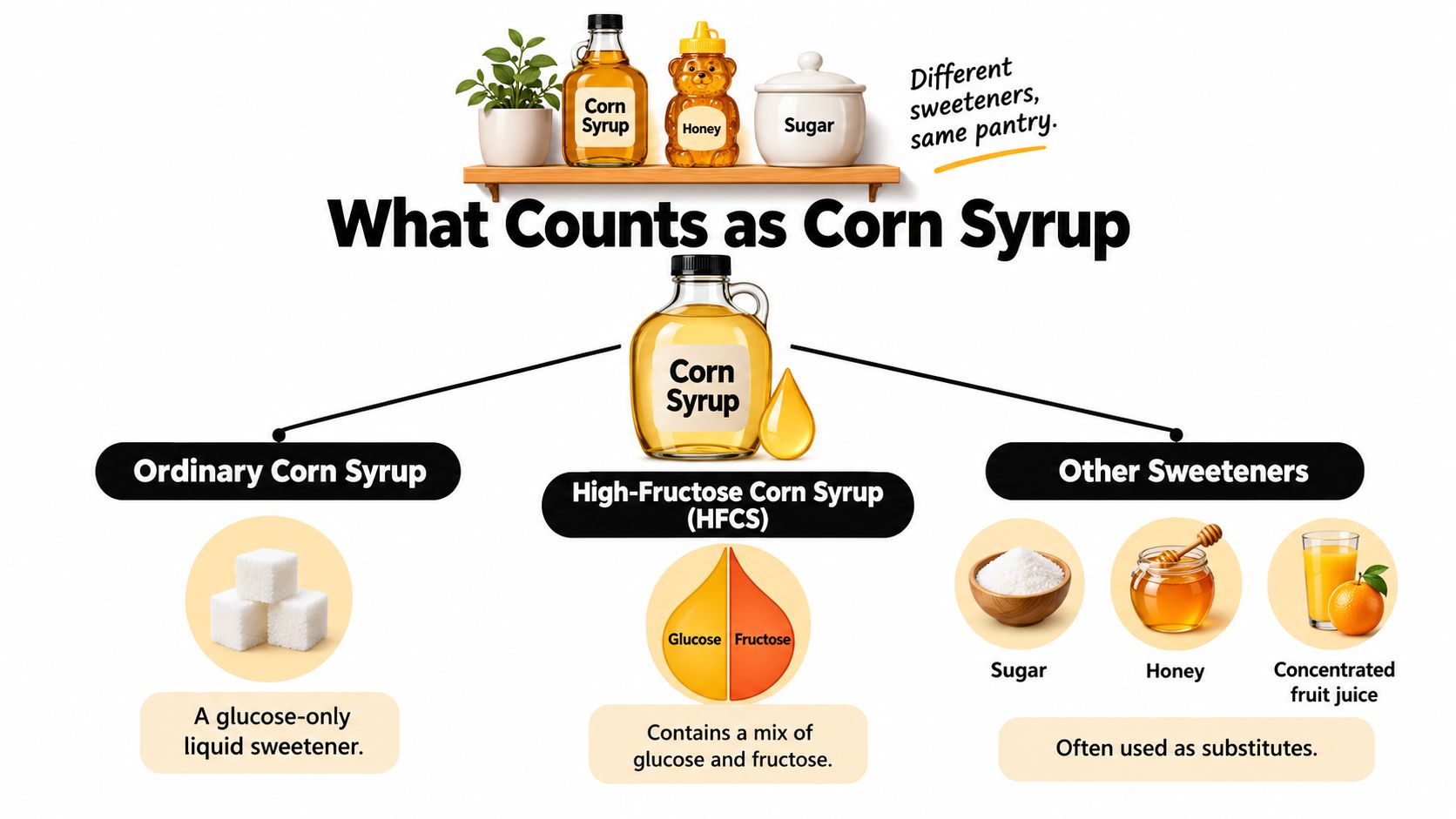
Start with a kitchen picture. Ordinary corn syrup is the thick, clear liquid you might recognize from a pantry bottle used in baking. It's made from corn starch broken down into glucose, so it's a glucose-only liquid sweetener. It helps prevent crystallization, keeps foods moist, and gives candies and baked goods a smooth texture.
High-fructose corn syrup starts from corn syrup, but manufacturers use enzymes to convert some of that glucose into fructose. Fructose tastes sweeter than glucose, so HFCS delivers a sweetness profile closer to table sugar while staying liquid and easy to blend into drinks and processed foods. On labels, look for the full words high-fructose corn syrup or HFCS.
The visual below maps those two ingredients alongside other sweeteners you'll often see used in their place.
Why Manufacturers Used It So Widely
HFCS was introduced commercially in 1967, and its availability rose sharply afterward, reaching a peak of 63.7 pounds per person in 1999 before falling to approximately 59 pounds per person by 2005, according to Harvard Health's overview of where added sugar hides. USDA researchers reported that corn sweeteners, mostly HFCS, replaced refined cane and beet sugar in many processed foods during much of that period. A separate USDA historical review found HFCS represented 39% of the 136.3 pounds of sweeteners available per person in 2008.
Manufacturers had practical reasons. A liquid sweetener pumps and blends easily at factory scale. It supports browning, moisture retention, shelf stability, and consistent flavor in beverages. Those functional advantages explain why HFCS became embedded in sodas and packaged foods, even in products that don't taste like obvious desserts.
For shopping purposes, keep the distinction simple:
- Corn syrup: Listed plainly as corn syrup, and primarily glucose based.
- HFCS: Listed as high-fructose corn syrup or HFCS, and contains both glucose and fructose.
- Other sweeteners: Sugar, honey, rice syrup, and concentrated juices aren't corn syrup, but they can still add sugar.
If your goal is avoiding corn-derived sweeteners, both corn syrup and HFCS matter. If your goal is lowering sugar, you also need to account for every replacement sweetener. Those are related goals, but they're not identical.
The Real Health Question Behind the Label
The strongest reason to pay attention isn't that HFCS has been uniquely proven worse than every other added sugar in every context. It's that total added sugar intake is already high, and sugary products make it easy to exceed national guidance without noticing.
This chart puts average daily intake in a form that's easier to picture than grams alone.
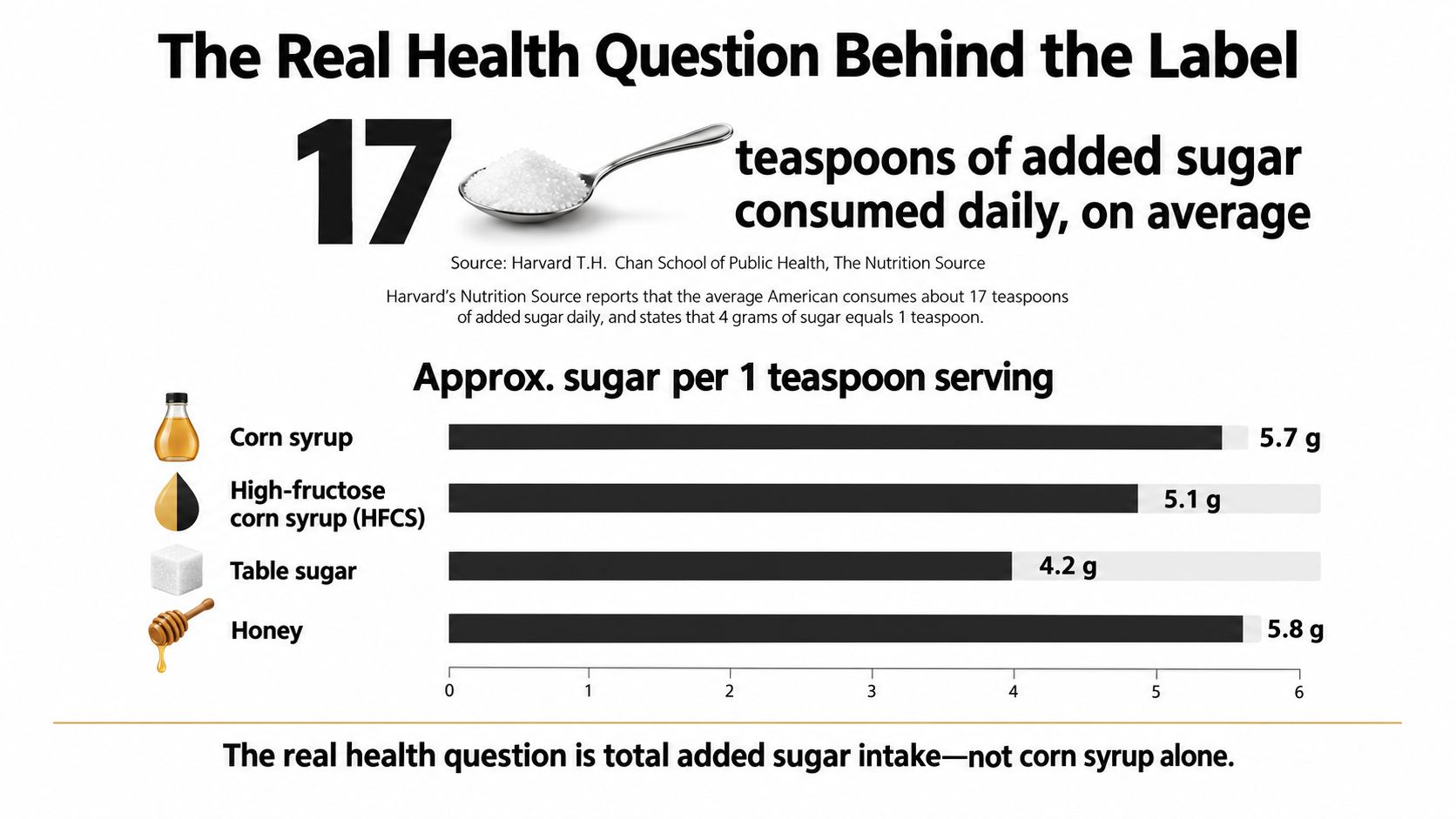
Harvard's Nutrition Source reports that U.S. adults, teenagers, and children consume about 17 teaspoons of added sugar daily, roughly 270 calories, while the Dietary Guidelines for Americans recommend keeping added sugars below 10% of total calories, as summarized in Harvard Health's discussion of whether sugar is unhealthy. On a 2,000-calorie diet, that limit equals no more than 200 calories or 50 grams of added sugar per day. Harvard Health likewise reports Americans consume more than 17 teaspoons, or about 290 calories, from added sugars each day, and that sugary beverages provide roughly half of total added sugar in the U.S. food supply.
One Drink Can Use the Whole Budget
A typical 20-ounce sugar-sweetened beverage contains approximately 65 grams of added sugar, often supplied by HFCS. That's about 16 teaspoons, and it's more than the recommended daily limit in a single bottle. You don't need to memorize that example perfectly. Just remember that liquid sugar adds up faster than expected because it doesn't feel like eating dessert.
If you're weighing the ingredient itself, Rip Van's explainer on why corn syrup raises health concerns is a useful next read. It helps to separate concern about HFCS specifically from concern about consuming too much added sugar overall.
The short video below offers another plain-language way to think about added sugar sources before you compare products.
Sweetener Identity Is Only Part of the Picture
Controlled-feeding evidence indicates HFCS and sucrose have broadly comparable postprandial glycemic effects, with reported glycemic-index values of approximately 58 to 65 for HFCS and about 65 for sucrose, according to controlled-feeding evidence on HFCS and sucrose. That means swapping HFCS for the same amount of cane sugar doesn't automatically create a lower glycemic product. Excess fructose is also more concerning when it increases total energy intake, while equal-calorie replacement of other carbohydrate generally shows more limited metabolic harm in controlled trials.
Practical rule: Judge the serving you'd eat by added sugar, total carbohydrate, fiber, and calories, not by sweetener name alone.
A corn-syrup-free snack that's also lower in added sugar and higher in fiber aligns more directly with dietary guidance. A corn-syrup-free snack that keeps the same sugar load may satisfy an ingredient preference, but it hasn't solved the larger nutritional issue.
How to Read Labels Like a Pro
You need two parts of the package working together. The ingredient list tells you which sweeteners are present. The Nutrition Facts panel tells you how much added sugar the serving contains. Using only one side gives you an incomplete answer.
The flow below turns that check into a quick routine you can repeat in any aisle.
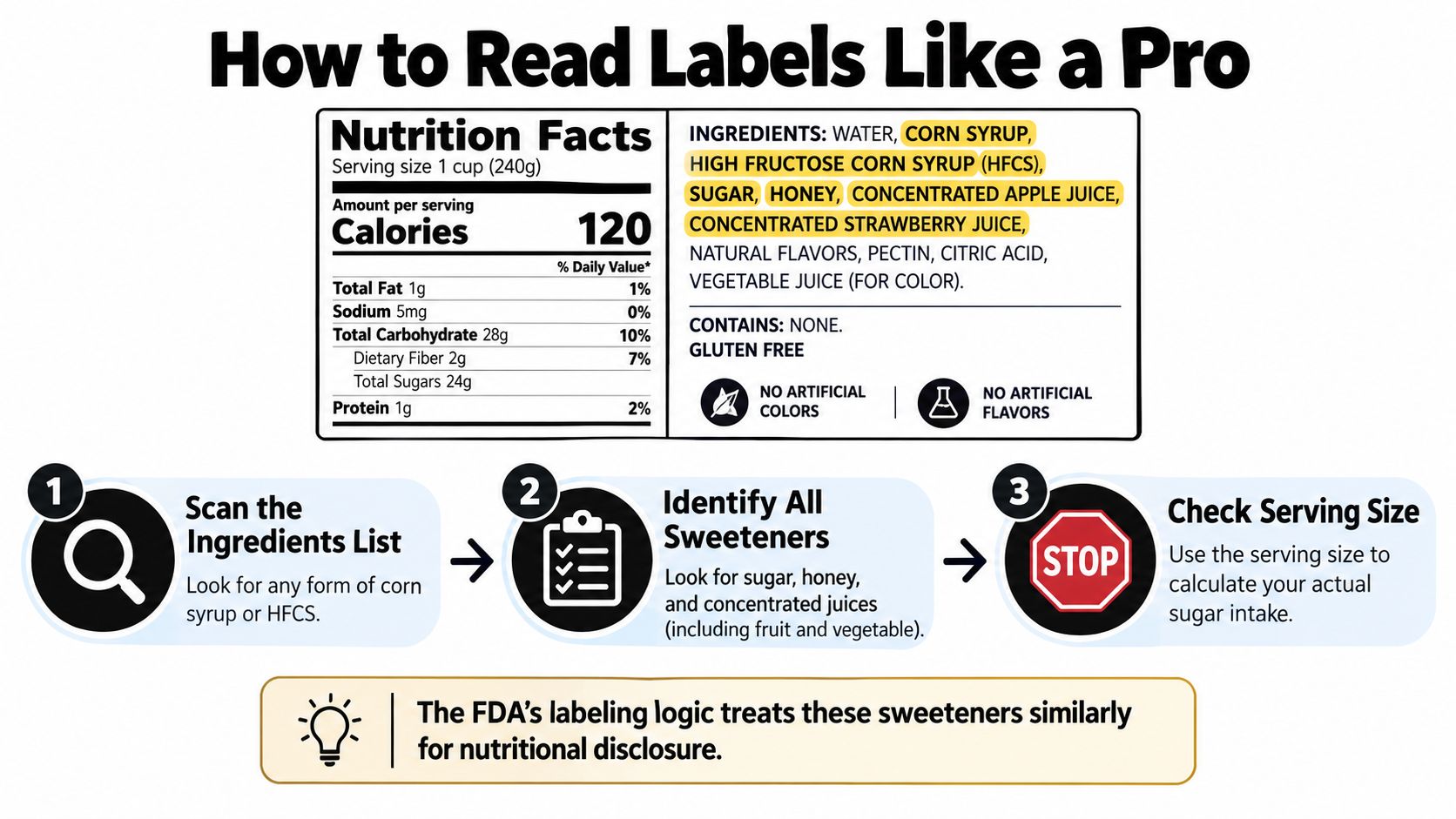
FDA labeling treats corn syrup, HFCS, sugar, honey, and relevant concentrated fruit or vegetable juices as added sugars when added during processing, and sugars produced through controlled hydrolysis, such as those in maltodextrin or corn syrup, must be counted as added sugars when introduced into a food, as explained in FDA guidance on Nutrition Facts label changes. Removing corn syrup therefore doesn't remove the need to disclose added sugar from other sweeteners.
A Three-Step Scan
- Start with serving size: Check whether the package contains one serving or whether you'd realistically eat more than the listed portion.
- Scan the ingredients: Look for corn syrup and HFCS first, then watch for cane sugar, brown rice syrup, dextrose, fructose, glucose, maltodextrin, honey, and fruit juice concentrate.
- Confirm with Nutrition Facts: Compare added sugar grams, percent Daily Value, fiber, total carbohydrate, and calories across similar products.
For a deeper walkthrough of each panel element, Rip Van's guide to reading nutrition labels breaks the process into manageable pieces. It's especially helpful if serving sizes or percent Daily Value still feel confusing.
Multiple sweeteners deserve extra attention. Ingredients are listed by weight, so several smaller sweeteners can appear lower in the list even when their combined contribution is meaningful. The added sugars line captures the total result, which is why you shouldn't stop after confirming that corn syrup is absent.
The same habit applies outside snacks. If you're comparing protein products, ThriveXDNA sweetener-free protein advice offers a related example of checking sweetener choices against your own preferences rather than trusting a front label. The product category changes, but the verification skill stays the same.
Try it on a snack bar. First confirm there's no corn syrup in the ingredients. Then ask whether the added sugar fits your day, whether fiber helps make the snack more satisfying, and whether the bar's stated serving matches what you'll eat. That short sequence turns a vague claim into a concrete decision.
Where Corn Syrup Hides in Everyday Foods
Corn syrup doesn't only appear in candy and soda. It also shows up in foods that taste savory, tangy, or only mildly sweet. Sauces, breads, dressings, and marinades are common places shoppers overlook because the sweetness is supporting flavor rather than announcing itself as dessert.
Categories Worth Checking First
- Beverages: Sodas, sweetened teas, sports drinks, fruit punches, and juice drinks that aren't fully juice often use HFCS for consistent sweetness.
- Sauces and condiments: Ketchup, barbecue sauce, sweet chili sauce, relish, and some jarred pasta sauces may rely on corn syrup or HFCS.
- Breakfast foods: Sweetened cereals, granola, instant oatmeal packets, pancake mixes, and commercial pancake syrup frequently contain corn-derived sweeteners.
- Breads and baked goods: Mass-market sandwich bread, packaged muffins, snack cakes, and cookies may use liquid sweeteners for moisture and shelf life.
- Snacks and desserts: Gummies, candy bars, ice cream novelties, flavored yogurts, and coffee creamers are routine places to check.
- Pantry shortcuts: Salad dressings, jarred marinades, frozen meal kits, and sweetened nut butters can carry more sweetener than the flavor suggests.
Across the entire category of added sugars and caloric sweeteners, U.S. per-capita food availability increased 19%, from 119 pounds in 1970 to 142 pounds in 2005, a long arc that helps explain why sweeteners spread across so many categories. Corn sweeteners became especially useful to manufacturers because liquid forms were practical for large-scale blending, storage, and beverage production. Cost and function, not taste alone, drove adoption.
Sweetener Profiles at a Glance
| Category | Common Sweetener | Label Aliases | Typical Added Sugar Per Serving |
|---|---|---|---|
| Beverages | HFCS | High-fructose corn syrup, HFCS | Often high, check the full bottle |
| Sauces | Corn syrup or HFCS | Corn syrup, glucose syrup | Small serving, easy to double |
| Cereals and bars | Corn syrup, sugar, rice syrup | Corn syrup solids, brown rice syrup | Varies widely by brand |
| Baked goods | Corn syrup or sugar | Corn syrup, invert sugar, dextrose | Varies, compare similar items |
| Dressings | HFCS or sugar | HFCS, cane sugar, honey | Small serving, check realistic use |
Use the table as a scanning map, not as a substitute for the panel. Two ketchups can use different sweeteners and deliver different added sugar per tablespoon. Two granola bars can both avoid corn syrup while using very different amounts of honey, cane sugar, or rice syrup.
The fastest habit is category awareness. When you pick up a drink, sauce, cereal, dressing, or packaged snack, flip it over automatically. You don't need to investigate plain whole foods with the same intensity. Save your label-reading energy for packaged products where manufacturers control the sweetener system.
Easy Swaps You Can Use Today
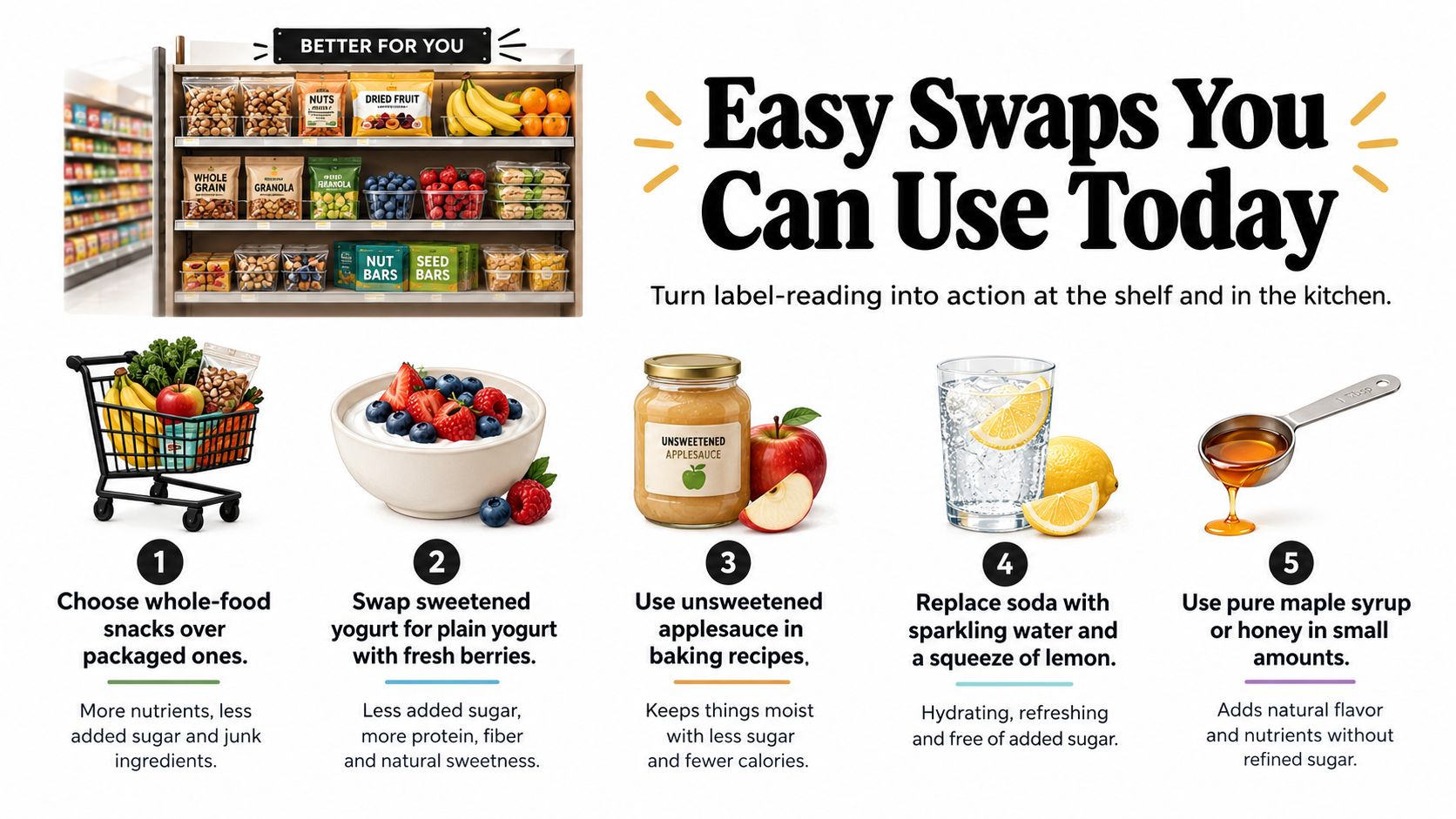
Good swaps do two jobs at once. They remove corn syrup when that's your preference, and they improve the overall profile through less added sugar, more fiber, or ingredients you recognize. A swap that only changes the sweetener name while keeping everything else the same is a smaller win.
These ideas translate the label routine into choices at the shelf and at home.
At the Store
Start with categories you buy repeatedly. Choose plain yogurt and add fresh berries instead of a heavily sweetened yogurt cup. Pick sparkling water with lemon when you want fizz without a sugary drink. Compare nut butters and favor versions where the nut itself does most of the work, then check added sugar rather than assuming a natural-sounding label means unsweetened.
For packaged snacks, look for a combination of no corn syrup, lower added sugar, and meaningful fiber. Rip Van's wafels, wafers, and cookies are one option in that category, formulated without corn syrup or artificial sweeteners and with attention to lower sugar and fiber. Treat any brand the same way. Confirm the claim on the ingredients list, then verify the serving on the Nutrition Facts panel.
If you want broader habits beyond individual products, Rip Van's practical ways to reduce sugar intake can help you build changes gradually. Small repeatable swaps usually work better than trying to overhaul every pantry item in one weekend.
In Your Kitchen
Home cooking gives you direct control, but texture can change. Corn syrup helps caramel stay smooth and granola hold together, so replacements may brown differently or produce a less glossy finish. That's not failure. It's useful information about what the ingredient was doing.
- For baking moisture: Try unsweetened applesauce or mashed banana in muffins and quick breads, knowing the flavor will be fruitier and the crumb softer.
- For sticky mixtures: Date paste can help bind homemade bars, but it still contributes sugar, so portion and total sweetness still matter.
- For gentle sweetness: Honey or pure maple syrup can work in small amounts, but don't treat them as sugar-free because they're familiar or natural.
- For everyday drinks: Unsweetened tea, sparkling water, or water with citrus removes the sweetener question entirely.
Choose three changes for your next grocery run. Replace one drink, check one sauce, and compare one snack using added sugar and fiber. That limited focus builds skill without making shopping exhausting, and you'll quickly learn which swaps your household actually enjoys.
Is Paying More Worth It
A higher price can be reasonable, but it should buy more than the absence of one ingredient. Shoppers clearly care about HFCS, and that concern affects what they're willing to pay. The challenge is deciding when the premium reflects a better product and when it mainly reflects a popular claim.
A 2026 PLOS ONE study reported that 93% of surveyed consumers knew what HFCS was, more than 58% said all or most of the products they consumed contained it, and respondents were willing to pay premiums of up to 16% for products labeled free of HFCS, according to the PLOS ONE consumer willingness-to-pay study. Reported premiums varied by category, including approximately $0.55 for cereal, $0.43 for salad dressing, $0.14 for soft drinks, and $0.30 for yogurt.
Those amounts may look small on one package. Across weekly groceries, they become a real budget decision. That's why the comparison should happen at serving level, using products you'd genuinely substitute for one another.
Four Questions Before You Pay the Premium
- Is added sugar lower: Compare grams per realistic serving, not just the sweetener name.
- Does fiber improve the trade-off: A snack with more fiber may be more satisfying than a similar low-fiber option.
- Are ingredients clearer: A shorter or more recognizable list may matter to you, but it doesn't cancel out a high sugar load.
- Will you enjoy it: Taste matters because a theoretically better product you won't eat isn't a useful swap.
Pay more when the nutrition profile earns it, not only when the label claim sounds reassuring.
Innovation may sharpen this distinction further. Food-industry reporting in 2025 described a corn-syrup alternative designed to preserve sweetness, texture, and browning while reducing sugar by 50% and calories by up to 30%. Products built around truly lower-sugar formulation will need to be distinguished from products that only replace corn syrup with another caloric sweetener at a similar level.
Your personal threshold may vary by category. You might pay extra for a lunchbox snack your child eats often, but choose a simpler unsweetened option for a drink. You might value corn avoidance itself because of a household preference. Those are valid reasons, as long as you know what you're buying. The premium becomes questionable when you believe you're purchasing low sugar but the panel shows that the sugar merely changed its name.
Building a Smart Snacking and Shopping Strategy
Use no corn syrup as one useful filter, then verify added sugar, fiber, serving size, taste, and price before deciding what belongs in your cart regularly.
Ready to put that label routine into practice with snacks made without corn syrup or artificial sweeteners, with lower sugar and fiber kept in view? Explore the wafels, wafers, and cookies at Rip Van, compare the Nutrition Facts for yourself, and choose the flavors that fit your routine.
0 comments