

You're ordering snacks for the week, and every package seems to promise something different. A cookie says keto, a wafer says low sugar, and a fruit bar looks wholesome until you open the nutrition panel. Meanwhile, the cheapest multipack stops looking cheap when shipping appears at checkout.
Buying healthy snacks online gets easier when you separate three questions: What's in the snack? Does it fit your needs? And what will the usable order really cost? Start with the label, not the promise on the package.
Five Label Numbers That Decide a Healthy Snack
A snack that fits your healthy-eating goal usually passes five checks: added sugars, dietary fiber, saturated fat, sodium, and serving size. Read them for the portion you'll eat, then compare similar products on an equal-weight basis.
Calories alone won't answer whether a snack suits you. In the 2024 State of Snacking survey, conducted among 3,785 adults across global markets, 78% prioritized overall nutritional value over calorie counts, and 74% preferred high-quality ingredients.
Label thresholds per serving
There isn't a universal cutoff that makes every cookie, nut mix, or wafer healthy. Use the following targets as comparison criteria, then apply any limits in your personal eating plan.
| Label number | Target per serving | Caution level | Why it matters |
|---|---|---|---|
| Added sugars | Lower than comparable snacks, within your personal limit | A substantial amount for the portion you'll actually eat | Helps distinguish a less-sweet snack from a dessert-sized sugar contribution |
| Dietary fiber | A meaningful contribution compared with similar products | Little fiber despite prominent fiber-focused marketing | Shows whether the claimed benefit appears in the nutrition panel |
| Saturated fat | Lower among otherwise comparable choices | A large contribution relative to your daily eating plan | Prevents a low-sugar claim from becoming the only criterion |
| Sodium | Compatible with your dietary needs | More than comparable products without a useful trade-off | Helps you account for salty snacks alongside meals |
| Serving size | Grams per serving and servings per pack clearly shown | A package you'll finish contains multiple servings | Every nutrient amount depends on how much you eat |
Added sugars and total sugars answer different questions. If your goal is reducing added sugar, use that line rather than assuming a product's sweetness tells you the amount. If you're following a carbohydrate-focused eating plan, don't stop at the added-sugar figure.
Fiber needs context, too. Compare the listed amount, but don't assume a fiber claim cancels out the rest of the panel or guarantees that you'll find the portion satisfying.
Read the portion before the nutrients
Start with the serving weight and ask whether it resembles what you'll really eat. A resealable pouch may contain several labeled portions even when it looks like a convenient afternoon snack.
Practical rule: Read the nutrition panel for the amount you expect to eat, not just the amount the manufacturer chose to display.
Use this guide to reading nutrition labels when you need help locating each line. Once you know where to look, your first screen becomes straightforward: portion, sugars, fiber, saturated fat, and sodium.
Why Ultra-Processed Is the Wrong First Question
You add a wafer bar to your cart, remember a headline about ultra-processed food, and remove it without reading the label. That reaction is understandable, but it leaves the practical question unanswered: would this particular snack fit your eating pattern?
A PwC global consumer survey covering 21,075 people across 28 markets found widespread concern about ultra-processed foods, yet only 35% said they greatly tried to avoid them. Concern and a workable shopping rule aren't necessarily the same thing.
A familiar shopping decision can benefit from a closer look.
Separate processing from nutritional fit
Think of “processed” like “vehicle.” The category is broad enough that the word alone doesn't tell you whether a particular option suits the job.
That isn't permission to ignore ingredients. It's a reason to ask more useful questions before making a judgment.
- Nutrient profile: Does the snack fit your sugar, fiber, and other dietary priorities?
- Ingredient function: What provides sweetness, texture, or the advertised nutritional benefit?
- Practical fit: Will you enjoy it, carry it conveniently, and eat a realistic portion?
A longer ingredient list shouldn't automatically disqualify a snack, just as a short list shouldn't automatically qualify it. A packaged bar may fit a reduced-sugar goal better than another snack marketed mainly around its simple ingredients.
What the label can't settle
Read the ingredient list alongside the nutrition panel. Use it to investigate the product's composition, not to estimate nutrient amounts that the list doesn't quantify.
Likewise, don't expect the nutrition panel to predict everything about your experience. It won't tell you whether you like the texture, whether the portion satisfies you, or whether a particular formulation agrees with you.
Processing and nutritional quality are separate questions. Neither deserves to replace a product-by-product assessment.
A sensible decision can include convenience without treating it as a moral compromise. Judge the measurable profile first, consider the ingredients and processing next, and keep the snack's role in your overall diet in view.
How to Compare Two Snacks Side by Side
Different serving sizes can make a comparison misleading. A smaller serving may display less sugar because there's less food in the serving.
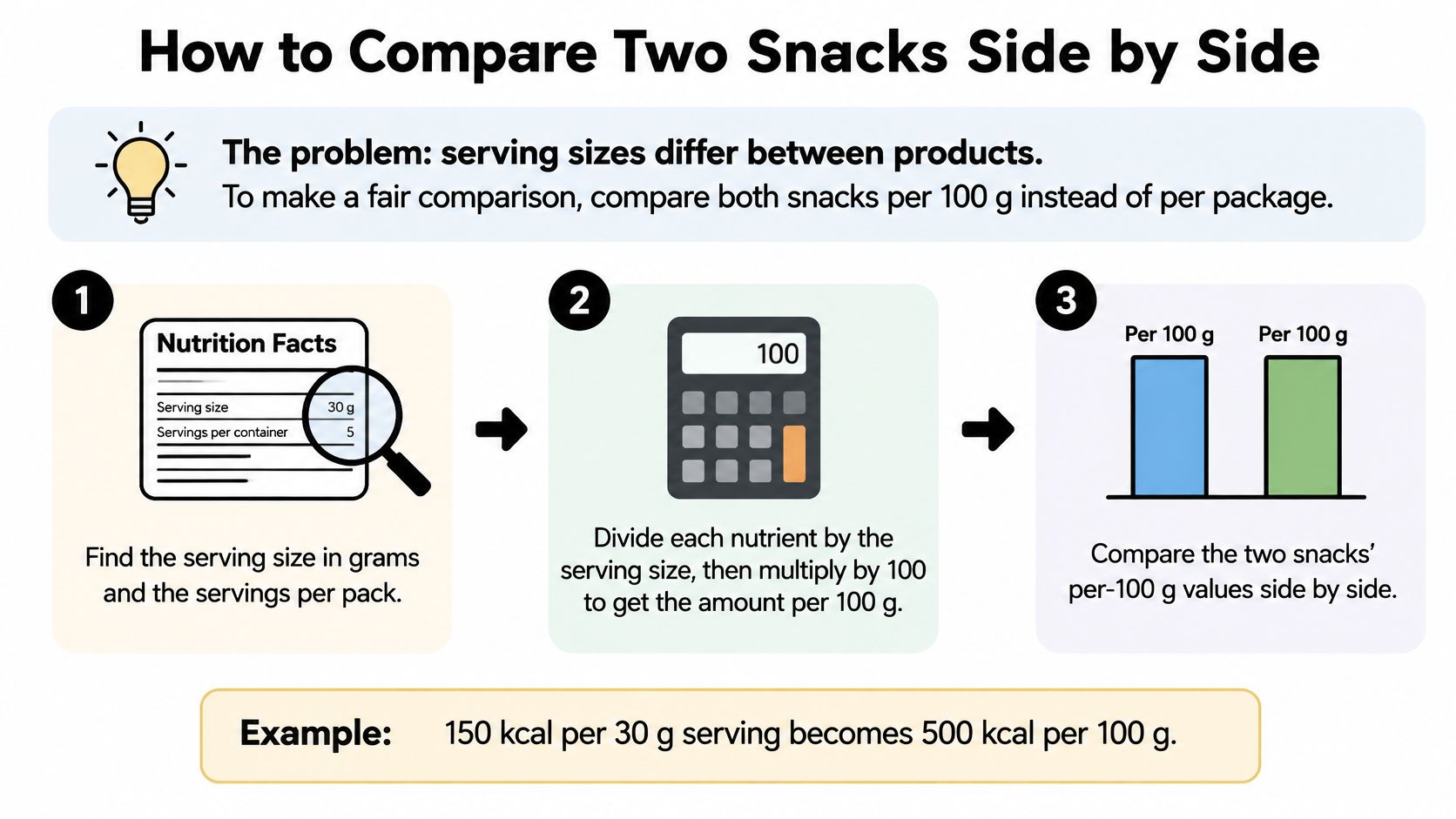
Use per 100 grams to compare equal quantities, then return to the portion you'll really eat. This is a calculation method, not a recommended snack size.
The visual below outlines the equal-weight approach.
A repeatable comparison method
- Find the portion: Record each product's serving weight and servings per package.
- Normalize the amounts: Divide each nutrient amount by the serving weight in grams, then multiply by 100.
- Match the columns: Place sugars, fiber, saturated fat, and sodium side by side using the same units.
- Apply your priorities: Check the results against your dietary needs rather than choosing a winner from sugar alone.
- Inspect the ingredients: Look for the ingredients responsible for sweetness and any ingredients you need to avoid.
- Check everyday usefulness: Compare portability, storage instructions, and price for the portion you'll eat.
- Make a conditional choice: Choose the product that meets your rule, or leave both out if neither does.
The formula is:
Nutrient per 100 grams = nutrient per serving ÷ serving weight in grams × 100
Equal weight and actual portions answer different questions
Consider a qualitative example: Snack A comes in a smaller portion and lists less sugar per serving. Snack B has a larger portion, so its serving contains more sugar, but after equal-weight comparison, B could still have less sugar per gram.
That doesn't automatically make B the better purchase. If you intend to eat the full serving, its larger portion still matters.
| Comparison | What it helps you decide |
|---|---|
| Per serving | What you'll consume in the planned portion |
| Per 100 grams | How concentrated the nutrients are at equal weight |
| Per package | What finishing the container would mean |
| Per usable portion | What the snack costs in practice |
Avoid comparing total sugars from one label with added sugars from another. If the product page doesn't provide matching information, acknowledge the gap instead of filling it with an assumption.
For a video resource to accompany your label check:
Equal-weight comparison reveals formulation differences; portion comparison keeps the decision realistic. You need both views, especially when comparing individually wrapped snacks with share-size bags.
Filtering for Low Sugar, Keto and Gluten-Free Needs
You find a snack marked “healthy,” then narrow the results by diet. The filter can save time, but it is only a first pass. A 2025 study of online grocery purchasing found that sorting products by healthiness rather than alphabetically improved average diet scores, increased purchases of Nutri-Score A or B products, and reduced purchases rated D or E. That supports using clear sorting tools, not treating a retailer's wellness category as proof. Separate research on online grocery recommendations shows that product positioning can influence choices, so the first result may not be the closest fit.
Diet filters and the label check behind each
| Diet goal | Filter or search term | What to check on the label | Common trap |
|---|---|---|---|
| Low sugar | Low sugar or no added sugar | Total and added sugars in the portion you plan to eat | Treating fruit-based sweetness as proof of low sugar |
| Keto | Keto or low carb | Carbohydrate amounts and how any net-carb claim is calculated | Accepting a marketing term without checking your own carbohydrate allowance |
| Gluten-free | Gluten-free | A certified gluten-free mark or explicit claim, plus shared-facility and cross-contact statements | Assuming another dietary claim proves gluten-free suitability |
| High fiber | High fiber | Fiber amount and serving weight | Comparing claims instead of the actual amounts |
| Vegetarian | Vegetarian | Ingredients against your own requirements | Treating vegetarian and dairy-free as interchangeable |
Set the rule before browsing
For low sugar, decide whether you want to reduce added sugar, limit total sugars, or manage carbohydrates more broadly. These are different tests, so products in the same search can meet one goal but not another.
For keto, look beyond the category name. If a brand highlights net carbohydrates, check its calculation method and whether that method fits your plan.
Gluten-free needs a product-specific check. Look for a certified gluten-free mark or an explicit gluten-free claim, then read statements about shared facilities or possible cross-contact. Verify the exact flavor and batch you plan to buy. A claim on another product line does not transfer to this one. The gluten-free snack guide can help you build a shortlist, but confirm each product's details before purchasing.
A filter can narrow the choices, but it cannot confirm details the listing leaves out.
Keep price visible as you compare. Divide the pack price by its total weight, then compare products on the same basis you used for nutrition. Price per 100 grams helps show the cost at equal weight, while the portion you will really eat keeps the comparison practical.
A snack can fit a diet rule and still be a poor choice for your budget, packaging preferences, or taste. Dietary suitability is one check, not a complete verdict.
Trusted Retailers Versus Brand-Direct Buying
In 2025, 16% of consumers said they bought snacks through online retailers such as Amazon Fresh or Imperfect Foods, according to Campfire Advisors' healthy-snack industry overview. Your own route should depend on the complete offer: selection, delivered price, seller accountability, and the condition of the food you receive.
Brand-direct shopping lets you investigate the brand's range and policies in one place. A retailer may let you combine snacks with groceries, while a marketplace listing requires closer attention to who sells the product in practice.
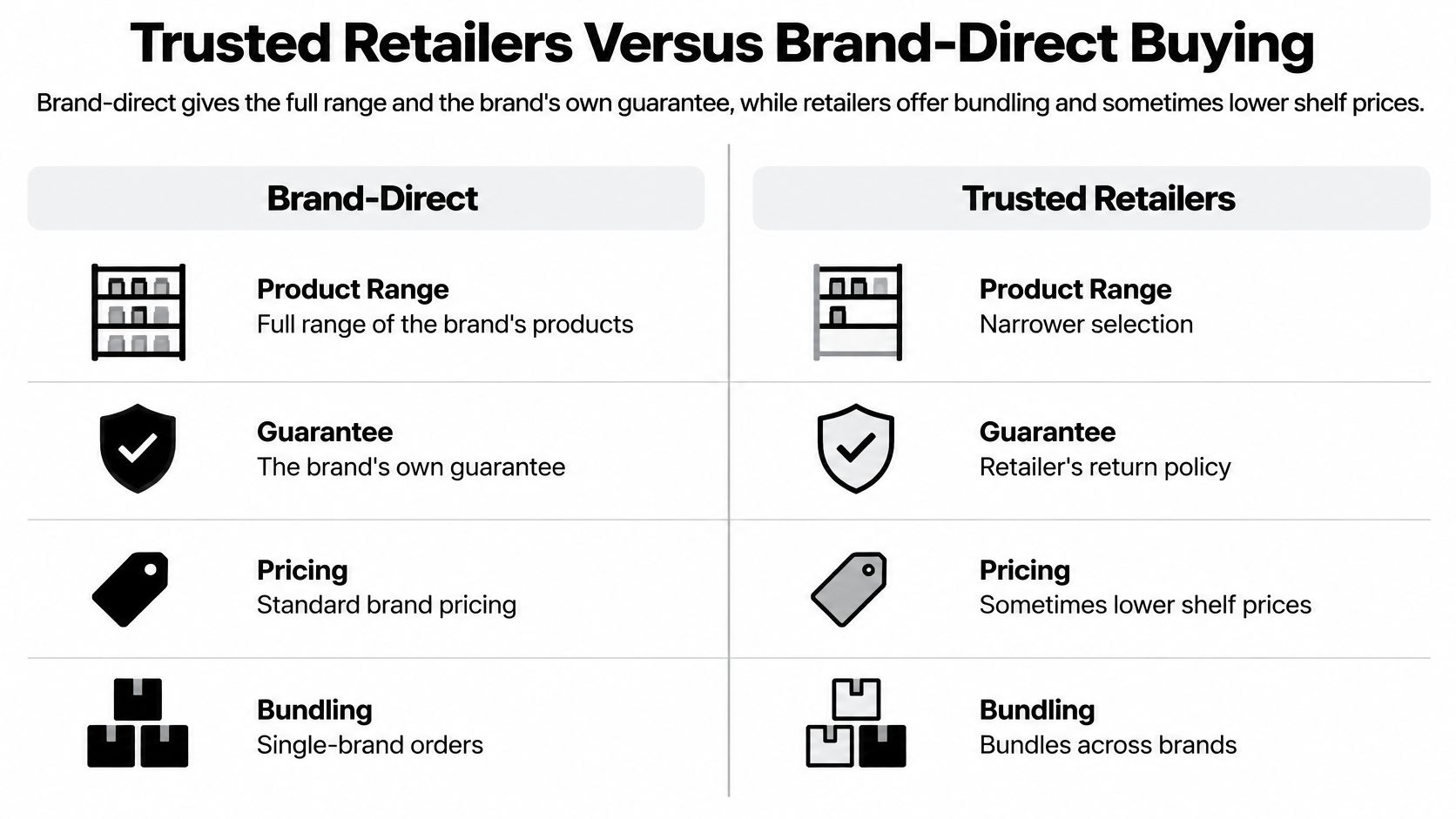
This chart highlights the questions to compare, rather than guarantees that every seller will meet them.
Buying routes compared
| Buying route | Price and promotions | Range and freshness |
|---|---|---|
| Brand-direct website | Check bundles, sign-up offers, and the delivered total | Browse the brand's listed range; confirm storage and dates |
| Large online grocer | Compare the added cost within your existing grocery order | Check which flavors and pack sizes are available |
| Health-food online retailer such as iHerb | Compare promotions, delivery charges, and eligibility | Review current listings and available freshness information |
| Retail partner or store locator | Confirm the actual store or online price | Verify availability and inspect the package date |
| Third-party marketplace seller | Don't assume the lowest listing has the lowest usable cost | Investigate seller identity, stock condition, and product origin |
Know who's responsible for the order
Check the seller of record, not just the website's logo. Then find out who handles a wrong item, damaged package, or complaint about product condition.
Don't assume direct purchasing always means newer stock, or that a large retailer always offers a narrower range. Treat those as questions to investigate for the specific order.
- Before payment: Confirm the seller, exact product, pack size, and fulfillment details.
- Before delivery: Consider whether the delivery arrangement suits the product's storage needs.
- On arrival: Inspect seals, package condition, and the best-by information.
An unknown marketplace seller is a little like a sealed box at an estate sale: you can see the price, but you may know little about its history. That uncertainty doesn't prove something is wrong; it tells you what you still need to check.
A bargain isn't useful if you won't eat the product you receive. Judge freshness and condition as part of value, not as an afterthought.
Shipping, Returns and Choosing Your Route
A basket below a free-shipping threshold gives you a choice: pay delivery, add something useful, or shop elsewhere. Adding unwanted snacks merely to remove a shipping charge can increase your spending without improving the order.
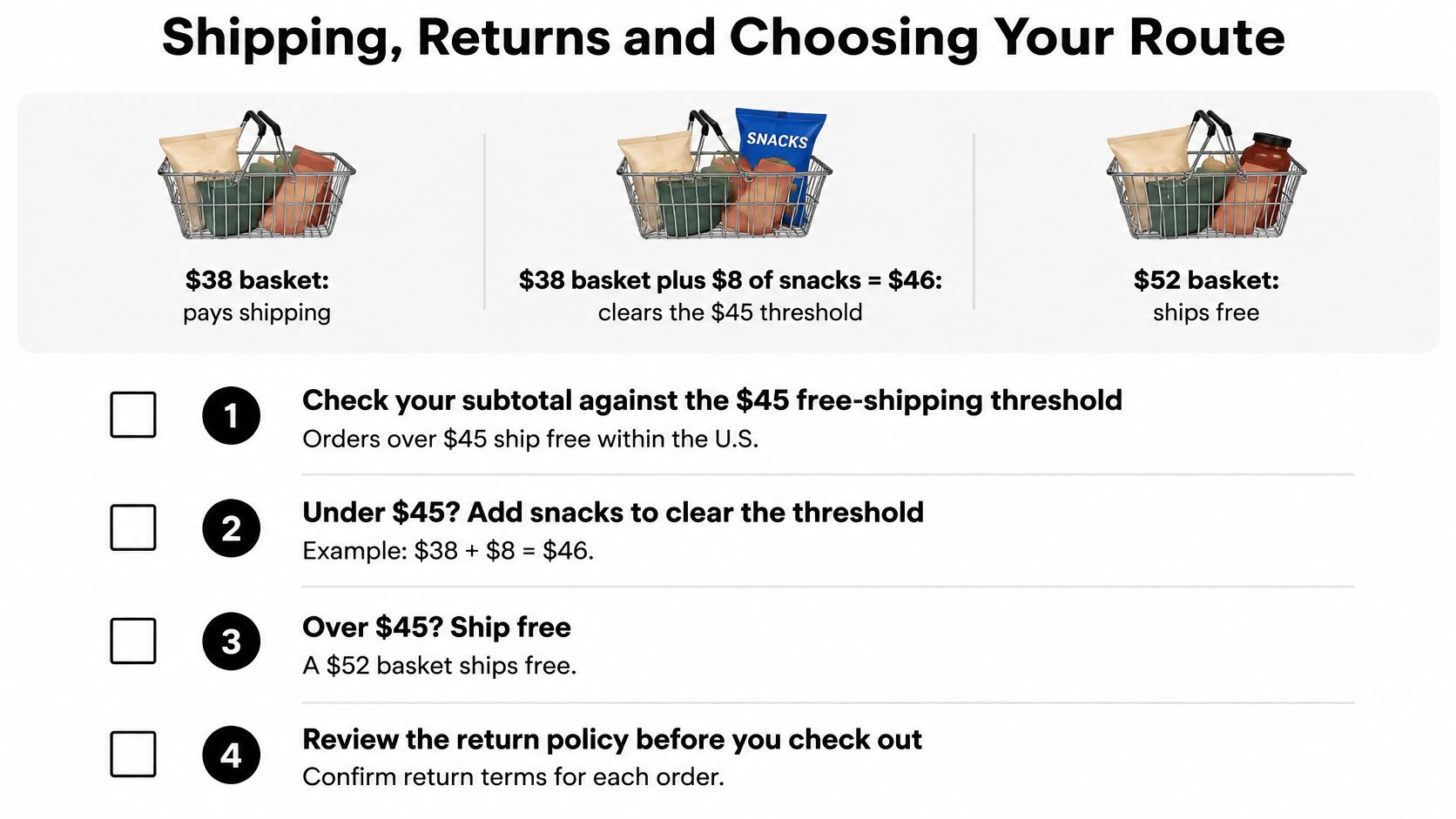
The direct store's published offer includes free U.S. shipping on orders over $45 and a 100% satisfaction Royal Guarantee; review the current shipping and returns terms before relying on either. A satisfaction promise is a useful starting point, but you still need to know how a claim works.
The visual below illustrates threshold arithmetic. Use the live checkout and policy terms for your actual purchase.
Policy terms that change the cost of an order
| Policy item | What good looks like | Brand-direct store | Retailer |
|---|---|---|---|
| Free-shipping threshold | Clear eligibility before payment | Confirm the current threshold and qualifying subtotal | Check whether your wider grocery basket qualifies |
| Satisfaction guarantee | Refund or replacement terms explained | Published satisfaction guarantee; verify its scope | Check whether dissatisfaction is covered |
| Return window | A clearly stated claim period | Confirm the current deadline | Confirm the deadline for food purchases |
| Damaged or melted in transit | A clear resolution process | Ask about heat damage, evidence, and replacement costs | Check seller-specific handling |
| International orders | Destination eligibility and import costs disclosed | Confirm available ordering routes | Check duties, carrier charges, and destination restrictions |
| Subscription terms | Clear renewal, change, and cancellation rules | Verify whether a subscription is currently offered | Review the particular program, not general store policies |
Compare delivered cost, not the shelf price
Build a realistic basket before comparing stores. Include only the snacks you intended to buy, apply valid discounts, and continue far enough through checkout to see delivery costs.
Then consider usable portions. A large pack isn't automatically economical if you won't finish it in acceptable condition, and a flavor you dislike won't become good value because you bought more of it.
Use this comparison checklist:
- Products: Are the pack sizes and flavors genuinely equivalent?
- Delivery: What will you pay after shipping and any other disclosed charges?
- Quantity: Will you comfortably use the amount you're ordering?
- Condition: Is there a clear process if the order arrives damaged?
- Commitment: Does the price depend on enrollment or a recurring purchase?
A retailer with a different shipping policy may be cheaper for a small basket, especially if the snacks join groceries you already need. A direct order may make more sense when you want several products from the same brand.
Neither route wins automatically. Compare the basket you'll really use.
Ask what the guarantee covers
Don't read “satisfaction guarantee” as a promise about every possible situation. Check whether it covers taste disappointment, damaged packaging, incorrect items, and opened packs.
Also look for the practical steps: whom to contact, what evidence to keep, and whether the resolution is a refund, credit, or replacement. Save your order confirmation until you've checked the delivery.
Before checkout: If a policy would affect whether you buy, resolve the uncertainty before you pay.
For international orders, investigate duties and carrier fees rather than assuming the checkout subtotal is the final cost. For heat-sensitive deliveries, ask how the seller handles a shipment that arrives in poor condition.
Make the first order a useful trial
Your first purchase should answer whether the snack works in your life. Can you carry it where you need it, do you like eating it, and does its portion fit your routine?
A recurring order should follow those answers, not precede them. An appealing introductory offer doesn't tell you whether you'll want the same quantity and flavors again.
- Choose the route that fits your basket, using brand-direct for its listed selection, a retailer for grocery consolidation, or a marketplace only after checking the seller.
- Check the final total and add threshold-filling items only when you really want them.
- Confirm the relevant policy for dissatisfaction, damage, and returns before payment.
- Inspect the delivery promptly, including the package condition and best-by information.
- Review recurring terms for skipping, pausing, changing flavors, cancellation, and renewal pricing before enrolling.
- Buy once if needed and set your own reorder reminder if no suitable subscription is available.
Keep the decision manageable: screen the label, choose a trustworthy buying route, and place an order you can evaluate before making a longer commitment.
Rip Van offers Dutch-style wafels, crispy wafers, wafer bars, and cookies, with dietary-benefit categories to help narrow your search. Visit Rip Van to compare the labels for your preferred flavors, check the delivered total, and try an order before deciding whether to make it a regular purchase.
0 comments