

You're standing in the snack aisle, hungry enough to grab something now but interested enough to make a better choice. Almonds look sensible, walnuts sound heart-friendly, pistachios seem easy to portion, and cashews are calling because they're creamy and mildly sweet. The question isn't whether nuts can belong in a healthy routine. It's which nuts fit your goal, how much you need, and what you'll enjoy eating.
Nuts for you works best as a goal-based toolkit, not a hunt for one magical “superfood.” The right choice can support a lower-carbohydrate snack, add texture and staying power to a small meal, or make a sweet treat feel more balanced. You'll also need to separate strong evidence from claims that are still developing, especially around gut health and diabetes.
Why Nuts Deserve a Spot in Your Daily Snack Routine
A handful of nuts can rescue a familiar afternoon moment. You've had lunch hours ago, dinner still feels distant, and the vending machine offers chips or candy. Nuts bring crunch like chips, richness like a dessert, and enough protein, fat, and fiber to make the snack feel substantial rather than fleeting.
That combination explains why nuts have moved beyond occasional holiday bowls. The International Nut and Dried Fruit Council's statistical yearbook estimated worldwide tree nut consumption at 1,651,450 metric tons in 2021, up from 1,241,949 metric tons in 2017 and 1,304,051 metric tons in 2018. Almonds and walnuts were the most widely consumed tree nuts in that dataset, but popularity doesn't make one variety universally right for every person.
Think in goals, not rankings
Consider three snackers. A person limiting carbohydrates may prefer pecans, macadamias, or walnuts. Someone prioritizing cardiovascular health may reach for walnuts or almonds. A student who needs a filling, portable bite may choose pistachios or peanuts, then use a measured portion rather than eating directly from the bag.
Those choices can all be sensible, but the reason matters. Nuts are energy-dense, so “healthy” doesn't mean unlimited. A portion that fits your afternoon can become much more than you intended if you keep the container beside your keyboard.
Practical rule: Choose the nut for the job, then choose the portion before hunger chooses for you.
Nuts also work best inside a broader snack pattern. Pairing them with something crisp, creamy, or lightly sweet can make a small serving satisfying enough to repeat. For more context on why planned snacks can support everyday eating habits, explore why healthy snacks are important.
By the end of this guide, you should be able to look at a nut variety and ask a useful question: does it match my carbohydrate target, heart-health priorities, satiety needs, taste preferences, and food-safety requirements? That's a much more practical question than asking which nut is “the healthiest.”
What Makes Nuts So Nutritious
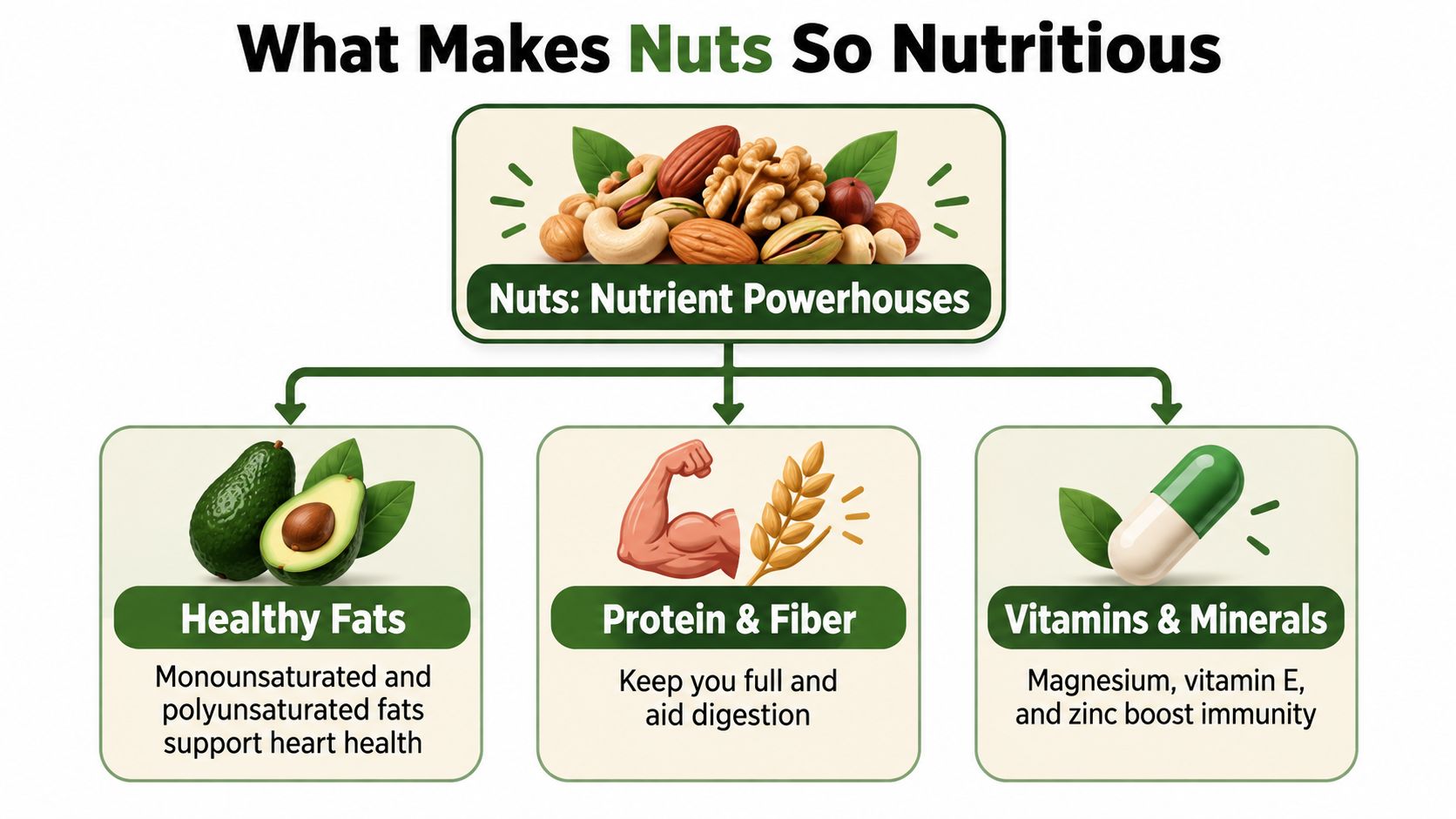
Nuts are small, but their structure gives them unusual staying power. Think of a quick sugary snack as kindling that catches quickly, while nuts are closer to a slow-burning log. Their fat, protein, fiber, and relatively low available carbohydrate digest at different rates, so the snack tends to feel steadier.
Three parts of the nutrition equation
Fat supplies richness and slows the speed at which a snack leaves your stomach. Most nut fat is unsaturated, which is one reason nuts fit naturally into heart-conscious eating patterns.
Protein gives the snack structure. It helps you build a more substantial bite, especially when you pair nuts with fruit, yogurt, or a low-sugar baked snack rather than eating a sweet food by itself.
Fiber adds bulk and supports fullness. It also changes the physical texture of the snack, so chewing takes longer than it does with a soft, rapidly eaten sweet.
Nuts contain relatively little available carbohydrate. In a controlled comparison summarized in this review of nuts and glycemic responses, mixed nuts provided about 9 g of carbohydrate, compared with 25 g in potato chips. The same comparison reported a glycemic index of 34 for mixed nuts versus 73 for potato chips, alongside lower after-meal glucose responses.
That doesn't mean every nut product has the same effect. Sugar coatings, sweetened nut butters, chocolate additions, and large portions change the overall snack. It also doesn't turn nuts into a treatment for blood-sugar conditions. The useful takeaway is narrower: a low-available-carbohydrate food with fat and fiber can release energy more gradually than a snack built mainly from rapidly digested starch.
Why the texture matters
Your body responds to more than a nutrition label. Whole nuts require chewing, and their firm texture naturally slows the pace of eating. A chopped nut topping can make yogurt or oatmeal more satisfying, while nut butter offers the same general food family in a faster-to-eat form.
Nuts also supply micronutrients, including vitamin E, magnesium, zinc, and other minerals. Those nutrients add value, but they shouldn't distract from the central habit: use nuts as a compact combination of fat, protein, fiber, and flavor, then fit the portion into your day.
Meet the Most Popular Nut Varieties and Their Strengths
A nut's personality matters. Walnuts bring a soft, slightly bitter richness; pistachios offer a firm bite and built-in pauses when you shell them; cashews taste buttery and mild. Nutrition can guide the choice, but flavor and texture determine whether the habit lasts.
The global market also reflects familiar preferences. The International Nut and Dried Fruit Council yearbook identifies almonds and walnuts as the most widely consumed tree nuts in its 2021 dataset. That prominence makes them easy starting points, not automatic winners.
Popular nuts at a glance
| Nut variety | Standout nutrient strength | Flavor and texture | Best for |
|---|---|---|---|
| Almonds | Fiber, vitamin E, and plant protein | Firm, crisp, gently sweet | A versatile everyday snack |
| Walnuts | Unsaturated fat, including plant omega-3 fat | Soft, earthy, slightly bitter | Heart-conscious combinations |
| Pistachios | Protein, fiber, and a naturally portion-friendly shell | Savory, lightly sweet, pleasantly firm | Slow snacking and topping bowls |
| Cashews | Creamy texture and useful plant protein | Mild, buttery, subtly sweet | Blended sauces and satisfying snacks |
| Pecans | Rich unsaturated fat and a dessert-like flavor | Tender, crisp, deeply buttery | Lower-carbohydrate snack ideas |
| Brazil nuts | Mineral density, especially selenium | Large, creamy, bold | Occasional variety in a mixed serving |
| Peanuts | Protein, fiber, and familiar affordability | Roasted, nutty, crunchy or creamy | Protein-focused snacks and spreads |
Peanuts are legumes botanically, but they're often used like nuts, so they belong in the practical comparison. Brazil nuts also deserve restraint. Their size and mineral density make them a distinct choice, but “more” isn't automatically better.
Flavor can solve a common problem: buying a food because it sounds healthy, then abandoning it in the cupboard. If walnuts taste too sharp, try them with apple slices or yogurt. If almonds feel dry, choose roasted almonds or add them to a creamy snack. If cashews disappear too quickly, buy a portioned pack or combine them with a higher-volume food.
The table is a map, not a prescription. Your best nut may be the one that fits your dietary target, survives your commute, and keeps you from reaching for a less satisfying snack an hour later.
Best Nuts for Your Specific Health Goals
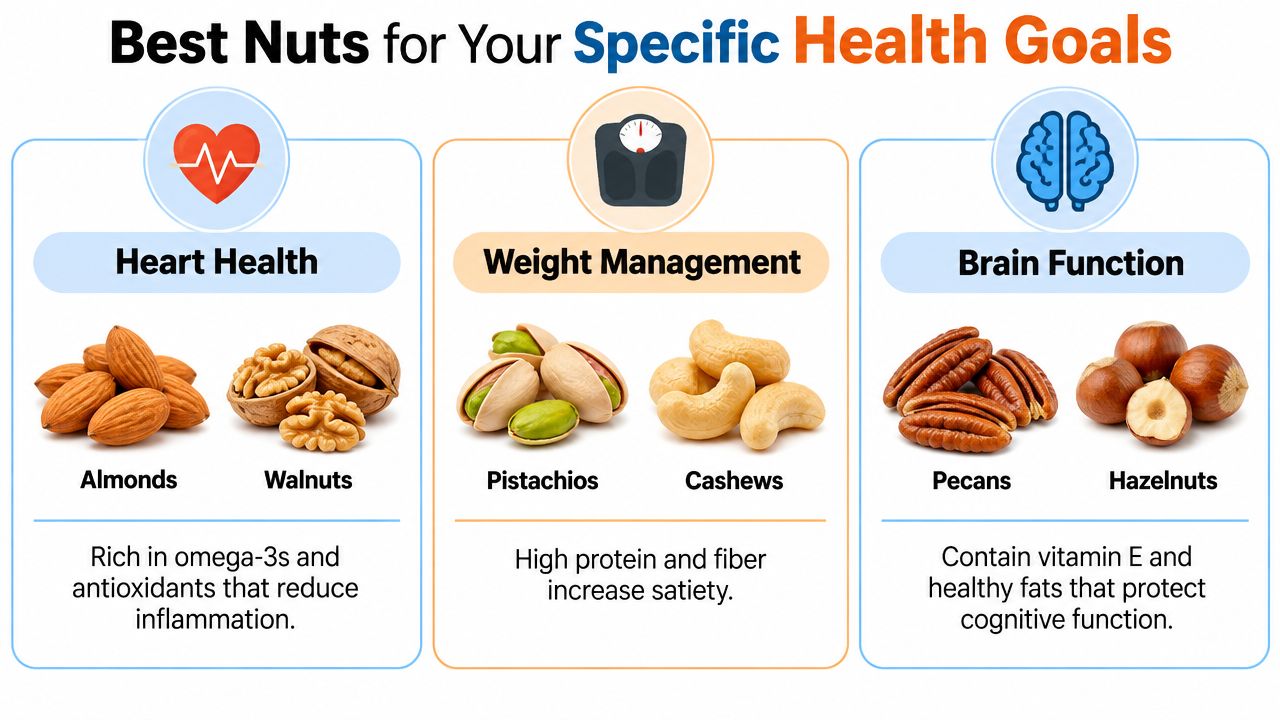
The best nut changes with the job. A keto-oriented snack needs low available carbohydrate and no sugary coating. A heart-focused choice benefits from a pattern rich in unsaturated fats. A protein-and-satiety snack needs enough substance to carry you to the next meal.
Match the variety to the priority
For keto and lower-carb eating, pecans, walnuts, almonds, and macadamias are practical starting points because they're naturally low in available carbohydrate. Check the full label on flavored products, because coatings can add sugar. The goal isn't to eat an unlimited amount. It's to choose a compact snack whose carbohydrate contribution matches your plan.
For heart health, walnuts and almonds are strong candidates, but the evidence belongs to the overall eating pattern rather than one variety in isolation. A large meta-analysis summarized in this report on nuts, mortality, and cardiovascular outcomes associated about 28 g of nuts per day with a 21% lower relative risk of cardiovascular disease and 22% lower all-cause mortality. Those are associations from pooled evidence, not a promise that a particular nut prevents disease.
For protein and satiety, peanuts, almonds, pistachios, and cashews can all work. A review of clinical literature reports that nuts generally increase satiety and can improve insulin-resistance markers, with meta-analytic evidence around median intakes of 52 g per day. Read that as evidence about patterns and outcomes, not a target everyone should force into their diet. You can learn more about practical food choices in this guide to reduce cholesterol naturally with diet.
A quick decision matrix
| Your priority | Start with | What to check |
|---|---|---|
| Lower carbohydrate | Pecans, walnuts, almonds | Added sugar and serving size |
| Heart-conscious eating | Walnuts, almonds, pistachios | Salt, preparation, and overall diet |
| Protein and fullness | Peanuts, pistachios, almonds | Whether the portion carries you to the next meal |
| Crunch with built-in pacing | Pistachios in shells | Your total serving, not just shell count |
The evidence isn't equally strong for every popular claim. Cardiovascular outcomes have the clearest support. Gut-microbiome findings remain modest and variable, while diabetes results are mixed, so “nuts improve gut health” or “nuts control diabetes” is too broad without context.
Use the toolkit this way: choose a variety that supports your objective, select an uncoated or lightly seasoned version, and measure enough to make the snack useful without turning it into an accidental meal.
Smart Portions and Satisfying Snack Ideas
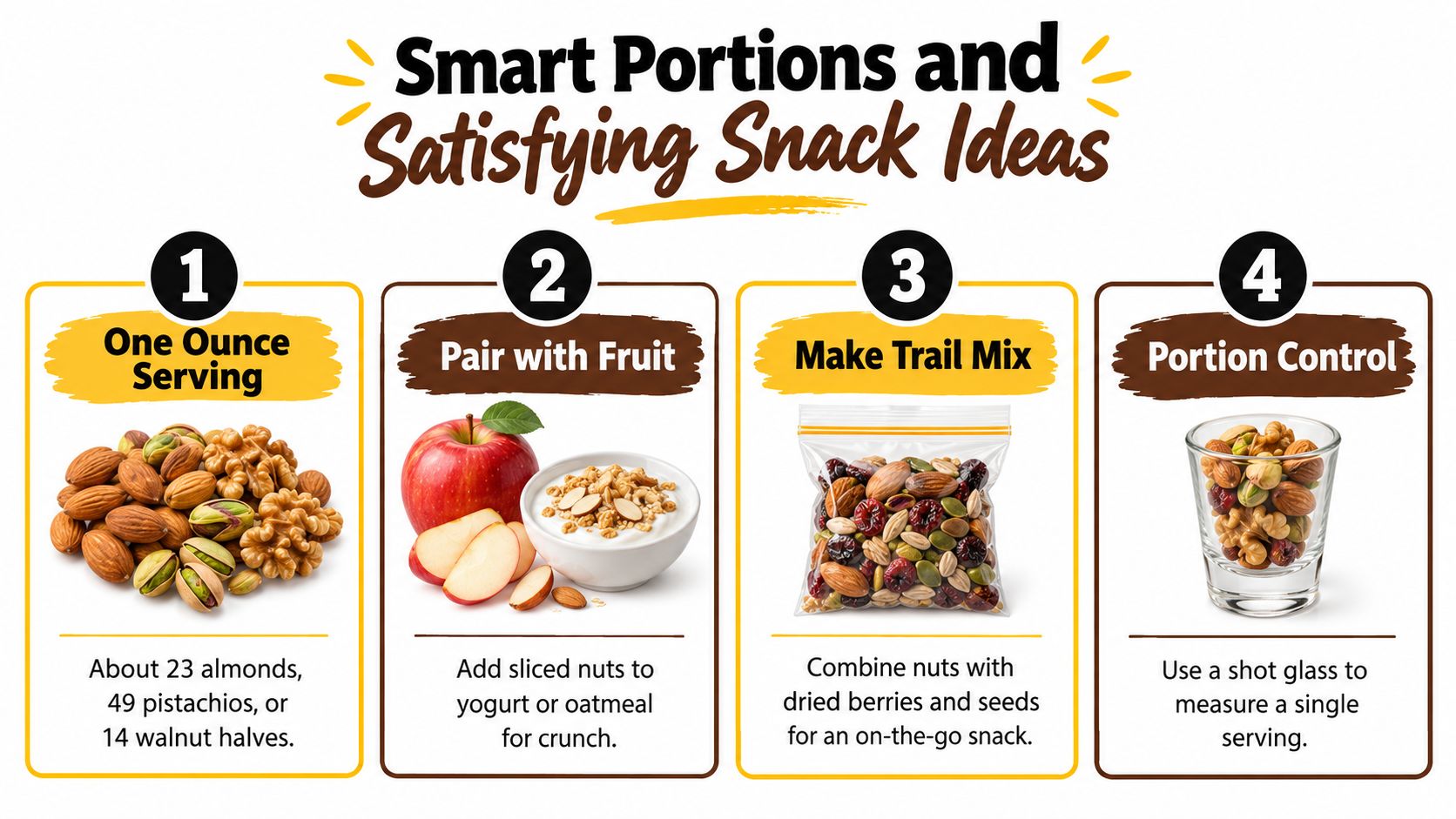
Nuts can be nutritious and easy to overeat at the same time. A mainstream consumer explainer places an average one-ounce serving at about 180 calories in its discussion of nut portions and health. That energy density isn't a reason to avoid nuts. It's a reason to make the serving visible before you start.
Build the portion first
A one-ounce serving is roughly a small palmful, but hands vary. A small bowl, measuring cup, or pre-portioned container gives you a more reliable starting point than eating from a large bag. The infographic's visual cues include about 23 almonds, 49 pistachios, or 14 walnut halves, but count-based estimates can vary with nut size.
A useful routine looks like this:
- Pour before sitting down. Put the amount you plan to eat into a bowl, then close the package.
- Pair for satisfaction. Add fruit, plain yogurt, vegetables, or a low-sugar snack with fiber.
- Slow the first few bites. Notice whether you want more flavor, more volume, or more food.
- Adjust the next serving. If you're hungry again quickly, build a more complete snack instead of reflexively doubling the nuts.
Four combinations that need no cooking
- Apple and almond crunch: Slice an apple and add a measured portion of almonds. The fruit brings freshness and volume, while almonds add chew and richness.
- Pistachio yogurt cup: Stir pistachios into plain or lightly sweetened yogurt. Add cinnamon or berries if you want more flavor without relying on a candy coating.
- Walnut oatmeal topper: Use chopped walnuts on oatmeal, then add seeds or fruit according to your hunger and carbohydrate plan.
- Peanut butter banana bite: Spread a thin layer of peanut butter on fruit or a crisp snack. Check the ingredient list for added sugars and oils if that matters to you.
A trail mix can also work, but keep the mix deliberate. Combine nuts with seeds and a small amount of dried fruit rather than filling a bag with equal parts of every sweet ingredient. Portable snacking has helped make nuts more convenient, and online shopping has become a growing route for snack-nut purchases in developed markets, but convenience still needs portion control.
For more hands-on ideas, see this guide to portion control snacks. The best routine is one you can prepare quickly, carry safely, and repeat without feeling deprived.
Allergy Safety Labels and Storage Tips You Should Know
Nutrition only helps when the food is safe and fresh. Nut allergies can cause serious reactions, and the verified evidence summarized in the available research places allergy or adverse reactions at 1–2% of adults. That figure still represents a meaningful safety concern, especially in shared kitchens, schools, offices, and homes with children.
Read the package beyond the front panel
Start with the allergen statement, then inspect the ingredient list. “Nutty,” “roasted,” or “protein” on the front doesn't tell you whether a product contains peanuts, tree nuts, or ingredients made alongside them. Look for sweet coatings, syrups, chocolate inclusions, added oils, and salt if those ingredients conflict with your goals.
Use this buying checklist:
- Allergen statement: Identify the specific peanut or tree-nut warning.
- Ingredient list: Check whether sugar, syrups, oils, or flavor coatings appear early.
- Serving information: Compare the listed serving with the amount you normally eat.
- Package condition: Skip packages that are damaged, damp, or visibly compromised.
- Freshness date: Choose a product with a reasonable best-by date for your use.
For general allergy education and practical health guidance, Vitamin Planet health advice can provide additional context. Anyone with a diagnosed allergy should follow their clinician's emergency plan, not rely on a general snack guide.
Protect the flavor at home
Nuts contain fats that can become rancid. An off, paint-like, or stale taste is a reason to discard them, not mask them with seasoning. Keep nuts in an airtight container away from heat, light, and moisture. Refrigeration or freezing can help preserve quality when you won't use them soon, while a cool cupboard can work for a shorter period.
Don't assume soaking makes nuts safer or more nutritious. The available food-safety research notes that soaking at room temperature can create conditions that support bacterial growth, and research doesn't support broad claims that “activating” nuts improves nutrient absorption.
For a practical guide to evaluating packaged foods, read how to read nutrition labels. A safe nut routine is simple: buy fresh, seal tightly, store appropriately, and stop eating the product if its smell or taste has changed.
Delicious Ways to Pair Nuts with Rip Van Snacks
A balanced snack should satisfy more than one sense. Nuts provide crunch and richness, while a low-sugar wafer or cookie can bring a lighter, sweeter finish. The pairing works best when you treat the snack as a small composition, not an excuse to pile every appealing ingredient into one bowl.
For an afternoon desk snack, try measured almonds with a Rip Van Nutty Crunch Dark Choco Peanut Butter snack. The peanuts and chocolate-style flavor create a familiar dessert profile, while the nuts add a separate crunchy texture. If hazelnut is your preference, pair a portion of toasted hazelnuts with Crispy Dunes Chocolate Hazelnut or Chocolate Hazelnut Wafers, checking the package for allergen information before serving.
Match pairings to real moments
For commuting: Carry a small container of pistachios with a low-sugar wafer. Pistachios make the eating pace more deliberate, and the wafer gives you the treat element many “healthy” snacks lack.
For a post-workout bite: Combine almonds or peanuts with yogurt or milk if those foods fit your routine. A sweet snack alone may not feel substantial, while nuts help add texture and macronutrient density.
For family snack time: Offer separate portions rather than one open bag. Children can choose between pistachios, almonds, or another tolerated variety alongside a low-sugar cookie, making the serving visible and reducing accidental grazing.
Rip Van's portfolio includes Dutch-style wafels, crispy wafers, wafer bars, LEOS and Romeos cookies, Crispy Dunes, and Crispy Choco varieties. The brand describes its products as low sugar, with no corn syrup or artificial sweeteners, natural flavors, no artificial colors, and non-GMO ingredients, with dietary filters that include gluten free, keto, low sugar, and vegetarian options. Check the current product label because formulations and availability can change.
Pairing food can also be part of a broader hosting ritual. If you're building a snack board for adults, nuts and a restrained sweet bite can sit alongside fruit and other foods. For a different kind of membership-based indulgence, you might compare the wine club membership benefits, but keep alcoholic drinks separate from everyday snack goals and personal health needs.
The strongest pairing follows one rule: let the nut do the filling, crunchy work, and let the sweet snack provide a controlled flavor accent. That approach gives you room to choose pecans for lower-carbohydrate eating, walnuts for a heart-conscious pattern, or pistachios when you want a slower, more interactive snack.
Rip Van offers low-sugar wafels, wafers, cookies, and bars that can complement a measured serving of nuts when you want a portable snack with contrasting textures. Explore the current options at Rip Van, filter by your dietary preferences, and build a pairing that fits your goal and your appetite.
0 comments