

You're standing in the cracker aisle, comparing a rustic-looking box with a familiar standard cracker. The front promises stone ground, perhaps alongside words such as whole grain, multigrain, or natural. It feels like the better choice, but the important question is hiding on the back: does stone milling change the cracker's nutrition, or only its production story?

A 40,000-Year-Old Idea in a Snack Aisle
Stone grinding sounds artisanal, but the underlying idea is ancient. Archaeological evidence from Italy indicates that humans processed wild cereals and other plants with grindstones approximately 39,000–43,000 years ago, during the transition between Neanderthals and Homo sapiens (archaeological evidence on early grinding).
Those early tools weren't making packaged crackers. They were helping people turn plants into flour that was easier to store and transport. Much later, flatbreads, hard biscuits, and crackers followed a related path: grind grain, add liquid, and bake a portable food.
The industrial story changed in the nineteenth century, when roller mills became more economical and efficient. That history helps explain why “stone ground” still carries meaning, much like a carefully developed brand story strategy for consumer packaged goods. It describes a process, but it doesn't automatically describe the finished cracker's fiber, sodium, or blood-sugar effect. For a useful comparison with other minimally processed snacks, see this guide to minimally processed snacks.
What Stone Milling Actually Does to Grain
Think of stone milling as cracking a nut between two rough surfaces rather than slicing it into neat pieces with a blade. The grain kernel is reduced through pressure and friction, producing flour with a particular particle structure.
A comparative study of whole-wheat flours found that stone milling produced a relatively uniform particle-size distribution, with many particles between 315 and 710 micrometers, while roller-milled flour showed a more bimodal distribution dominated by particles below 250 micrometers and above 1,000 micrometers (comparative flour milling study).
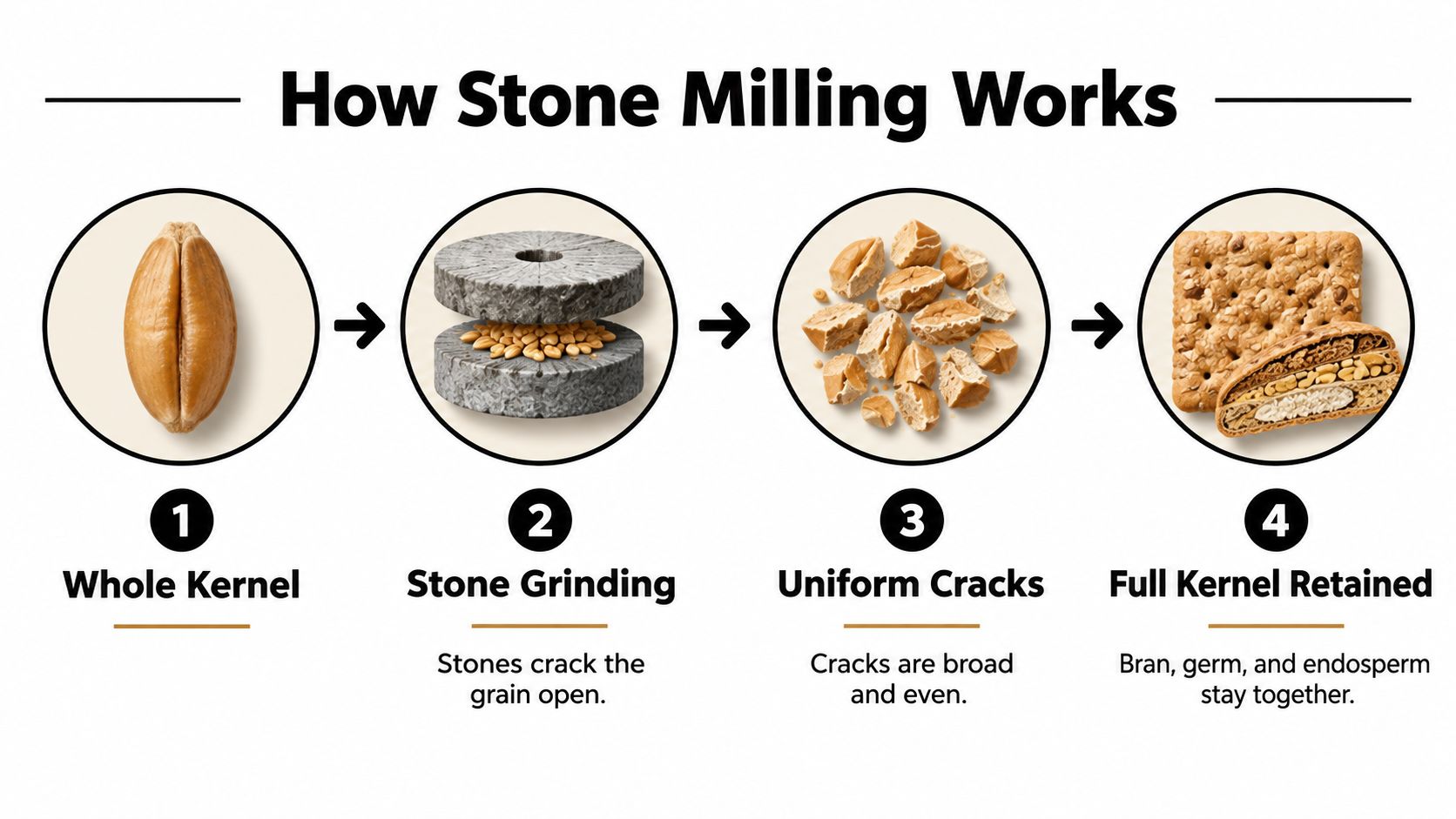
The key distinction is what the mill does with the kernel's parts. Whole-kernel stone grinding can keep the bran, germ, and endosperm together, while roller milling often separates and removes more bran and germ when producing refined flour. That doesn't mean every stone-ground product is whole grain. The label still depends on the actual ingredients.
Practical rule: “Stone ground” tells you how grain was milled. It doesn't tell you how much whole grain ended up in the cracker.
Particle structure can influence dough handling and texture, which is why stone-ground crackers may feel more substantial or taste more grain-forward. For a related explanation of soluble and insoluble fiber, it helps to remember that milling structure and fiber type are separate questions. For sensory inspiration beyond the pantry, even wine and art tours in Calistoga show how process and presentation can shape expectations without replacing the underlying product details.
Stone Ground vs Whole Grain vs Multigrain
These three terms answer different questions.
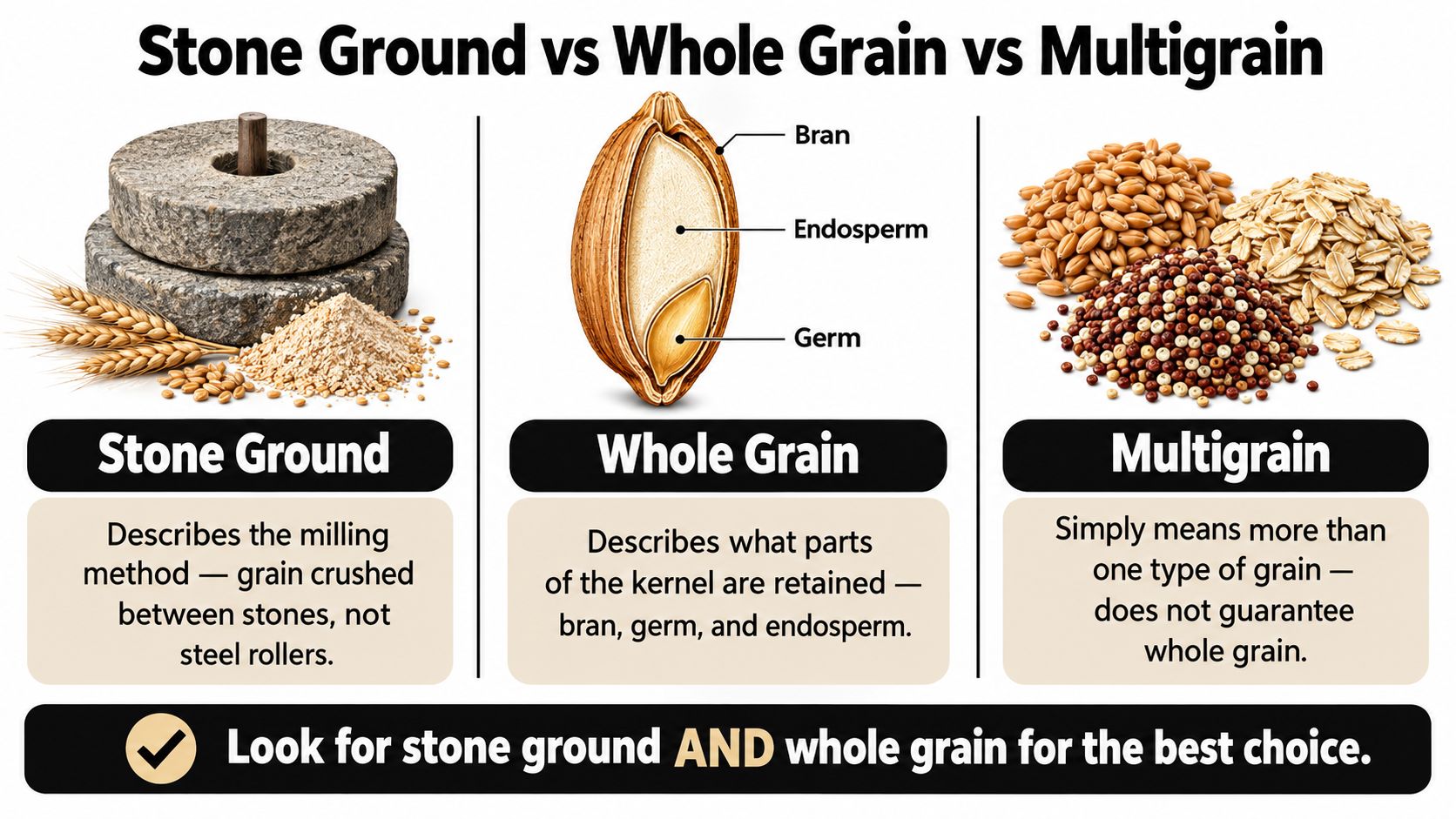
Stone ground describes the milling method. Whole grain describes whether the bran, germ, and endosperm remain in the grain ingredient. Multigrain only means that more than one type of grain is present. A multigrain cracker may contain several refined grains, so the word alone doesn't guarantee whole-grain nutrition.
Milling method also isn't a reliable shortcut for predicting glycemic response. In a controlled cracker study, conventional-flour crackers had a glycemic index of 90, crackers containing 30% whole-wheat flour had a GI of 77, and crackers containing 30% sunflower-seed flour reached a GI of 53 (controlled cracker study).
That pattern points to the bigger lesson. Protein, soluble fiber, seed or legume ingredients, cereal type, and the final baked structure can matter more than the mill pictured on the package. A stone-ground cracker may be a good choice, but you'll need to verify the formulation rather than treating the milling term as a health guarantee.
How to Read a Stone Ground Cracker Label
A rustic mill illustration can make a cracker look wholesome before you have checked what is inside. Start with the ingredient list. Find the grain used first, then see whether whole grain appears among the leading grain ingredients or refined flour comes earlier. “Multigrain” and “made with whole grains” need the same careful reading because neither phrase identifies the main flour by itself.
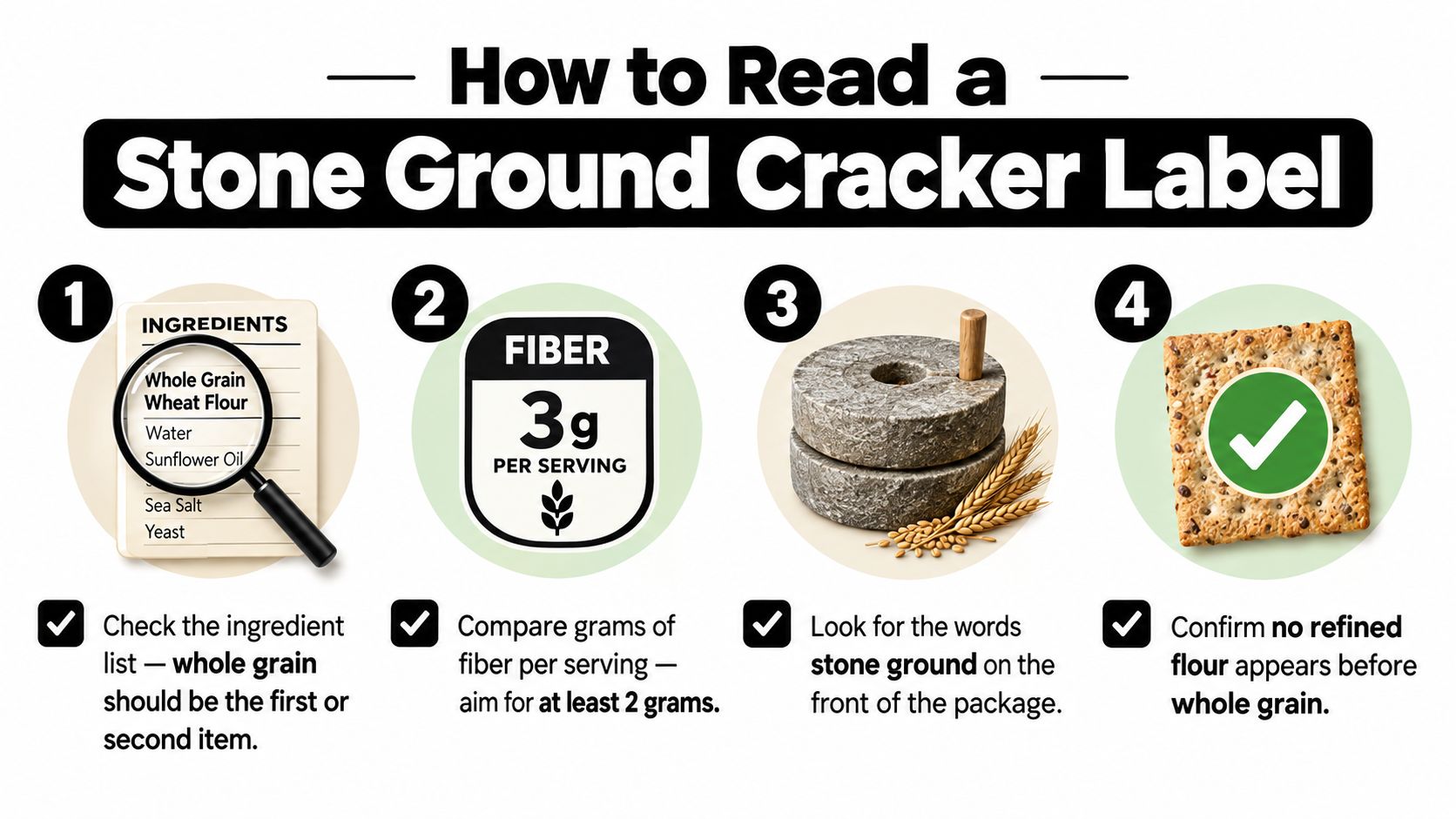
Milling explains how the grain was processed. The Nutrition Facts panel explains what the finished cracker contributes. Compare fiber grams per serving, rather than relying on words such as wheat, grain, or natural. FDA labeling requires fiber grams and % Daily Value on the panel; separate soluble and insoluble amounts are required only when the package makes a related claim (FDA dietary fiber labeling information).
The FDA's draft guidance on whole-grain label statements uses a threshold of at least 51% whole-grain ingredients by weight for whole-grain health claims (FDA whole-grain label guidance). Because it is draft guidance, treat that threshold as context, not a guarantee that a cracker fits your dietary goal. Use this guide to reading nutrition labels to make the comparison routine: goal first, sodium and fiber next, package imagery last.
Matching Cracker Styles to Your Goal
Choose the cracker by dietary goal first. Fiber, sodium, and protein describe what you eat; stone milling describes how the grain was processed. The package image belongs last in the decision.
| Cracker Style | Typical Fiber | Key Tradeoff | Best For |
|---|---|---|---|
| Stone-ground whole wheat | Roughly 2 to 4 g per serving, depending on the flour blend | May still contain substantial sodium or some refined flour | Shoppers seeking whole-grain texture and flavor |
| Seed-based | Roughly 3 to 5 g per serving | Seeds can change calories, fat, and texture | Shoppers seeking more protein or fiber potential |
| Low-carb | Roughly 3 to 8 g per serving, often from added or alternative fibers | Fiber totals may not reflect the same grain structure | People following a low-carbohydrate pattern |
| Standard refined | Roughly 0 to 2 g per serving | Often less fiber, though sodium may be lower | Shoppers prioritizing taste, price, or sodium |
Use the serving size as your measuring cup. A product can offer 7 g of fiber and still contain 430 mg of sodium per serving, as shown in FDA Nutrition Facts examples (FDA Nutrition Facts fiber example). That combination makes the comparison more useful than a health-focused front label.
For higher fiber, compare grams per serving and check the ingredient list for the main flour. For lower sodium, compare sodium directly, even among whole-grain crackers. If blood-sugar response matters, consider fiber, protein, carbohydrate, and portion size together. A less dramatic-looking cracker with lower sodium and a realistic serving may fit your everyday goal better.
A Simple DIY Stone Ground Cracker Plan
Begin with a stone-ground whole-grain flour and add enough water to form a cohesive, rollable dough. Because particle structure affects absorption, add liquid gradually and give the dough a short rest before deciding it needs more flour.
For a more substantial formulation, replace part of the flour with seed or legume flour. The controlled cracker research described earlier found a lower GI with sunflower-seed flour, but a homemade result shouldn't be assumed to match a clinical value. Bake the dough thin and evenly, then judge the finished cracker by its texture, flavor, and measured nutrition rather than by the stone-ground label alone.
Putting It All Together
Stone ground crackers can offer an appealing texture and a meaningful connection to an older milling tradition. But stone ground is a processing description, not a nutrition guarantee. Choose by goal first, then compare fiber, sodium, protein, saturated fat, ingredients, and serving size. U.S. CDC data show that whole grains represented 15.8% of adults' total grain intake during 2013–2016, with intake ranging from 12.9% among adults aged 20–39 to 19.7% among adults aged 60 and older (whole-grain intake data). For another way to think about flavor and protein-forward snack choices, you can browse Macro Mike protein flavours. Sometimes, a lower-sodium standard cracker eaten in a realistic portion is smarter than a premium product relying on craft language.
Rip Van offers low-sugar, better-for-you wafels, wafer bars, cookies, and crispy snacks that make label comparison easier when you're building a balanced snack drawer. Visit Rip Van to explore options by dietary preference and find a convenient treat that fits your goals.
0 comments