

At 3 p.m., the light is cutting across your desk, your attention is fading, and your hand is already reaching for something sweet. A wellness reminder appears on your phone just as you're deciding between a familiar cookie, a chocolate bar, or the snack in the cupboard that promises “better-for-you” indulgence.
That moment captures the appeal of low sugar sweet treats. You don't necessarily want to give up comfort, crisp edges, chocolate, caramel, or a soft cookie center. You want a treat that fits your priorities without asking you to pretend that a dry, chalky substitute is satisfying. The useful question isn't just how little sugar a product contains. It's what replaces the sugar, and whether that replacement preserves the eating experience.
Why Low Sugar Sweet Treats Matter Right Now
A cookie can fit a lower-sugar routine and still disappoint if its sweetness is replaced with chalky texture, a cooling aftertaste, or a short, unsatisfying bite. That is why the useful question is not only how much sugar appears on the panel. It is what replaces it, and whether fiber, polyols, or other sweeteners preserve the texture people want.
Sugar also arrives outside the dessert aisle. Drinks, sauces, breakfast foods, cookies, and snack bars can all add to the day's total. The World Health Organization recommends keeping free sugars below 10% of total daily energy intake, with additional health benefits below 5%. That guidance has encouraged reformulation across candies, cookies, wafers, and other indulgent snacks. (HTF Market Insights)
The wider food system continues to put sugar-reduction choices in front of shoppers. Global sugar consumption rose from about 130 million tonnes in 2000/2001 to 178 million tonnes in 2013/2014, and was expected to reach about 182 million tonnes in 2014/2015. The OECD-FAO Agricultural Outlook projects continued expansion of 1.2% per year, reaching 202 million tonnes by 2034. Practical alternatives therefore remain relevant, rather than a passing diet trend.

The category now extends beyond a specialist shelf. One market tracker valued global sugar-free confectionery at USD 2.45 billion in 2024 and projected USD 3.16 billion by 2030. Other estimates also forecast expansion, although their scope and methods differ. Together, these reports indicate a durable segment shaped by sugar reduction, wellness interest, and alternative sweeteners. (Market Report Analytics)
A lower number on the label does not guarantee a better treat. Judge the replacement strategy, including texture, fiber, sweetener tolerance, ingredient quality, and satisfaction. For practical ways to reduce sugar intake, ways to reduce sugar intake offers a useful starting point. A sustainable routine can include treats, chosen with intention.
What Counts as a Low Sugar Sweet Treat
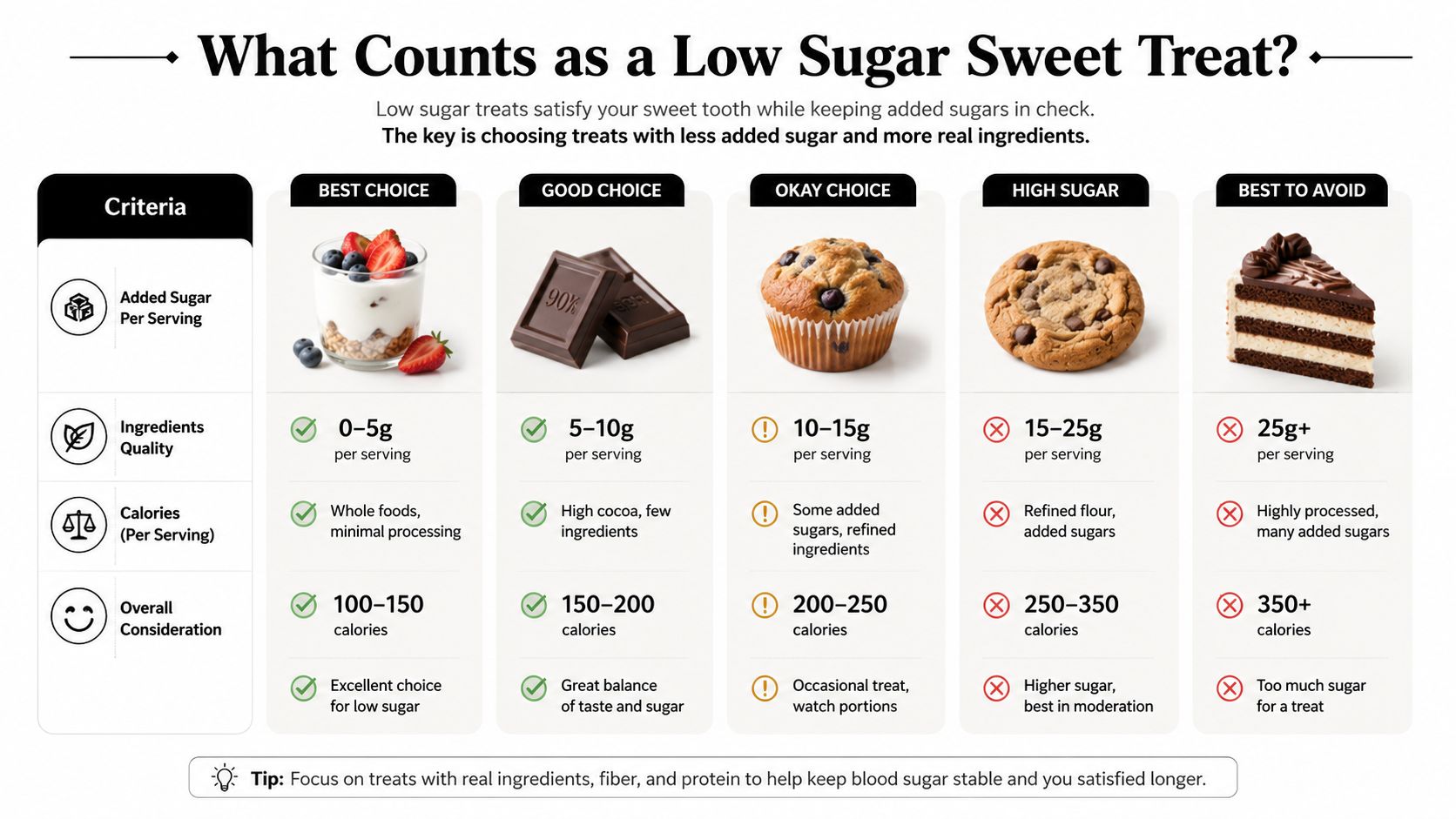
A low sugar sweet treat is a sweet-tasting snack or dessert deliberately made with less added sugar than a conventional counterpart while still aiming to deliver the flavor, aroma, and texture people expect. A chocolate cookie can remain crisp or chewy. A wafel can still have a delicate snap and a sweet filling. The point is to reduce sugar without removing the sensory reasons people reach for the product.
The terminology gets confusing because several claims sit close together on the package.
Three claims that aren't interchangeable
Low sugar describes a relative reduction or a lower amount of sugar, depending on the product's labeling rules and market. It tells you to look at the panel, but it doesn't explain the recipe.
Sugar-free generally refers to a product containing less than a defined regulatory threshold of sugar per serving. These products often rely on polyols, stevia, monk fruit, or other non-nutritive sweeteners to create sweetness without using ordinary sucrose.
No added sugar describes the manufacturing process. It means sugar wasn't added during processing, but the food may still contain naturally occurring sugars from fruit, milk, or grains. A date-based bite, for example, can have no added sugar while still tasting distinctly sweet.
Think of the category as a spectrum. Low sugar sits in the middle, sugar-free usually signals substitution, and no-added-sugar focuses on what happened during production rather than promising a particular final sugar number.
The replacement determines the experience
Sugar contributes much more than sweetness. In baked goods, it adds bulk, holds moisture, supports browning, and helps create structure. A review indexed by PubMed notes that reducing sugar by about 15–20% is often possible without radically changing a sweet baked formulation, while reductions from 20–80% usually need a functional replacement system. (PubMed)
That's why the strongest products don't just subtract sugar. They rebuild the bite with fiber, healthy fats, bulking ingredients, and carefully selected sweeteners. A lower number on the front matters, but a treat people won't enjoy twice isn't a successful replacement.
Health Benefits and Honest Caveats
Reducing added sugar can make a sweet snack easier to fit into a broader eating pattern. A lower-sugar option may produce a gentler post-meal glucose response than a comparable product built mainly around sucrose, and it can reduce the amount of sweetness contributing to an afternoon energy swing. It may also help people manage dental concerns, especially when a treat replaces a more sugary alternative rather than becoming an extra snack.
The most interesting benefit often comes from what manufacturers add in place of sugar. Fiber can provide bulk and texture while supporting satiety and regularity, giving a cookie or wafer more nutritional structure than a product that replaces sugar with refined starch alone.
Practical rule: Treat “low sugar” as an invitation to inspect the whole panel, not as a health halo.
Why sweetener tolerance matters
Polyols, also called sugar alcohols, are common in reduced-sugar confectionery. They can provide sweetness with a lower glycemic impact than sucrose, but some people experience bloating, gas, or loose stools when they consume too much. Maltitol and sorbitol deserve particular attention if your digestion is sensitive, because a generous portion can be less comfortable than the label suggests.
Polyols also behave differently from one another. Published benchmark values list erythritol at a glycemic index of 0, xylitol at 13, sorbitol at 9, lactitol at 6, isomalt at 9, and maltitol at 35, compared with sucrose at 69. Those values explain why product developers may choose erythritol for keto-oriented foods and maltitol when they want more sugar-like functionality, but they don't tell you how your own body will respond. (PMC)
What the sugar number misses
Some treats trade sugar for refined flour, starch, or a heavy saturated-fat load. Others contain plenty of fiber but rely on a sweetener blend that leaves an unpleasant cooling or lingering finish. A strong choice balances added sugar, fiber, fat quality, portion size, ingredient familiarity, and enjoyment.
The upgrade is meaningful when the product gives you real flavor and a satisfying texture while improving the overall composition. It's less meaningful when “low sugar” is the only favorable feature on the package.
How to Read a Low Sugar Snack Label
Start with the Nutrition Facts panel, not the large claim on the front. Find the serving size first. A package may look like one small snack while the listed values apply to only part of it, so compare the serving description with the number of pieces you're likely to eat.
Next, separate total sugars from added sugars. Total sugars include naturally occurring sugar, such as the sugar in fruit or milk. Added sugars identify sugar introduced during processing. For a packaged sweet treat, the added-sugar line usually answers the more useful question: how much of the sweetness came from added sugar?
Read the panel in a fixed order
- Check added sugar. A practical screening target is under 5 g per serving, but that's a shopping filter, not a universal health rule.
- Look at fiber. Fiber above 4 g per serving can signal a more substantial formulation, especially if the ingredient list identifies a meaningful source.
- Calculate net carbohydrates carefully. Keto shoppers often subtract fiber and, depending on the product and their chosen approach, some polyols from total carbohydrates. The label's “net carbs” figure isn't automatically standardized across every product, so use the manufacturer's calculation as a clue and verify the ingredients.
- Scan the sweeteners. Erythritol, allulose, maltitol, sorbitol, stevia, monk fruit, and sucralose each behave differently in taste, baking, and digestion.
- Read ingredients from first to last. Ingredients appear in descending order by weight. If sugar, syrup, or a refined starch appears at the beginning, the low-sugar positioning deserves closer scrutiny.
Use the ingredient list to test the promise
Look for recognizable flours, nuts, cocoa, oats, fruit ingredients, chicory root, oat fiber, or other clearly named sources of bulk. A short list isn't automatically better, but a list you can understand makes it easier to connect the nutrition panel with the actual recipe.
This same habit helps beyond snacks. If you're trying to avoid sweeteners in everyday oral-care products, find toothpaste without sweeteners explains why checking the full ingredient list matters there, too.
For a broader walkthrough, how to read nutrition labels can reinforce the process. The goal isn't to find a perfect package. It's to judge whether the sugar number, fiber, sweetener system, and ingredient order tell the same story.
Keto Friendly and Fiber Forward Compared
Keto-friendly and fiber-forward treats overlap, but they solve different problems. Keto products prioritize keeping digestible carbohydrate low, while fiber-forward products use fiber to make a snack more filling and structurally satisfying. Neither approach automatically creates better flavor or better nutrition.
| Attribute | Keto Friendly | Fiber Forward |
|---|---|---|
| Typical carbohydrate target | Roughly 5 g net carbs or fewer per serving | Moderate net carbs, balanced with added fiber |
| Fiber focus | Helpful, but secondary to net-carb control | Usually 4–8 g of fiber per serving |
| Common sweeteners | Erythritol, allulose, monk fruit, stevia | Polyols, fibers, and sometimes small amounts of cane sugar |
| Main macronutrient emphasis | Fat often plays the largest role | More balanced, depending on the recipe |
| Best fit | Strict low-carb eating and glucose-focused routines | Satiety, gut-health goals, and a softer entry into reduced-sugar eating |
Choose the format that matches the job
A keto shopper may examine total carbohydrates, fiber, and polyols before considering taste. Erythritol, allulose, monk fruit, and stevia can help keep sweetness high without relying on ordinary sugar, although each can affect texture and aftertaste differently.
A fiber-forward shopper may accept moderate net carbohydrates in exchange for a snack that feels more substantial. Chicory root fiber, oat fiber, or another bulking fiber can support a chewy or crisp structure, but a high fiber number doesn't guarantee comfortable digestion. Start with a portion that suits you, particularly when the product uses several forms of fiber or polyols.
A useful distinction: Keto asks, “How low can digestible carbohydrate go?” Fiber-forward asks, “What makes this treat more satisfying?”
Many better-for-you cookies and wafers borrow from both styles. They may use a modest amount of sugar, a polyol blend, and added fiber, creating a middle path for people who aren't following strict keto but still want to reduce sugar. If you're comparing portable options, high-fiber low-carb snacks provides ideas for evaluating that overlap.
Buying, Storing, and Spotting Quality
The front of a package is designed to create appetite. The back tells you whether the product deserves a place in your routine. Start with the ingredient list, then check whether the Nutrition Facts panel supports the promise.
A strong candidate usually has recognizable ingredients, a clear fiber source, and a sweetener blend you're comfortable eating. Chicory root and oat fiber can add useful bulk, while polyols can reduce sugar and preserve sweetness. The right amount depends on the recipe and your tolerance, so don't choose solely because a product advertises a large fiber number.
Where to shop
Specialty grocers often group low-sugar products near keto, natural, or functional foods. Mainstream supermarkets may place them in the natural section rather than beside conventional cookies, while direct-to-consumer websites make it easier to compare flavors, dietary filters, and multipacks.
Online shopping helps when you already know what you tolerate. It also makes it easier to inspect the full ingredient list before buying several boxes. For a first purchase, a smaller assortment is usually more useful than committing to one flavor based only on its front-of-pack claims.
Protect the texture you paid for
Crisp wafers and wafels absorb humidity quickly. Reseal the inner package after opening and keep it in a cool, dry cupboard rather than a warm or humid pantry. If the product includes portion-controlled sleeves, leave unopened portions sealed until you're ready to eat them.
Cookies have their own texture risks. A chewy cookie can dry out, while a crisp cookie can soften. Follow the expiration date, rotate older packages forward, and store opened products according to the package directions.
Shopping rule: If the ingredient list looks like a kitchen pantry and the macros match the label, the treat has earned a trial. Taste and digestion decide whether it stays.
Snack and Treat Ideas Worth Trying
The easiest way to enjoy low sugar sweet treats is to stop asking them to do every job alone. Pair a high-fiber cookie with almond butter and apple slices, or serve it beside Greek yogurt for a contrast of crisp, creamy, tart, and rich. A few dark chocolate chips can add intensity without turning the snack into a bowl of loose sweets.
For a lunchbox or commute, wafer rolls and individually wrapped wafers travel neatly and pair well with coffee or tea. The best texture contrast comes from keeping the wafer crisp and adding something soft nearby, such as a banana slice or a small yogurt dip.
Build the snack around the occasion
At mid-afternoon, break a stroopwafel-style wafel over berries and place the pieces beside a protein-rich food. You get caramelized sweetness and a crisp-chewy texture, but the plate feels more complete than a treat eaten directly from a large bag.
For an easy dessert, crumble a fiber-forward cookie into whipped cottage cheese with cinnamon. Another option is to layer a wafer with banana and cinnamon, then warm it briefly so the edges soften while the center keeps some bite.
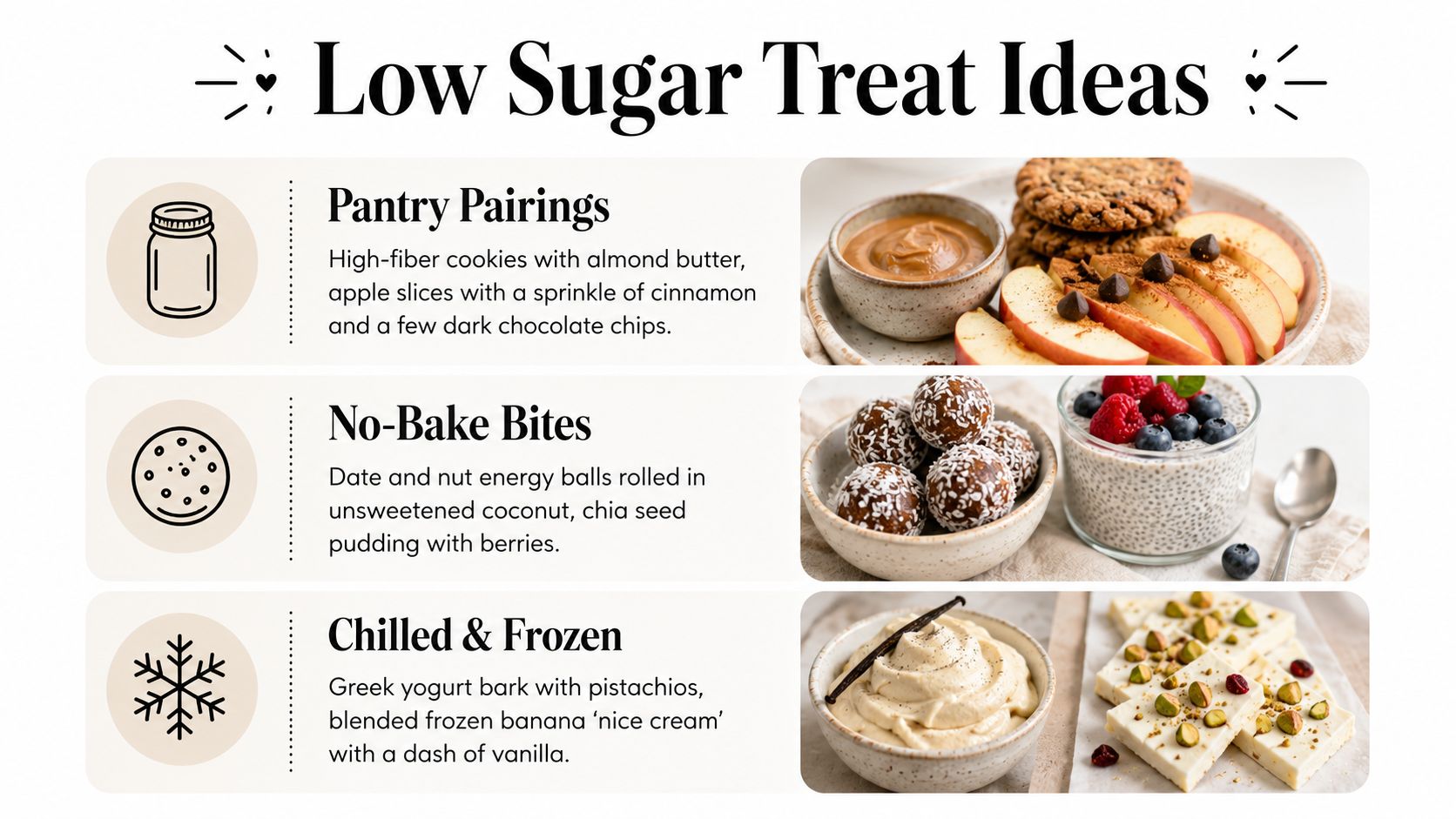
No-bake combinations work well when you want flexibility. Try chia pudding with berries, date and nut bites rolled in unsweetened coconut, or Greek yogurt bark scattered with pistachios before freezing. Blended frozen banana with vanilla creates a soft “nice cream” base, and a small cookie crumble adds the crunch that the fruit alone lacks.
If chocolate is the main craving, compare a reduced-sugar wafer or cookie with a guilt-free dark chocolate treat rather than trying to replace chocolate flavor with fruit every time.
Rip Van's low-sugar lineup includes wafels, wafers, and cookies designed for these portable, pairing-friendly occasions, with fiber included and modest sweetness across flavors such as Cookies & Cream Wafel, Snickerdoodle, Honey & Oats, Chocolate Brownie Wafel, and Lemon stroopwafel.

Cravings, Habits, and Smart Sweet Choices
Cutting added sugar doesn't automatically erase a sweet tooth. A Wageningen study reported that a six-month low-sweetness diet didn't make participants like sweet flavors less, and a 2025 summary of related research reported no change in sweet taste preferences, food choice, or energy intake after reducing exposure to sweet-tasting foods. (New Hope Network)
That finding challenges the popular promise of a quick “craving reset.” Your preferences may adapt as you consistently choose less-sweet foods, but the desire for sweetness can remain. A low sugar treat works better as a realistic choice within your routine than as a temporary cleanse that's supposed to eliminate desire.
Build a repeatable snack loop
Keep two or three trusted options visible, perhaps a crisp wafer, a chewy cookie, and a fruit-and-yogurt combination. Pair the sweet item with protein, fat, or fiber instead of grazing from an open package, then pay attention to both satisfaction and digestion over the following weeks.
A simple loop looks like this:
- Choose deliberately: Put one serving on a plate instead of eating beside the cupboard.
- Add contrast: Use berries, yogurt, nut butter, cottage cheese, or another filling companion.
- Review carefully: Keep the product only if its sweetness, texture, and after-effects work for you.
For readers who want a more structured approach to handling cravings, Trim's step-by-step cravings plan can provide an additional framework without assuming that every craving needs to disappear.
Common questions
Can low sugar treats fit a keto plan? They can, if the serving's net carbohydrates, sweeteners, and portion fit your personal approach. Check the full panel rather than relying on “keto” printed on the front.
Does fiber make a treat filling? Fiber can add bulk and support satiety, but the overall recipe and your portion still matter. A high-fiber product may also require gradual introduction if your digestion isn't used to it.
Are polyols the same as ordinary sugar? No. Polyols are used for sweetness and texture, and their glycemic effects vary. Erythritol, maltitol, and sorbitol shouldn't be treated as interchangeable.
Can children eat these snacks? Children can enjoy sweet treats in moderation, but parents should read the ingredient list, watch portion size, and pay attention to digestive tolerance. A familiar flavor and pleasant texture usually matter more than an aggressively restrictive label.
Rip Van offers low-sugar wafels, wafers, and cookies with added fiber for shoppers who want a portable sweet snack without relying on excess sugar. Visit Rip Van to compare flavors and choose an option that fits your preferred texture, ingredients, and eating routine.
0 comments